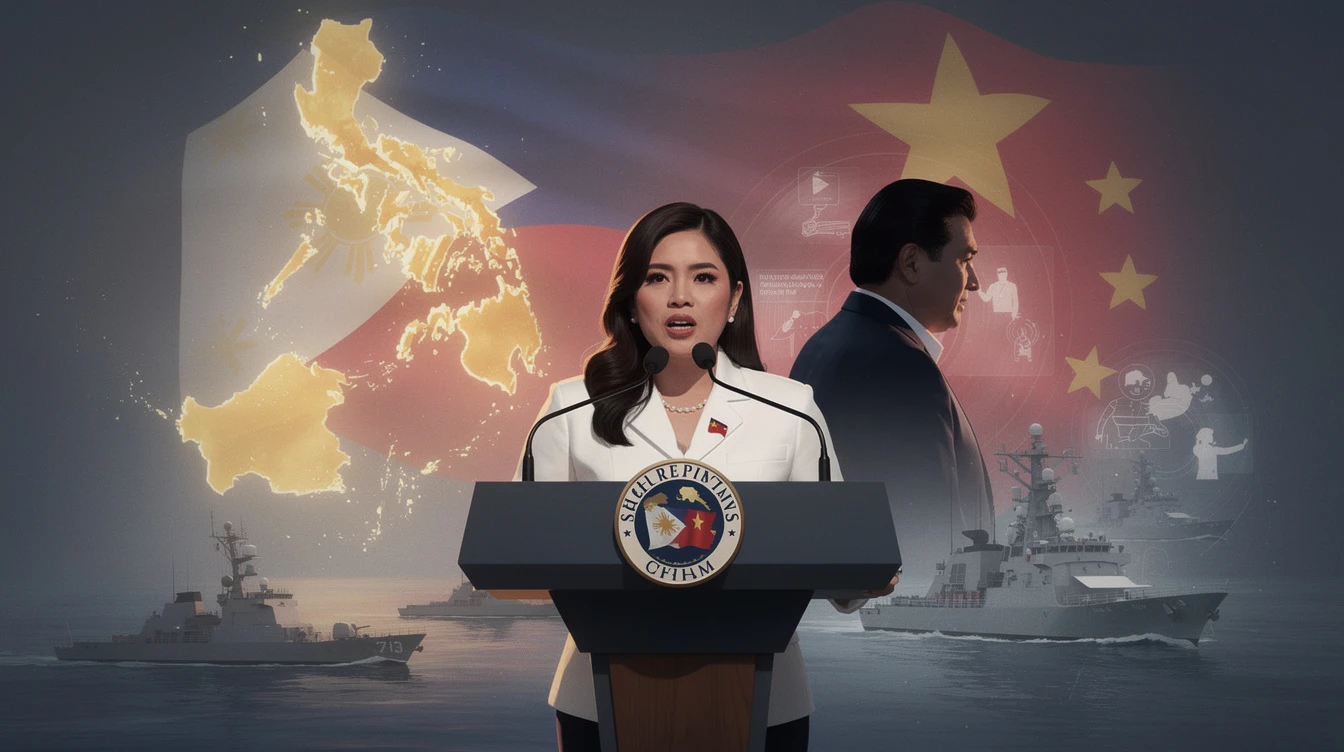
Vice President Sara Duterte declared that true valor lies in protecting Philippine sovereignty and upholding the law during a public address on Thursday. Her remarks emphasized defending national rights against foreign intrusion, creating a stark contrast with ongoing criticism of President Ferdinand Marcos Jr.'s approach to China.
Duterte specifically warned against allowing the Philippine justice system to be used to promote foreign interests. She underscored that defending individual rights must align with upholding national sovereignty, a statement seen as a nuanced position within the current political climate.
"The rights of any citizen, while protected under law, are not synonymous with the sovereignty of the Philippine state," Duterte stated. "Sovereignty resides in the Filipino people and their institutions, which must never be compromised."
Her comments arrive amid persistent accusations from critics and opposition figures that President Marcos has been soft on China's encroachment in the West Philippine Sea. Simultaneously, his administration faces allegations of cracking down on domestic dissent.
This creates a visible fault line within the administration. The Vice President's strong sovereignty rhetoric is not directly coordinated with the Palace's recent diplomatic maneuvers with Beijing.
Security analysts note Duterte's framing taps into deep-seated public sentiment. Many Filipinos remain fiercely protective of the nation's maritime claims, as affirmed by the 2016 Hague ruling.
The Department of Foreign Affairs continues to file diplomatic protests against Chinese actions. However, the perceived gap between diplomatic statements and tangible on-water enforcement fuels domestic political debate.
For the millions of Filipino families with relatives working as overseas foreign workers (OFWs), sovereignty disputes have direct economic and security implications. Secure maritime territories are vital for fisherfolk livelihoods and national resources.
The Vice President's focus on legal integrity also touches on concerns about foreign influence operations. These concerns extend to economic investments and political narratives within the country.
Observers suggest Duterte is carving a distinct nationalist stance. This positions her separately from both her father's previous China-friendly policy and the current president's balancing act.
The political significance for Filipino readers is substantial. It highlights growing internal debates on how to assert Philippine sovereignty effectively, whether through forceful rhetoric, legal channels, or military alliance building.
Ultimately, the Vice President's speech underscores a central question for the nation: defining the line between pragmatic diplomacy and perceived compromise in defending what is unequivocally Philippine.