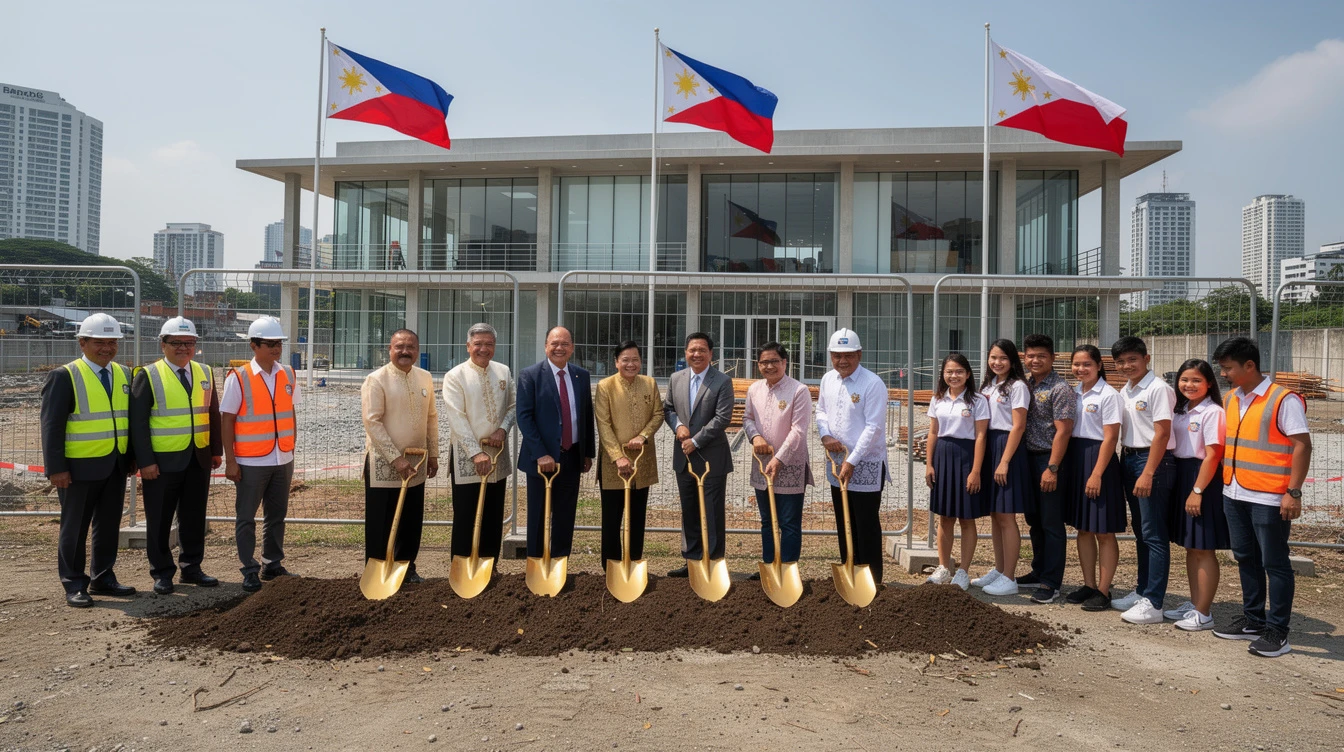
The Technical Education and Skills Development Authority (TESDA) on Tuesday officially kicked off the construction of the Regional Training and Innovation Center (RTIC) in Quezon City, a flagship project aimed at arming thousands of Filipinos with job-ready skills for high-demand industries in the National Capital Region (NCR). TESDA Director General Suharto Mangudadatu led the groundbreaking ceremony, citing that the RTIC-NCR will focus on artificial intelligence , robotics , renewable energy , and advanced manufacturing fields critical to the country's economic recovery and global competitiveness. "Through the RTIC-NCR, we are expanding opportunities for Filipinos to access advanced skills training that leads to better employment and higher income," Mangudadatu said in a statement. The center is expected to train 10,000 individuals annually once operational by late 2026.
This initiative comes as the Philippine Statistics Authority (PSA) reported a 4.3% unemployment rate in NCR in January 2025, with youth aged 15-24 accounting for nearly half of jobless Filipinos nationwide. For more on labor trends, see Philippine Politics . The innovation hub is part of TESDA's broader Philippine Skills Framework , a government-industry collaboration to align training programs with actual employer needs.
The RTIC-NCR will offer both free and subsidized courses, targeting out-of-school youth, underemployed workers, and returning overseas Filipino workers (OFWs). Located on a 1.2-hectare lot near the University of the Philippines Diliman campus, the facility will house state-of-the-art labs for 3D printing , Internet of Things (IoT) development, and electric vehicle maintenance . "This is not just a building; it is a bridge to the future of work," Mangudadatu added. TESDA has allocated P200 million for the first phase of construction, sourced from the national budget under the 2024 General Appropriations Act .
TESDA
The agency has partnered with Asian Development Bank (ADB) for technical assistance and with private firms like Globe Telecom and DOST for equipment and curriculum design. The RTIC-NCR is the fourth such center in the country, following similar hubs in Davao, Cebu, and Bicol. Each center specializes in regional industry needs, but the NCR hub is the largest in scope, targeting information technology , business process outsourcing (BPO) , and green construction sectors. "This is a game-changer for job seekers in Metro Manila," said Maria Concepcion Santos , president of the Employers Confederation of the Philippines (ECOP) , in an interview.
Santos noted that over 60% of companies in NCR report difficulty finding workers with advanced technical skills, per a 2024 ECOP survey. The center will also offer micro-credentialing and online blended learning to accommodate working professionals. TESDA plans to integrate its existing National Certificate (NC) programs with the RTIC curriculum, ensuring graduates are immediately employable.
Labor Secretary Bienvenido Laguesma praised the move, calling it "a strategic investment in human capital" during the groundbreaking. He emphasized that the RTIC will help reduce the skills mismatch in industries like health care , logistics , and creative industries that are expanding in NCR. For more updates on local initiatives, see Local News .
Breaks
The construction timeline spans 18 months, with the center expected to open doors by March 2027 . TESDA will release enrollment details in early 2026, with priority slots for Pantawid Pamilyang Pilipino Program (4Ps) beneficiaries and displaced workers. Mangudadatu confirmed that TESDA will deploy mobile training units in the interim to reach barangays in Quezon City, Navotas, and Tondo.
These units will offer starter courses in digital marketing and solar panel installation . The Department of Trade and Industry (DTI) and Board of Investments (BOI) will also use the center as a venue for industry dialogues and technology expos , further connecting trainees with potential employers. For OFWs, the RTIC offers a special retooling program designed for those who lost jobs abroad. "We want them to come back ready for the Philippine economy's needs," Mangudadatu said.
The innovation hub is also expected to create 500 direct jobs during its construction phase, according to TESDA's engineering office. Local construction firms from NCR will bid for the project, ensuring economic spillovers. Critics have questioned whether TESDA can sustain the center's operational costs, which are estimated at P50 million annually.
Mangudadatu assured that the agency will partner with private corporations and international donors to fund the hub beyond 2027. For related technology news, see Technology . The RTIC-NCR is a key pillar of the Philippine Development Plan 2023-2028 , which targets transforming the country into a middle-income economy by 2028 through a skilled workforce.
Ground
The innovation hub directly supports the plan's human capital development goal. In a parallel move, TESDA has launched a digital platform for online enrollment and assessment, already used by 50,000 registrants across NCR. The platform will be integrated into the RTIC's operations.
The significance for Filipino readers: This innovation hub is not just a facility, but a lifeline . With the global economy shifting toward automation and green industries, Filipino workers risk being left behind if they lack modern skills. The RTIC-NCR levels the playing field, giving every Filipino—from fresh graduates to displaced OFWs—a chance to upskill and secure better-paying jobs right in the heart of the country's economic center.
It reduces the need for overseas work by creating quality employment opportunities at home, strengthening the nation's economic resilience and improving the lives of millions.