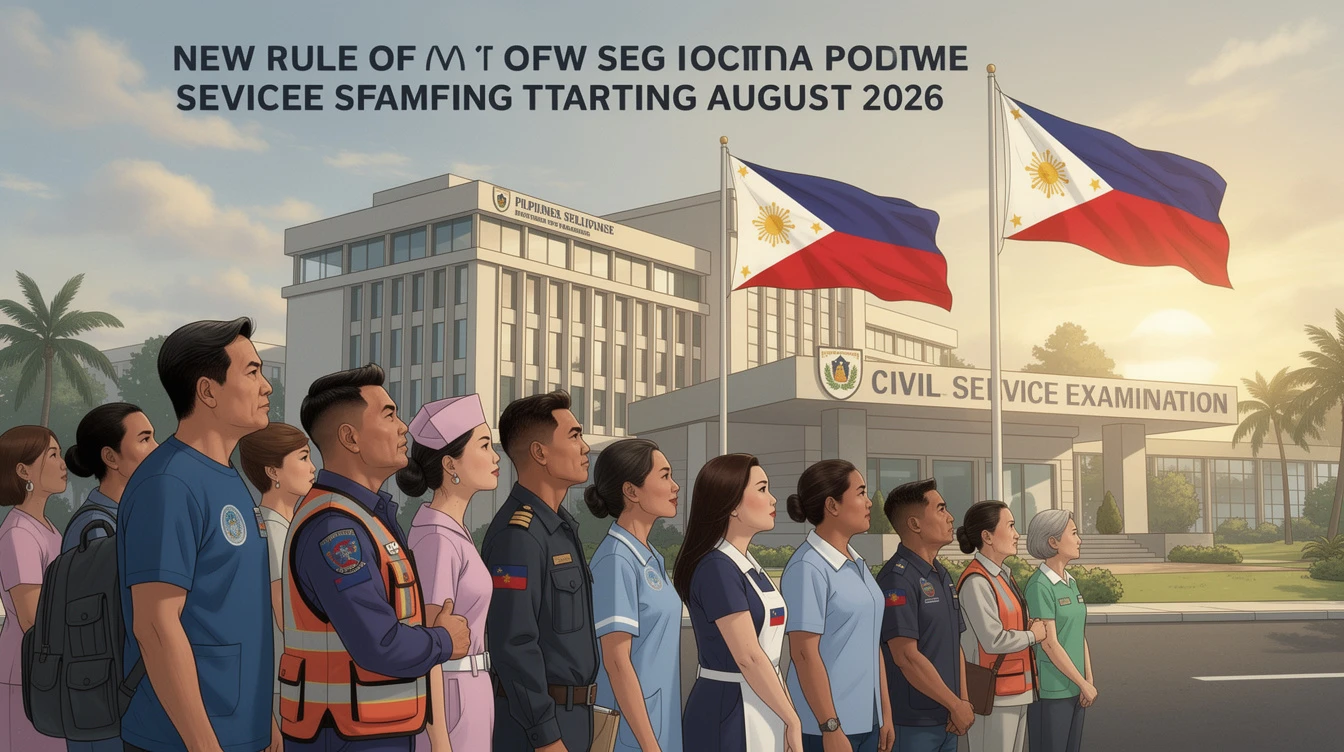
Starting August 9, 2026, overseas Filipino workers (OFWs) will have a new advantage when taking the Civil Service Examination. The Civil Service Commission (CSC) has approved the OFW-PR (Overseas Filipino Workers–Preference Rating), a policy that grants additional points to eligible examinees.
The move is a direct acknowledgment of the professional experience and sacrifices of OFWs. It also creates a clearer pathway for them to enter government service after years abroad.
Resolution No. 2600596, dated April 30, 2026, formally adopts the OFW-PR. It applies to Filipinos currently working overseas, those set to begin overseas employment, and even individuals already contracted but still in the Philippines.
The benefit takes effect with the CSC examination scheduled on August 9, 2026. But there are specific conditions you must meet to qualify. Here's everything you need to know.
What Is the OFW Preference Rating (OFW-PR)?
The OFW-PR is a scoring boost that adds extra points to the general rating of qualified OFW examinees. It is not a separate exam or a waiver. You still need to take and pass the standard Civil Service Examination.
Under the policy, an eligible examinee must obtain a general rating of at least 70.00, in accordance with existing CSC rules. The additional points are granted on top of that passing score.
The exact number of extra points has not been publicly detailed in the initial resolution, but the commission has confirmed the mechanism will be implemented starting with the August 9, 2026 exam.
Who Is Eligible for the Extra Points?
Eligibility is based on two main criteria: employment status and years of overseas work experience.
Employment Status
The program is open to:
- Filipinos currently working abroad
- Those set to begin overseas employment (including those still in the Philippines but under contract)
- Individuals who have completed overseas work but are still within the qualifying period
Five-Year Work Requirement
Applicants must have accumulated a total of at least five years of overseas work experience starting from January 1, 2000. This period can be continuous or broken into shorter stints.
For example, if you worked two years in Singapore, then returned to the Philippines for a year, then worked three more years in Dubai, you still qualify. The total must reach 60 months cumulatively.
The experience must be verified through government-issued documents, such as overseas employment certificates, contracts, or POEA records.
Why the CSC Created This Policy
The CSC stated that the initiative "acknowledges the professional experience and contributions of overseas Filipino workers while creating an additional route for them to enter public service."
OFWs bring unique skills: international exposure, cross-cultural communication, project management, and often specialized technical expertise. The government wants to tap into that talent pool for its own agencies.
This is not a charity measure. It is a strategic recruitment tool. The Philippine bureaucracy needs competent, experienced personnel. OFWs have proven they can thrive in demanding environments.
How to Apply for the OFW-PR
The application process will be integrated into the standard CSC exam registration. Here are the general steps based on the resolution:
- Register for the August 9, 2026 Civil Service Examination through the CSC online portal.
- Indicate your OFW status and submit proof of overseas employment (contracts, certificates, POEA records).
- Verify your five-year experience through official documentation dated on or after January 1, 2000.
- Take the exam and achieve a general rating of at least 70.00.
- Receive the additional points automatically upon verification of eligibility.
The CSC will release more detailed guidelines closer to the exam date. Monitor the official CSC website and social media for announcements.
Real-World Impact: What This Means for OFWs
This policy changes the game for thousands of OFWs who dream of coming home and serving their country. Instead of starting from scratch, they get a head start.
It also addresses a long-standing complaint: that overseas experience was not adequately recognized in Philippine civil service hiring. Now, it is.
For OFWs with 10, 15, or 20 years abroad, the extra points could make the difference between passing and failing—or between ranking high enough to get a preferred assignment.
Key Dates and Deadlines
- April 30, 2026: CSC Resolution No. 2600596 approved
- August 9, 2026: First exam where OFW-PR applies
- Ongoing: Gather and verify your overseas employment documents now
If you are planning to take the exam, start preparing your paperwork immediately. The five-year experience requirement means you need to document all overseas stints since 2000.
Common Misconceptions
Some OFWs worry the extra points will automatically push them to the top. That is not the case. You still must pass the exam with a 70 minimum rating. The bonus points come after.
Others think the policy applies retroactively. It does not. Only exams taken on or after August 9, 2026, qualify.
The program is also not limited to land-based OFWs. Sea-based workers (seafarers) with verified overseas experience may also apply, provided they meet the five-year threshold.
Future Outlook
The CSC is expected to release implementation rules within the next few months. These will detail the exact number of extra points, verification procedures, and appeal mechanisms.
There is also potential for the policy to expand. If successful, it could be extended to other government exams or even become a permanent feature of the civil service system.
For now, the message is clear: OFWs are no longer just remittance heroes. They are being welcomed as public servants with open arms and a scoring boost.
Frequently Asked Questions
How many extra points will OFWs get?
The exact number has not been disclosed yet. The CSC resolution confirms the program exists but leaves the specific point allocation to upcoming implementing guidelines. Check the CSC portal for updates.
Can I apply if I am still in the Philippines but have a confirmed overseas contract?
Yes. The policy covers individuals "set to begin overseas employment," including those already contracted but still in the country. You must provide proof of your upcoming overseas assignment.
Does the five-year experience need to be with one employer?
No. The total 60 months of overseas work can be accumulated from multiple employers and countries, as long as it started on or after January 1, 2000. Keep all your contracts and certificates.
What documents do I need to prove my overseas work?
You will likely need overseas employment certificates, employment contracts, POEA Overseas Employment Certificates (OEC), or company IDs. The CSC will publish a complete list closer to the exam date.