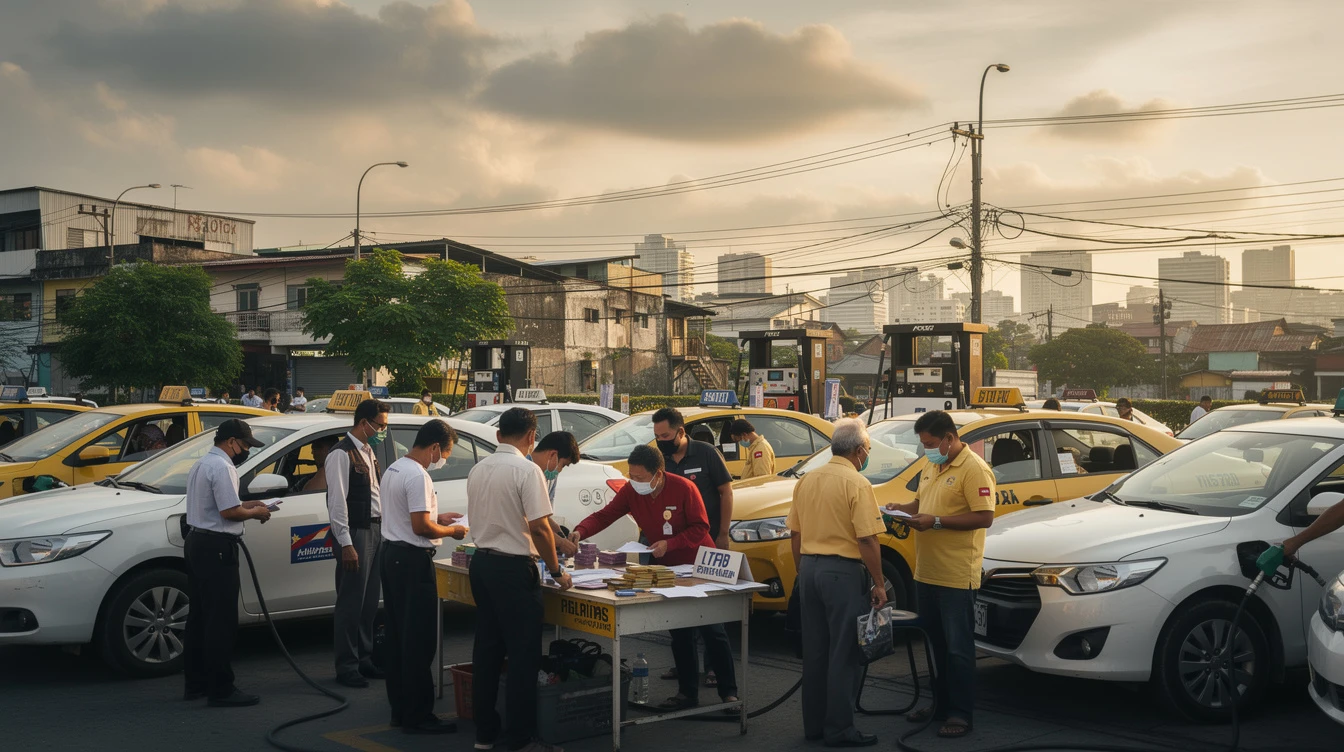
More than 2,000 taxi drivers received P5,000 each in fuel subsidies on Saturday, April 25, 2026, as the Land Transportation Franchising and Regulatory Board (LTFRB) released P10 million in aid at its central office in Quezon City, according to a report from "24 Oras Weekend."
LTFRB Chairman Vigor Mendoza II confirmed that the payout covered drivers who arrived at the agency’s main office, adding that the subsidy is a direct response to rising fuel costs affecting Filipino transport workers, per a statement from The Manila Times and GMA News.
2,000
The subsidy program is part of the government’s broader effort to cushion the impact of volatile global oil prices on public utility vehicle operators and drivers, many of whom have seen their daily earnings shrink as gasoline and diesel prices climb.
In Cagayan de Oro City , a separate payout on April 8 distributed P5,000 to more than 281 taxi drivers through LTFRB Region 10, as documented on Instagram by GMA News, showing the program’s nationwide reach across major urban centers.
The payout in Quezon City drew long lines of taxi drivers, some of whom arrived as early as dawn to secure their slots. Mendoza said the agency processed claims efficiently to ensure drivers could return to work quickly, according to The Manila Times.
Drivers
"We want to make sure that our taxi drivers, who are essential in moving people around Metro Manila, get the support they need," Mendoza said in a statement. "This is not a one-time fix, but a timely intervention."
The P10 million fund was sourced from the agency’s annual budget allocation for fuel assistance, which is part of the Department of Transportation’s (DOTr) overall transport subsidy program approved by Congress.
Taxi driver organizations have praised the move but called for a more sustainable solution, including lower pump prices and expanded subsidies for other public transport sectors like jeepneys and tricycles, which also face similar financial pressures.
For more on government support for transport workers, seePhilippine Politics andLocal Updates.
The subsidy comes at a time when the average price of gasoline in Metro Manila hovers around P60 per liter , according to Department of Energy data, with diesel slightly lower at P55, squeezing margins for drivers who spend up to P1,500 daily on fuel.
A total of 2,041 taxi drivers were verified as eligible recipients, based on LTFRB records. Each driver presented their franchise and identification cards to claim the cash assistance, ensuring only active operators benefited.
Mendoza emphasized that the agency will continue monitoring fuel price trends and may release additional tranches if needed, especially during the peak summer travel season when demand for taxis increases.
The program has been rolled out in phases since early 2026, beginning with a pilot in Metro Manila and expanding to key cities like Cebu, Davao, and now Cagayan de Oro, as reported by GMA News on Instagram.
In the Caraga region , similar payouts were held on April 10, but officials noted lower turnout due to logistical challenges, with only 1,024 drivers claiming subsidies in that area, per sources referenced by GMA News.
The LTFRB’s initiative has drawn comparisons to the Pantawid Pasada program under the previous administration, which provided monthly fuel vouchers to jeepney drivers, but the current subsidy is a lump-sum cash grant designed for more flexibility.
For industry analysis, checkPhilippine Business Trends.
Critics, however, argue that the P5,000 amount covers only about 80 liters of gasoline—enough for roughly a week of full-time operation—calling for a higher subsidy or a price freeze on public transport fuel.
"It helps, but it’s not enough," said Rogelio Santos , a taxi driver who claimed his subsidy in Quezon City. "Fuel prices keep going up, and our fares are fixed. We need a long-term solution."
The LTFRB has coordinated with the Department of Energy to explore options like discounted fuel rates for taxis, but no official agreement has been reached so far.
Mendoza assured drivers that the agency is also working on digitizing the subsidy distribution system to reduce wait times and prevent fraud in future payouts, with a target of launching an online portal by the third quarter of 2026.
This digital shift could benefit an estimated 250,000 drivers nationwide who rely on public utility vehicles, making the process more accessible for those in remote areas.
The Saturday payout in Quezon City was the first of three scheduled batches, with the next two set for May 2 and May 9 to accommodate drivers who missed the initial round due to work schedules or distance.
For more on sustainable transport, readPhilippine Technology.
Across the Philippines, taxi drivers are classified as a priority group for fuel assistance because they operate under a fixed fare structure, unlike ride-hailing services that can adjust prices dynamically.
The DOTr has allocated a total of P500 million for the entire transport subsidy program in 2026, covering not only taxis but also jeepneys, buses, and UV vans, though distribution schedules vary by region.
In a separate development, the LTFRB has warned taxi drivers against selling their slot in the payout line, after unconfirmed reports of scalpers offering to queue for a fee, which the agency said undermines the program’s purpose.
"We have security personnel monitoring the premises, and we will disqualify any driver found to have misrepresented their claim," Mendoza warned in a radio interview on DZMM.
The agency also reminded drivers that the subsidy is non-transferable and must be personally claimed, with biometric verification now being piloted in select offices to enforce this rule.
For consumer advice, visitWeather and Commute Tips.
The fuel subsidy program comes amid a broader inflationary trend in the Philippines, where transport costs have risen by 5.2% year-on-year as of March 2026, according to the Philippine Statistics Authority.
Receive
This puts additional pressure on everyday Filipinos, especially those in Metro Manila who rely on taxis for daily commutes. The subsidy aims to prevent fare hikes that would further burden passengers.
For Filipino readers, this development matters because stable transport costs help keep commodity prices in check—when drivers earn less, they may pass on costs through informal fare adjustments or avoid certain routes, affecting mobility for millions.