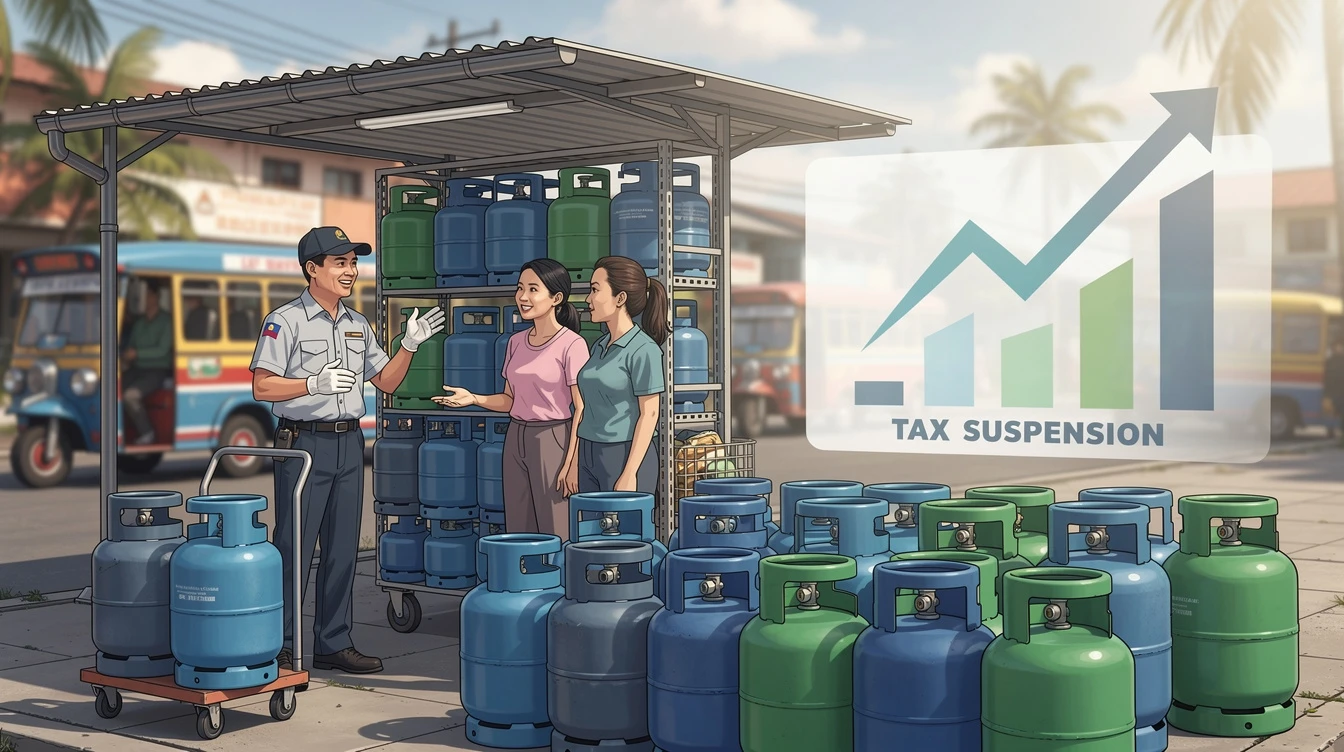
President Ferdinand "Bongbong" Marcos Jr. announced on April 13 the suspension of excise taxes on liquefied petroleum gas (LPG) and kerosene.
The move targets relief for Filipino households grappling with volatile global oil prices driven by Middle East tensions.
The Department of Finance estimates consumers may save around P36.96 per standard 11-kilogram LPG cylinder.
Kerosene users could see savings of P5.56 per liter following the presidential order.
In response, the Liquefied Petroleum Gas Marketers' Association (LPGMA) called on sellers Wednesday to charge correct prices.
The industry group urged members to ensure the full tax suspension benefit reaches consumers directly.
"We call on sellers to charge the correct LPG prices on their customers," the LPGMA stated.
The directive aims to prevent market irregularities and maximize relief for Filipino families.
Finance officials estimate the three-month suspension will result in P4.1 billion in foregone government revenues.
The Development Budget Coordination Committee (DBCC) advised against expanding cuts to gasoline and diesel.
"Suspending excise taxes on diesel and gasoline would not likely provide meaningful relief," Finance Secretary Ralph Recto said.
He explained any pump price reduction would be marginal and offset by market dynamics.
Such an expansion would carry a significantly higher fiscal cost with limited impact.
Lawmakers like Cagayan de Oro Rep. Rufus Rodriguez continue urging broader tax suspension.
Rodriguez has repeatedly called for suspending increased excise taxes on gasoline and diesel.
He argues broader action is needed to combat inflation and transport cost pressures.
The current policy focuses relief on household cooking and heating fuels.
LPG and kerosene are vital for millions of Filipino homes, especially lower-income families.
The tax suspension follows a previous rollback of diesel prices by up to P20 per liter.
Global oil market instability remains a primary concern for Philippine economic managers.
The government is balancing consumer relief with maintaining critical revenue streams.
The DOF emphasized targeted measures provide the most efficient support.
For Filipino consumers, the LPGMA's vigilance is crucial to realizing promised savings.
Market monitoring will determine if the P37 per tank reduction materializes at retail.
This affects household budgets across the nation, particularly for OFW families managing expenses.
Transparent pricing ensures government policy translates to tangible economic relief.
The significance for Filipino readers is direct and substantial. Millions rely on LPG for daily cooking.
Any reduction in living costs provides breathing room amid persistent inflation pressures.
The success of this policy hinges on industry compliance and government enforcement.
It represents a targeted effort to shield vulnerable households from global energy shocks.