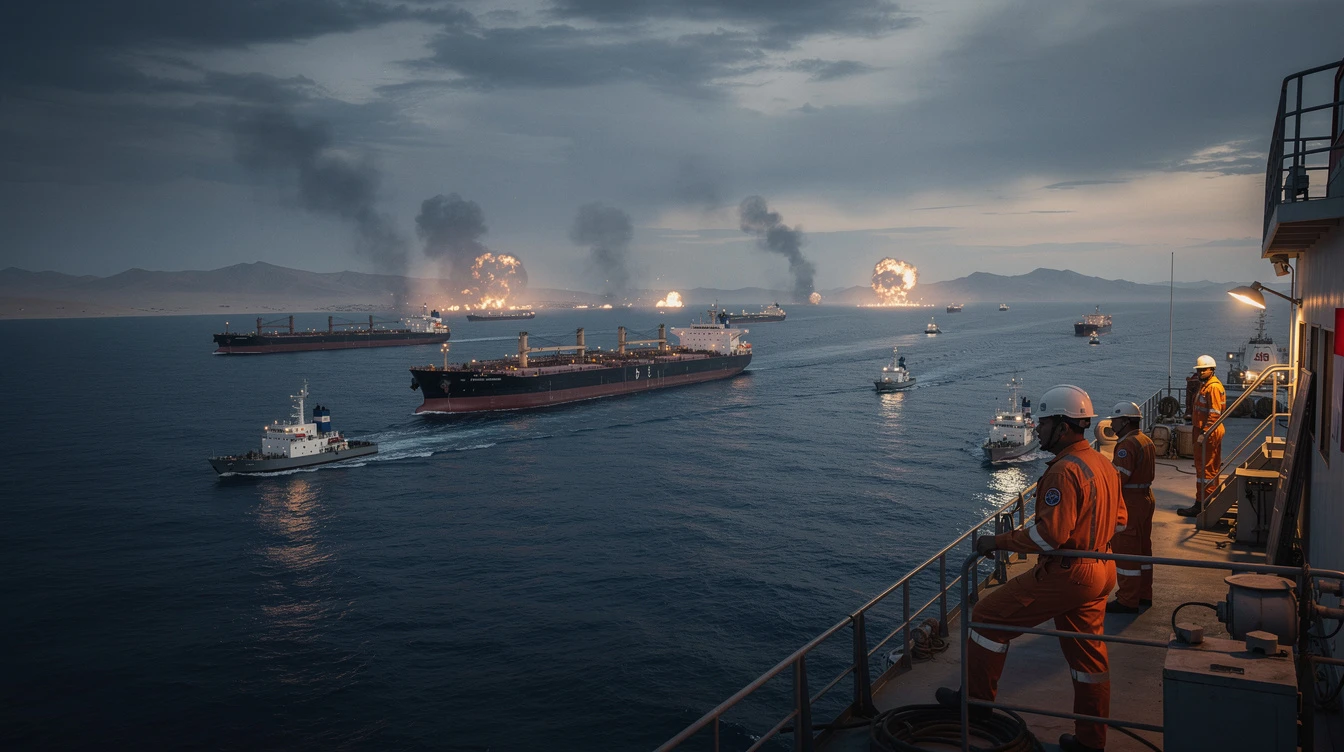
Recent attacks on two Indian-flagged crude oil tankers in the Strait of Hormuz have triggered immediate concern in Manila, where officials are assessing risks for the over 50,000 Filipino seafarers working on international vessels. The Philippines, the world's top supplier of ship officers, relies heavily on the security of global maritime routes for its $6.7 billion seafarer remittance industry.
India summoned Iran's envoy on Monday, July 1, expressing \"deep concern\" after the vessels, including the Sanmar Herald, were targeted while crossing the strategic waterway. Per Reuters, the incident underscores escalating regional tensions that directly threaten the safety of Filipino crew members, who comprise nearly 25% of the global maritime workforce.
The Department of Migrant Workers and the Maritime Industry Authority confirmed they are closely coordinating with manning agencies and ship owners. \"The safety of our seafarers is paramount,\" a DMW spokesperson stated, urging vessel operators to adhere to heightened security protocols in the Gulf region.
While no Filipino casualties were reported in these specific attacks, the Strait of Hormuz is a critical artery for global oil shipments and sees constant traffic from vessels employing Filipino crews. Any prolonged disruption or escalation risks not only lives but also the stability of remittances, a cornerstone of the Philippine economy.
The attacks come amid heightened tensions involving Iran-backed Houthi rebels in the Red Sea and ongoing conflicts in the Middle East. The Philippine government has previously issued advisories for Filipino seafarers assigned to routes through high-risk areas, including the Gulf of Aden and the Strait of Hormuz.
Industry groups, including the Associated Marine Officers' and Seamen's Union of the Philippines, have called for clearer guidelines and guaranteed \"danger pay\" for sailors traversing conflict zones. The recent incidents are likely to intensify these negotiations between unions and international shipping companies.
For the families of hundreds of thousands of overseas Filipino workers, particularly those in maritime sectors, news of regional instability triggers immediate anxiety. Remittances from seafarers alone account for roughly 20% of the total annual remittances that fuel domestic consumption and investment.
The Philippine Coast Guard and Department of Foreign Affairs maintain communication channels with international naval task forces, like the Combined Maritime Forces, operating in the region. However, direct Philippine naval presence in the Middle East remains limited, relying on diplomatic and multilateral efforts to ensure safe passage.
This latest security alert follows a pattern of maritime threats that have directly impacted Filipinos, including past hijackings in the Gulf of Aden. Each incident forces a recalculation of risks and rewards for the nation's most lucrative labor export sector.
The significance for the Philippines is profound and multi-layered. Beyond the immediate human safety concerns for its citizens, the nation's economic health is intrinsically linked to secure sea lanes. Continued volatility in chokepoints like the Strait of Hormuz could force shipping reroutes, increase insurance costs, and potentially disrupt the employment of thousands of Filipino mariners, impacting livelihoods and national revenue at a critical time.