Myanmar's military-aligned government has reduced the prison sentence of ousted leader Aung San Suu Kyi and freed former president Win Myint, her lawyer confirmed to Reuters on April 17, 2026. The amnesty, ordered by the new president installed after the 2021 coup, cuts Suu Kyi's 27-year sentence by one-sixth.
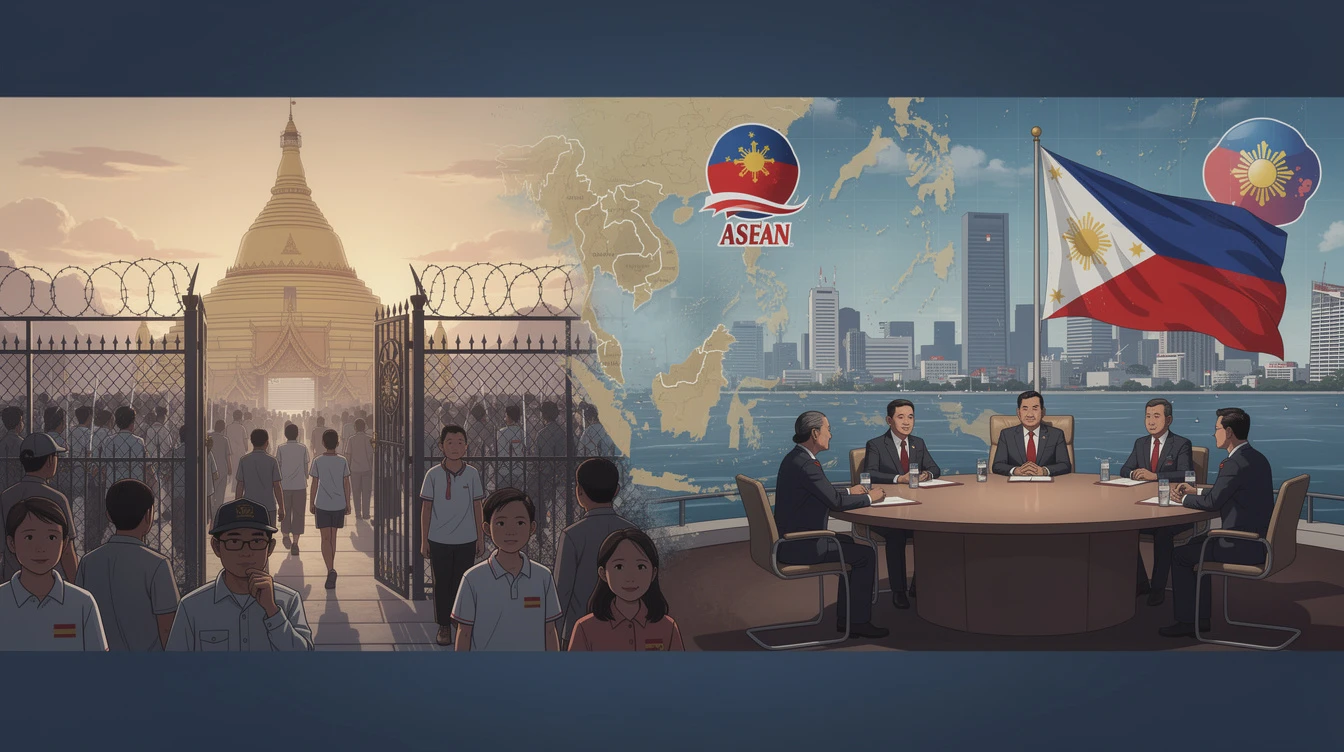
This development directly impacts the Philippines' foreign policy within the Association of Southeast Asian Nations (ASEAN). Manila, as a founding ASEAN member, has been part of the bloc's \"Five-Point Consensus\" seeking to resolve Myanmar's crisis, making this political gesture a critical test for regional diplomacy.
State broadcaster MRTV stated Win Myint was \"granted a pardon and the reduction of his remaining sentences under specified conditions.\" The 80-year-old Suu Kyi was convicted on numerous charges her supporters and international observers deem politically motivated.
The charges ranged from incitement and corruption to election fraud and violating a state secrets law. The 2021 coup was led by Senior General Min Aung Hlaing, who overthrew the democratically elected government.
The amnesty comes as the military government faces sustained pressure from ethnic armed groups and pro-democracy forces. Analysts suggest the move may be an attempt to project legitimacy ahead of potential political negotiations or future elections.
For the Philippines, which has historically supported democratic transitions, the situation presents a complex challenge. The Department of Foreign Affairs (DFA) has consistently called for a peaceful, inclusive, and Myanmar-led resolution in line with ASEAN's consensus.
Per a recent DFA statement, the Philippines remains committed to humanitarian assistance for the people of Myanmar. The ongoing crisis has led to a significant refugee outflow, affecting regional stability in Southeast Asia.
Filipino migrant workers and diplomats in the region also monitor such instability closely. Any escalation in conflict could threaten the safety of overseas Filipinos in neighboring countries.
The Philippine government, under President Ferdinand Marcos Jr., has emphasized adherence to international law and peaceful conflict resolution. This principle guides its position on the Myanmar issue within ASEAN forums.
However, the limited nature of the amnesty—a sentence reduction, not a release—is unlikely to satisfy international calls for a full restoration of democracy. Western nations have maintained sanctions on the junta.
ASEAN's approach has been divided, with some members favoring engagement and others pushing for stronger pressure. The Philippines has generally aligned with the consensus-driven, non-interference stance while advocating for dialogue.
The move may be seen as a token gesture that falls short of addressing core issues. It does not signal a return to civilian rule or the release of all political prisoners, key demands of the pro-democracy movement.
For Filipino readers, this underscores the fragile nature of democratic institutions in the region and the importance of regional solidarity. The Philippines' role in ASEAN requires navigating such crises while protecting its national interests and values.
The significance for Filipinos lies in understanding how geopolitical shifts in neighboring countries can impact regional security, economic stability, and the framework of ASEAN cooperation, which is vital for the Philippines' diplomatic and economic strategies.