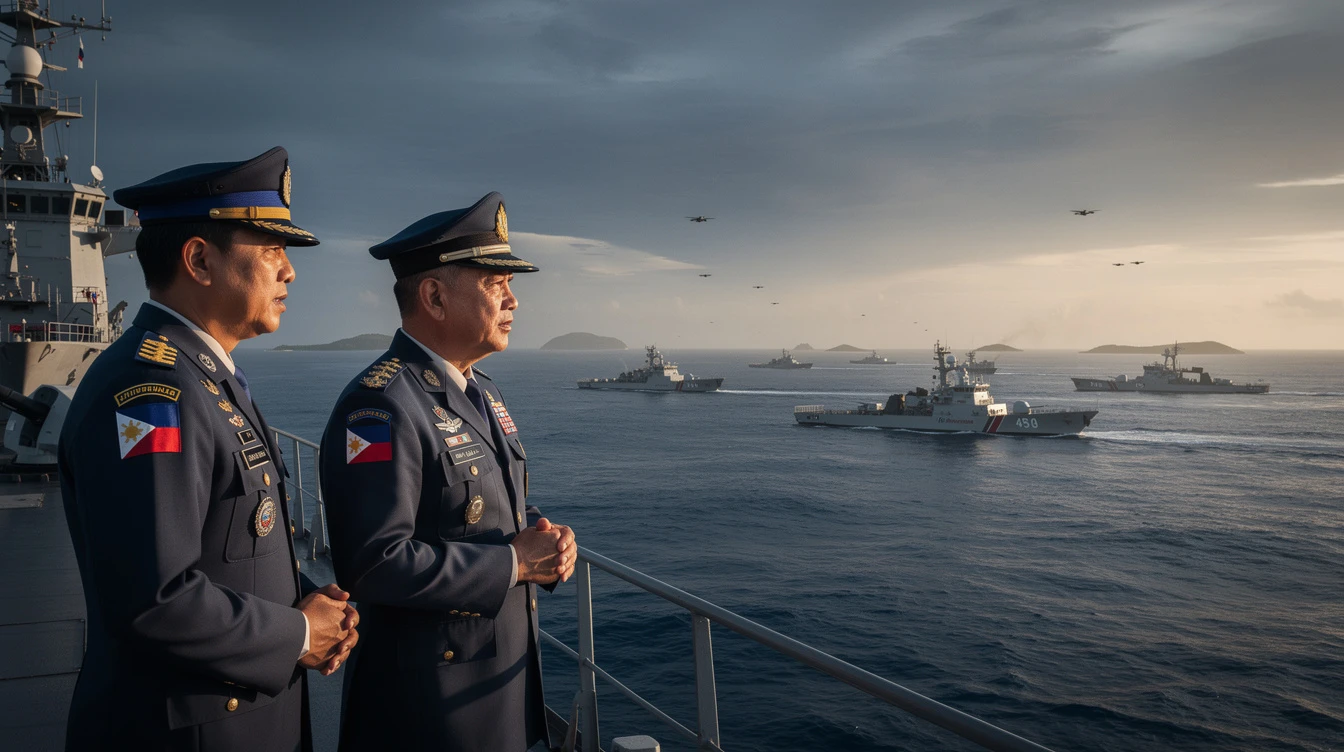
Armed Forces of the Philippines (AFP) Chief of Staff General Romeo Brawner Jr. has instructed the newly installed commander of the Western Command (WESCOM) to sustain a "credible and steady" presence in the West Philippine Sea , according to a statement from the AFP on Thursday.
General Brawner issued the directive during the change-of-command ceremony at Camp General Artemio Ricarte in Puerto Princesa City, Palawan, where Commodore Alvin Villanueva formally turned over his post to his successor.
Chief
The presence of WESCOM in the West Philippine Sea is critical for protecting Filipino fishermen and upholding the country's sovereign rights, Brawner said, highlighting the command's role in a disputed region.
For more on territorial defense, read about the AFP modernization plans for the West Philippine Sea.
Brawner commended Villanueva for ensuring that WESCOM maintained a credible maritime and sovereignty presence in the West Philippine Sea throughout his tenure.
Brawner
"Under your leadership, WESCOM sustained a credible and steady presence in the West Philippine Sea , and the entire AFP is grateful for your service," Brawner said, as quoted by the AFP's social media channels.
The AFP chief also stressed that the incoming commander must continue these efforts, which include regular patrols and naval exercises aimed at asserting Philippine jurisdiction in the West Philippine Sea .
The ceremony was attended by top AFP officials, local government leaders, and representatives from the Philippine Navy and Marine Corps.
Read about Philippine Navy operations in the West Philippine Sea and how they protect territorial waters.
Commodore Villanueva, who took command of WESCOM in 2024, oversaw a period of heightened tension in the West Philippine Sea , with frequent encounters between Philippine vessels and China Coast Guard ships.
During his term, WESCOM intensified maritime patrols and enhanced coordination with the Philippine Coast Guard to secure supply missions to Ayungin Shoal , where a Philippine Navy ship is grounded.
In his farewell message, Villanueva expressed gratitude to his troops, saying that their dedication ensured the command's effectiveness in the West Philippine Sea .
The AFP has not yet officially named Villanueva's successor, but military sources confirm that the new WESCOM chief is a seasoned officer with extensive experience in naval operations.
For background on the strategic importance of WESCOM, check out West Philippine Sea defense strategy updates.
General Brawner's directive comes as the Philippines continues to face challenges in the West Philippine Sea , including Chinese survey ship deployments and large-scale fishing activities near Philippine-claimed features.
The AFP has adopted a two-pronged approach: diplomatic engagement through the Department of Foreign Affairs and a robust military posture under WESCOM.
Brawner also urged the new WESCOM chief to focus on troop welfare, logistical readiness, and inter-agency collaboration to maintain a credible presence in the West Philippine Sea .
The change of command is part of the AFP's regular rotation of key officers, ensuring that commands benefit from fresh leadership perspectives while keeping institutional continuity.
Since taking over as AFP chief in 2024, General Brawner has prioritized territorial defense, with the West Philippine Sea as a cornerstone of his tenure.
In a statement, Brawner called the West Philippine Sea a "national priority," underscoring the need for all Filipinos to support the armed forces in protecting the country's maritime domain.
The new WESCOM chief is expected to continue these efforts while managing operational demands and maintaining morale among troops stationed in remote islands.
Tells
The AFP's Western Command is responsible for defending the country's western maritime frontier, including the West Philippine Sea , and operates out of Palawan.
For Filipino readers, General Brawner's directive highlights how the AFP maintains a steady, credible presence in the West Philippine Sea , which directly affects national security, fishing livelihoods, and maritime sovereignty. This commitment ensures that Philippine interests remain protected amid ongoing regional tensions.