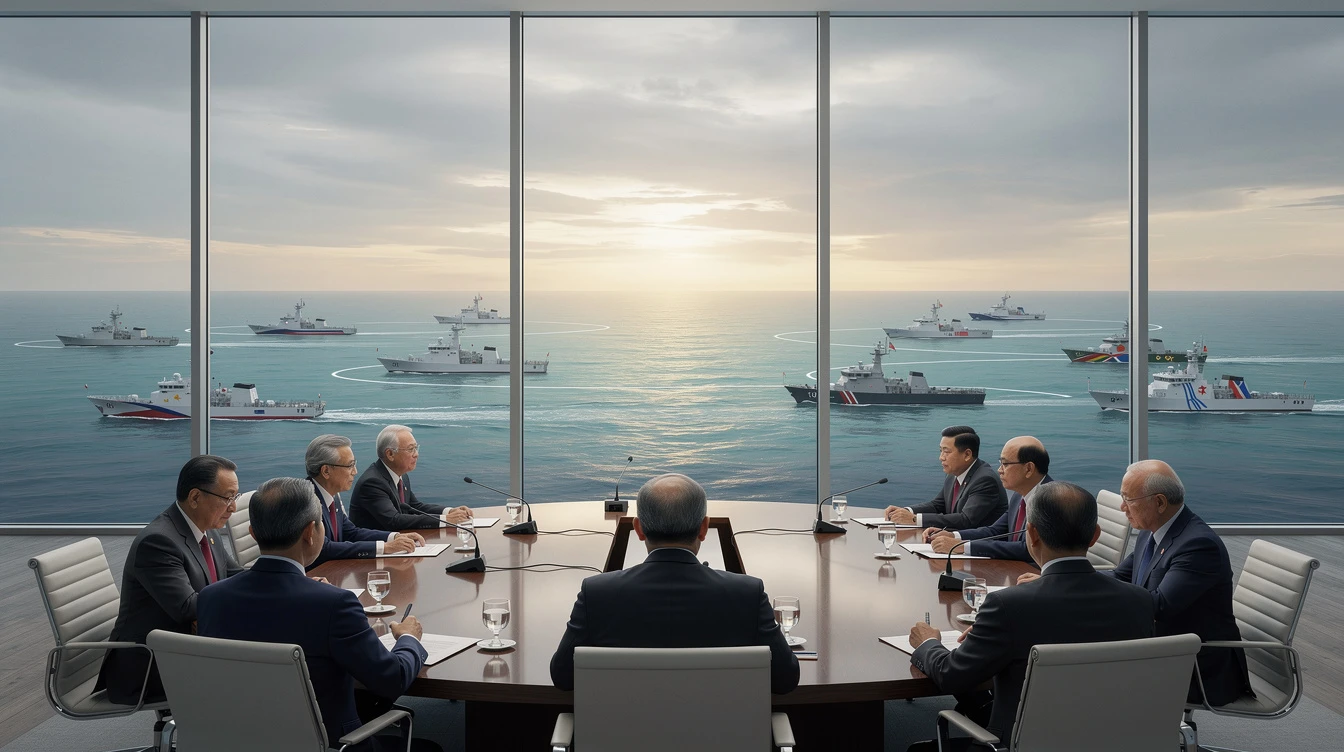
Southeast Asian leaders on Sunday renewed their call for self-restraint in the disputed South China Sea, following a recent incident that heightened tensions in the strategic waterway. The appeal was made during the ASEAN summit in Bangkok, where the member states also reiterated their alarm over ongoing developments.
Summit Outcome: A Call for Calm
The leaders, representing the 10-member Association of Southeast Asian Nations, issued a statement pressing all parties to exercise self-restraint and avoid actions that could escalate disputes. The statement underscored the importance of maintaining peace, security, stability, safety, and freedom of navigation in the South China Sea.
“We remain seriously concerned about the situation,” the ASEAN chairman’s statement read, according to reports from the summit. The leaders specifically referenced a new incident that occurred in the days leading up to the meeting, though details were not immediately disclosed in the public communique.
Code of Conduct Progress
A key focus of the discussions was the long-negotiated Code of Conduct (COC) between ASEAN and China. The proposed COC seeks to establish rules aimed at preventing disputes in the South China Sea from escalating into armed conflict. The leaders reaffirmed their commitment to finalizing the code, which has been under negotiation for years.
“We look forward to the early conclusion of an effective and substantive Code of Conduct,” the statement said. The COC is seen as a critical mechanism to manage tensions and provide a framework for dialogue, though significant differences remain among the parties.
Background of the Dispute
The South China Sea is a major global shipping lane and is believed to hold substantial oil and gas reserves. Several ASEAN members—including the Philippines, Vietnam, Malaysia, and Brunei—have overlapping claims with China, which asserts sovereignty over almost the entire sea. These competing claims have led to frequent confrontations between coast guard vessels and fishing boats.
The latest incident prompting the ASEAN statement was reported in the days before the summit. Sources familiar with the matter said it involved a confrontation between Chinese and Vietnamese vessels near the disputed Paracel Islands, though details remain sketchy. Neither country has officially confirmed the incident.
“We urge all parties to refrain from actions that could undermine peace and stability,” said a senior ASEAN diplomat who spoke on condition of anonymity because he was not authorized to discuss the matter publicly. “The situation requires constant dialogue and restraint.”
Philippine Position
The Philippines, a key claimant in the dispute, has been a vocal advocate for a rules-based order in the South China Sea. Manila recently won a landmark arbitration case in 2016 that invalidated China’s expansive claims, but Beijing has refused to accept the ruling. Despite this, the two countries have maintained diplomatic engagement, with recent talks focusing on managing tensions and exploring joint development projects.
Foreign Secretary Enrique Manalo represented the Philippines at the summit. In his remarks, Manalo emphasized the importance of adhering to international law, particularly the United Nations Convention on the Law of the Sea (UNCLOS). “We cannot allow a situation where might makes right,” he told reporters on the sidelines of the meeting.
Reactions and Analysis
Analysts say the ASEAN statement reflects a delicate balancing act. The bloc must maintain unity while dealing with China, which is both a major economic partner and a strategic rival. “ASEAN is trying to avoid being seen as anti-China while still addressing the concerns of its members,” said Dr. Maria Rosario, a political analyst at the University of the Philippines. “The call for self-restraint is a diplomatic way to manage the conflict without direct confrontation.”
China, for its part, has consistently called for bilateral negotiations and has urged ASEAN to set aside the 2016 arbitration ruling. Beijing’s foreign ministry said in a separate statement that it supports the COC negotiations and is committed to regional stability.
Forward-Looking Statement
The ASEAN leaders agreed to continue monitoring the situation and to hold further talks with China on the COC later this year. The next round of negotiations is scheduled for early next month in Indonesia. Observers say the success of the COC will depend on whether both sides can agree on binding dispute resolution mechanisms and rules for activities like drilling and fishing.
While the path to a final agreement remains long, the renewed call for self-restraint signals that ASEAN is determined to prevent the South China Sea from becoming a flashpoint for wider conflict. The bloc’s unity and patience will be tested in the months ahead as tensions simmer beneath the surface of ongoing dialogue.