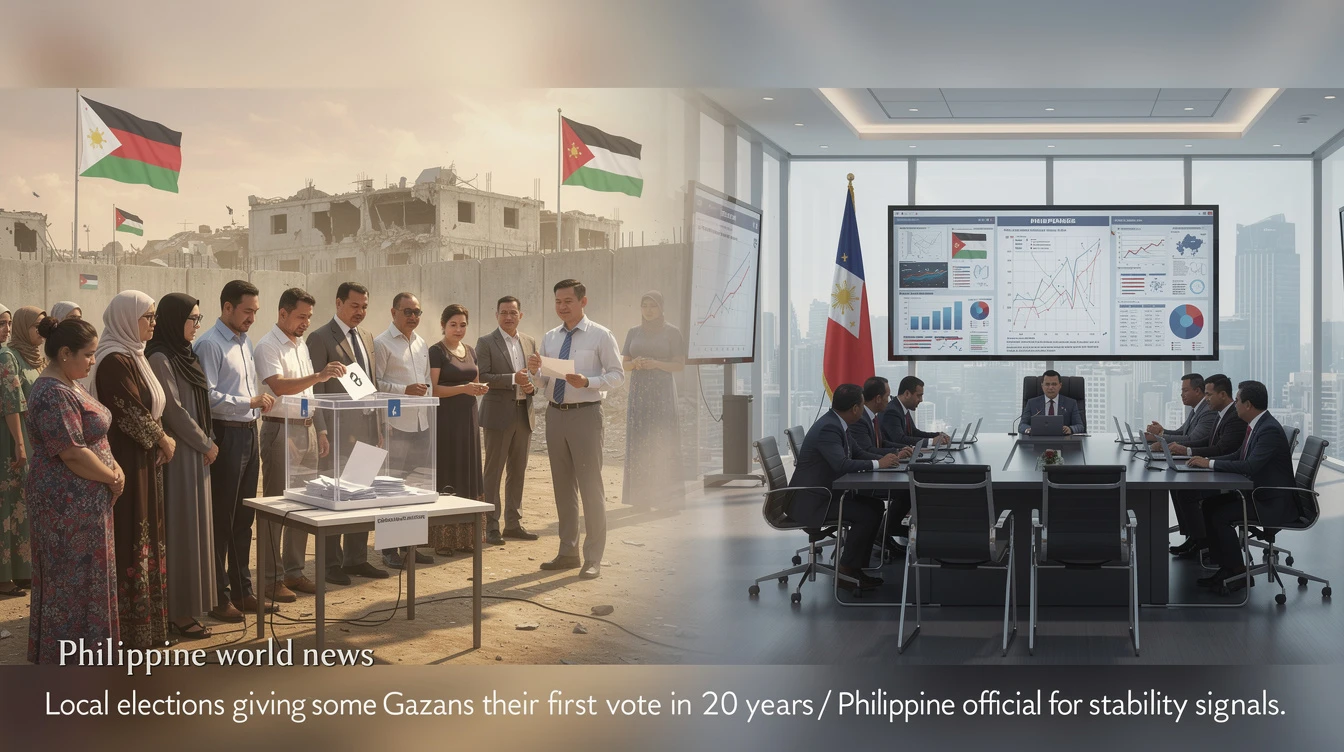
Palestinians in Gaza voted in local elections on Saturday, April 25, 2026, for the first time in two decades as 70,000 eligible voters in the enclave cast ballots, according to the Palestinian Central Elections Committee. This marks a watershed moment for a population long denied political participation since Hamas took control in 2007. For Manila, this development holds significance as the Philippines maintains diplomatic ties with the Palestinian Authority and hosts tens of thousands of OFWs in the region .
The Philippine Embassy in Cairo, which covers Palestinian territories, recently issued a security advisory urging Filipino workers to avoid non-essential travel near conflict zones. The local elections, though limited to Deir al-Balah, could signal a shift in the political landscape that may affect regional stability, according to Philippine foreign affairs officials.
Palestinian
The Palestinian Central Elections Committee reported that more than one million Palestinians are eligible to vote across the West Bank and Gaza, with results expected late Saturday or Sunday. The committee cited widespread destruction from the ongoing war as a reason why voting could not be held across the rest of Gaza, over half of which is under Israeli control.
This election tests public sentiment at a time when Israel’s government, led by Prime Minister Benjamin Netanyahu, seeks to destroy any future for a Palestinian state. The West Bank-based Palestinian Authority hopes the symbolic inclusion of Deir al-Balah will reinforce its claim to authority over the war-torn territory.
Some Palestinian factions are boycotting the elections in protest of the Palestinian Authority’s requirement that candidates back its agreements, which include recognition of the State of Israel. Hamas, which ousted the Palestinian Authority from Gaza in 2007, has not formally endorsed the vote but has not actively disrupted it, according to local reports.
Local
For the Philippines, which has consistently supported a two-state solution, these elections serve as a barometer for potential changes in the region’s governance. The Department of Foreign Affairs in Manila has repeatedly called for a peaceful resolution to the Israeli-Palestinian conflict, stressing the safety of overseas Filipino workers.
Currently, around 30,000 Filipinos are estimated to be working in Israel, with a smaller number in Palestinian territories, per the Philippine Overseas Employment Administration. The Philippine government has not reported any Filipino casualties directly linked to the voting process, but officials remain vigilant.
Should the elections lead to a more unified Palestinian leadership , it could positively impact regional stability and potentially open economic opportunities for Filipino businesses. Conversely, any escalation following the vote could endanger OFW lives and disrupt remittance flows, which totaled over $2 billion from Israel alone in 2025, according to the Bangko Sentral ng Pilipinas.
The Philippine government has historically maintained neutrality in the conflict but has offered humanitarian aid through the Department of Social Welfare and Development. In 2024, President Ferdinand Marcos Jr. pledged $1 million in assistance to Palestinian refugees, aligning with international calls for a ceasefire.
Meanwhile, the elections in Deir al-Balah have drawn international attention. The United Nations and the European Union have called for the vote to proceed without interference, while Israel has expressed concern that any election outcome could embolden Hamas, which it considers a terrorist organization.
The Philippine Senate has not issued a formal statement on the elections, but Senator Aquilino “Koko” Pimentel III, chair of the foreign relations committee, told reporters that the government will “closely monitor” the situation. “We hope for a peaceful process that respects the rights of all parties,” he said in a text message.
For more updates on this evolving story, see Philippine World News. The election results could influence Philippine policy on Middle East deployments.
The Deir al-Balah vote is also a test for the Palestinian Authority’s legitimacy. Analysts say a low turnout could undermine its claim to represent all Palestinians, while a high turnout could strengthen its position in future negotiations with Israel.
In contrast, the last Palestinian legislative elections were held in 2006, which Hamas won, leading to a split between the West Bank and Gaza. Since then, no nationwide polls have taken place, making this municipal vote a rare political exercise.
The elections come amid a brutal war that has devastated Gaza. The Palestinian health ministry, which operates under Hamas, reports over 40,000 casualties since October 2023, though the figure cannot be independently verified. The Philippine government has condemned all violence against civilians.
For Filipino migrants , particularly those in Israel, the elections represent both hope and uncertainty. An OFW in Tel Aviv, who requested anonymity for security reasons, told reporters: “We watch closely because any political change can affect our jobs and safety.”
The Philippine Department of Migrant Workers has not issued a new alert but maintains a standing advisory for Filipino workers in the region to register with the embassy. The agency says it is ready to assist any Filipino who wishes to repatriate.
These elections also come at a time when the Philippines is strengthening its ties with Middle Eastern nations. Under President Marcos, Manila has pursued stronger economic partnerships with Saudi Arabia, UAE, and Qatar, which have disproportionate influences on Palestinian politics.
Should Gaza’s political landscape evolve positively, the Philippines could explore expanded trade routes and labor agreements, according to analysts. However, any resurgence of violence would likely deter such opportunities.
The Palestinian Central Elections Committee deployed mobile polling stations in Deir al-Balah to accommodate displaced voters. Despite the challenges, queues formed early Saturday morning as Gazans, many holding tattered voter IDs, waited to cast their ballots. For many, it was their first time voting in any election. “It feels like a small step toward normalcy," said one voter, who gave only his first name, Ahmed, to reporters.
The results are expected to show which factions—PA-allied independents or Hamas-backed candidates—gain ground. The Philippine government will likely analyze the outcome for lessons on conflict resolution and humanitarian intervention.
Elections
In related developments, the Philippine Red Cross has donated medical supplies to Gaza through the International Committee of the Red Cross, underscoring Manila’s commitment to humanitarian aid. For the latest on aid efforts, visit Philippine Local News.
For Filipino readers, these elections serve as a reminder of the precariousness of peace in the Middle East and its direct impact on the lives of overseas workers and the national economy. As the Philippines continues to advocate for peace, the outcome of this vote could shape policy for years to come.