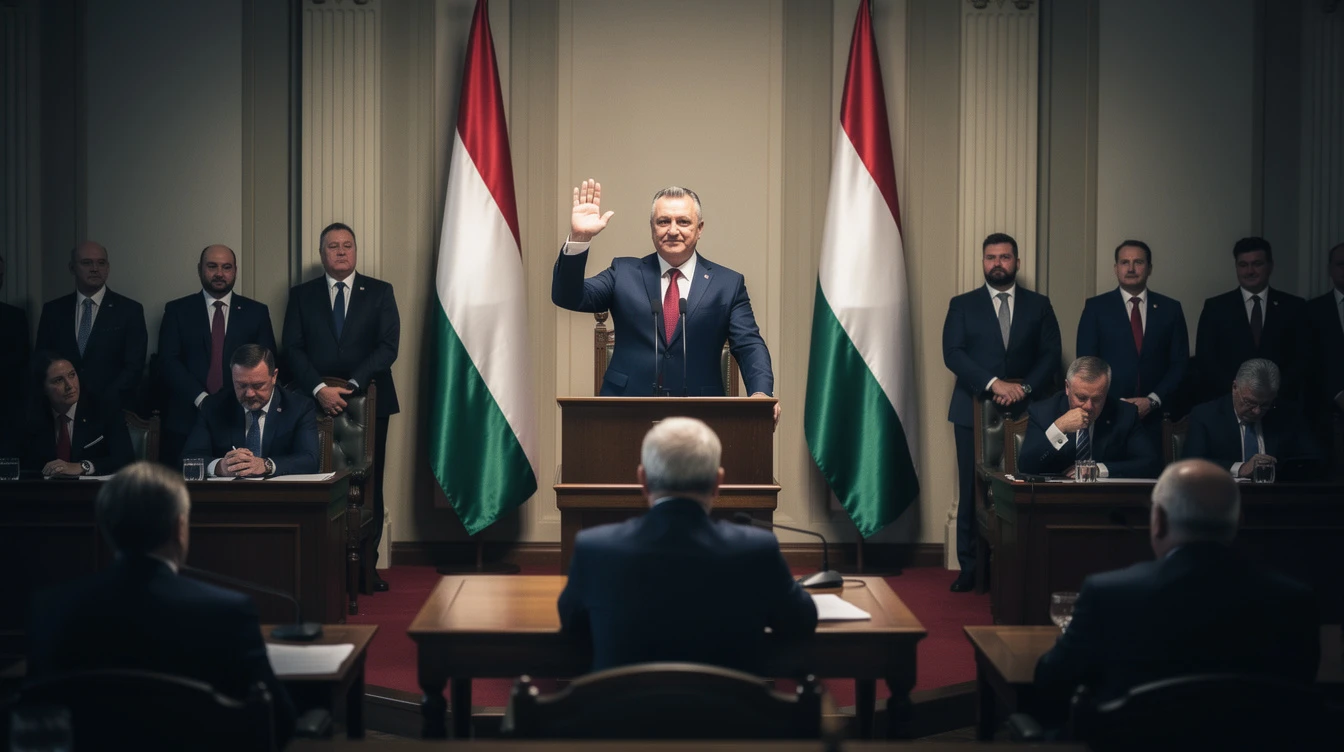
BUDAPEST — Center-right leader Peter Magyar was sworn in as Hungary's prime minister on Saturday, taking office on promises of sweeping reforms after his Tisza party won a landslide election last month. The inauguration ends 16 years of rule by nationalist Viktor Orban.
Magyar, 45, took the oath of office before parliament in Budapest. His Tisza party holds 141 of 199 seats in the legislature, a dramatic shift from zero seats just two years ago when the party was founded.
Mandate for a 'new chapter'
In his first speech as prime minister, Magyar told lawmakers that Hungarians had given his government a clear mandate. "They have given us a mandate to open a new chapter in Hungary's history," he said, according to local media reports.
"They have given us a mandate to open a new chapter in Hungary's history."
Magyar described the election result as a call for a "change of system," not just a change of government. He vowed to restore democratic checks and balances and break with what he called Orban's authoritarian rule.
EU flag returns to parliament
A visible sign of the shift in power came Saturday when the European Union flag was hoisted outside Hungary's parliament building. The flag had been removed in 2014 under Orban's orders, a move widely seen as a snub to the bloc.
The return of the EU flag was part of the celebration. A large "celebration of freedom and democracy" was held in front of parliament along the banks of the Danube River, drawing thousands of supporters.
Landslide victory in April
Magyar's Tisza party won the April parliamentary election in a landslide, securing a supermajority. The party was founded only two years ago and rose rapidly on a platform of anti-corruption and pro-European Union policies.
The election ended Orban's 16-year hold on power. Orban's Fidesz party, which had dominated Hungarian politics since 2010, suffered a crushing defeat.
Promises of reform and transparency
Magyar has promised to reverse what critics describe as Orban's erosion of democratic institutions. He has pledged to end state contracts and funds being channeled to business circles close to Fidesz, a practice that drew scrutiny from the EU.
In the months before the election, the outgoing Orban government initiated a spending spree that some analysts called an attempt to buy votes. Magyar said his government would audit these expenditures and restore transparency.
He also vowed to repair Hungary's strained relations with the European Union. Under Orban, Budapest clashed repeatedly with Brussels over rule-of-law issues, leading to the suspension of billions of euros in EU funds.
Background of the new leader
Peter Magyar, a lawyer and former diplomat, entered politics just two years ago. He founded the Tisza party as a centrist alternative to Fidesz, capitalizing on public frustration with corruption and media curbs.
His campaign drew large crowds and benefited from a unified opposition. Magyar positioned himself as a pragmatic reformer, promising economic stability and alignment with Western allies.
Magyar's rise marks a sharp reversal for Orban's brand of illiberal democracy, which had inspired other nationalist movements in Europe. Hungary's election result is seen as a bellwether for shifting voter sentiment in Central Europe.
Key challenges ahead
Magyar takes office with high expectations. Restoring independent media and judicial independence are among his first priorities. His government also faces the task of unlocking EU funds frozen over rule-of-law disputes.
Economic challenges include inflation and a strained budget. The spending spree by the Orban government in the final months of its rule has left a fiscal gap that the new administration must address.
Magyar has promised to steer Hungary back toward the European mainstream. He has signaled support for continued sanctions against Russia and for NATO's eastern flank, a departure from Orban's skepticism toward the alliance.
Reaction from international partners
European Union officials welcomed Magyar's inauguration. EU Commission President Ursula von der Leyen congratulated Magyar, saying she looked forward to working with his government on shared democratic values.
NATO Secretary General Jens Stoltenberg also issued a statement, expressing hope for strengthened ties. The United States called the peaceful transfer of power a testament to Hungary's democratic resilience.
Analysts say the transition will be closely watched as a test of whether Hungary can reverse democratic backsliding. The new government's first 100 days are expected to set the tone for its reform agenda.
Magyar is expected to name his cabinet in the coming days. Parliament is scheduled to approve ministerial appointments by the end of the week. The new prime minister has said he will prioritize anti-corruption legislation and media freedom bills.
The coming months will show whether Magyar can deliver on his promises of change. For now, the EU flag flies again over Budapest, and Hungary prepares for a new political chapter.