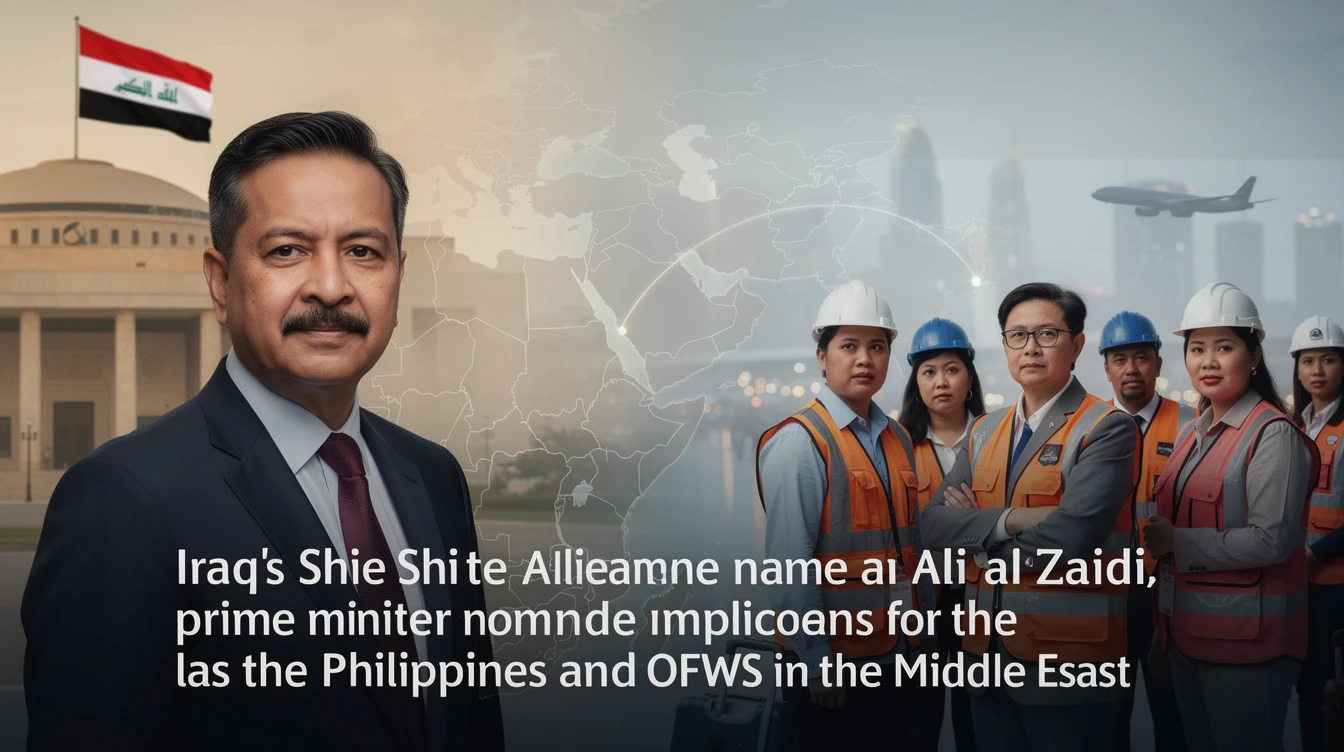
The Coordination Framework , Iraq’s dominant Shi’ite political alliance, named Ali al-Zaidi as its nominee for prime minister on Monday, April 27, 2026, according to reports from Reuters and Al-Monitor. The announcement came after months of political deadlock following the October 2025 parliamentary elections.
Iraqi President Nizar Amedi formally invited Zaidi on Monday evening to form a government, as Zaidi represents the largest parliamentary bloc. The move sets the stage for a new administration that could reshape Iraq’s domestic and foreign policies.
Iraq’s
For the Philippines , this development carries significant weight. Over 1,500 Filipino workers are currently employed in Iraq, many in the construction and service sectors, according to the Philippine Overseas Employment Administration. Political instability in Iraq has historically disrupted their safety and remittances.
The Philippine government has maintained a deployment ban for OFWs in Iraq since 2020 due to security concerns. The selection of a new leader could either ease or tighten restrictions, depending on his stance on foreign labor and regional security.
Zaidi, a former oil minister, is known for his technocratic background and close ties to Iran—backed factions. His nomination signals a potential continuation of Iran’s influence in Iraq, which the Philippines must navigate carefully amid Middle Eastern geopolitics.
Shi’ite
The Coordination Framework, an alliance of Shi’ite parties, holds the majority in parliament after the 2025 elections. Zaidi’s nomination follows the resignation of former Prime Minister Mohammed Shia al-Sudani in February 2026 amid corruption allegations.
President Amedi’s invitation is a constitutional step that triggers a 30-day period for Zaidi to form a cabinet. If he fails, a new nominee must be selected. This timeline directly affects OFW deployment policies, as the Philippine Department of Foreign Affairs typically reassesses bans after government formation.
Iraq is OPEC’s second-largest oil producer , pumping about 4.5 million barrels per day . Political stability in Baghdad influences global crude prices, which impact the Philippines as a net oil importer. A stable Iraqi government could moderate fuel costs for Filipino consumers.
The Philippines imported $3.2 billion worth of crude oil in 2025, with Iraq accounting for about 12% of that supply, per data from the Philippine Statistics Authority. Any disruption in Iraqi production could raise prices at the pump in Metro Manila and provinces.
Zaidi’s nomination has drawn mixed reactions internationally. The United States has expressed caution, while Iran has welcomed the move. For Philippine diplomats, balancing relations with both the U.S. and Iran is crucial given the country’s reliance on American security partnerships and Middle Eastern labor markets.
Over 2 million Filipinos work in the broader Middle East, including Saudi Arabia, UAE, and Kuwait. Instability in Iraq often has spillover effects, prompting precautionary repatriation efforts by the Philippine government, as seen during the 2019 Iran–U.S. tensions.
The Philippine Embassy in Baghdad, led by Ambassador Elmer Cato , has been monitoring the political transition. In a recent advisory, the embassy urged OFWs to avoid large gatherings and register with the embassy for emergency updates.
Zaidi’s policy priorities are expected to focus on anti-corruption reforms, infrastructure rebuilding, and energy sector expansion . These could create opportunities for Filipino engineers and technicians, but only if the deployment ban is lifted.
The Philippine government under President Ferdinand Marcos Jr. has pursued a balanced foreign policy, maintaining ties with both the U.S. and China. Iraq’s new leadership could test this approach, especially if it deepens alliances with Iran, a rival of Gulf states where many OFWs work.
For Filipino families dependent on remittances from Iraq, the nomination brings a mix of hope and uncertainty. Remittances from Iraq totaled $120 million in 2025, according to Bangko Sentral ng Pilipinas data, supporting thousands of households.
The international community will watch the next 30 days closely. If Zaidi forms a stable government, it could lead to the gradual normalization of Iraq’s economy and security, potentially paving the way for the Philippines to reconsider its OFW deployment ban.
In a related development, the Philippine government recently launched a skills verification program for OFWs in the Middle East to ensure they meet international standards. This program could be expanded to Iraq if conditions improve, according to Department of Migrant Workers Secretary Hans Leo Cacdac .
The Coordination Framework’s decision comes amid broader regional shifts. The 2026 ceasefire between Israel and Hamas has reduced tensions in the Middle East, but Iraq remains vulnerable to sectarian conflicts that could endanger foreign workers.
For more insights on Philippine foreign policy in the Middle East, see Philippine Politics. To understand how global oil prices affect local fuel costs, visit Business. For updates on OFW deployment policies, check Local. The latest on Middle Eastern geopolitics is available at World.
Alliance
President Marcos has not issued a statement on Zaidi’s nomination as of Tuesday morning. However, the Department of Foreign Affairs is expected to release a situational briefing within the week, according to a source familiar with the matter.
For Filipino readers, Iraq’s political transition is not a distant event but a development with direct implications for their finances, family members abroad, and the country’s energy security. The nomination of Ali al-Zaidi marks a pivotal moment that demands attention from every Filipino household reliant on stable oil prices and overseas employment.