The Philippine Statistics Authority (PSA) reports that a family of five needs at least P25,374 monthly to be considered middle-income, a threshold increasingly strained by inflation that hit 6.1% in September 2024.
This official income band, spanning P25,374 to P140,384 monthly, encompasses government employees, teachers, nurses, and small business owners who are now grappling with eroded purchasing power.
"We essentially divided per capita income not just into the poor and the non-poor, but in seven groups," explained a researcher from the Philippine Institute for Development Studies (PIDS).
"The lowest two form the low income, while the middle three tiers constitute the middle-income class," the PIDS analysis stated, highlighting the nuanced economic stratification.
For Filipino households, this means the middle class includes those who can afford basic comforts like appliances and education but have little buffer for major emergencies.
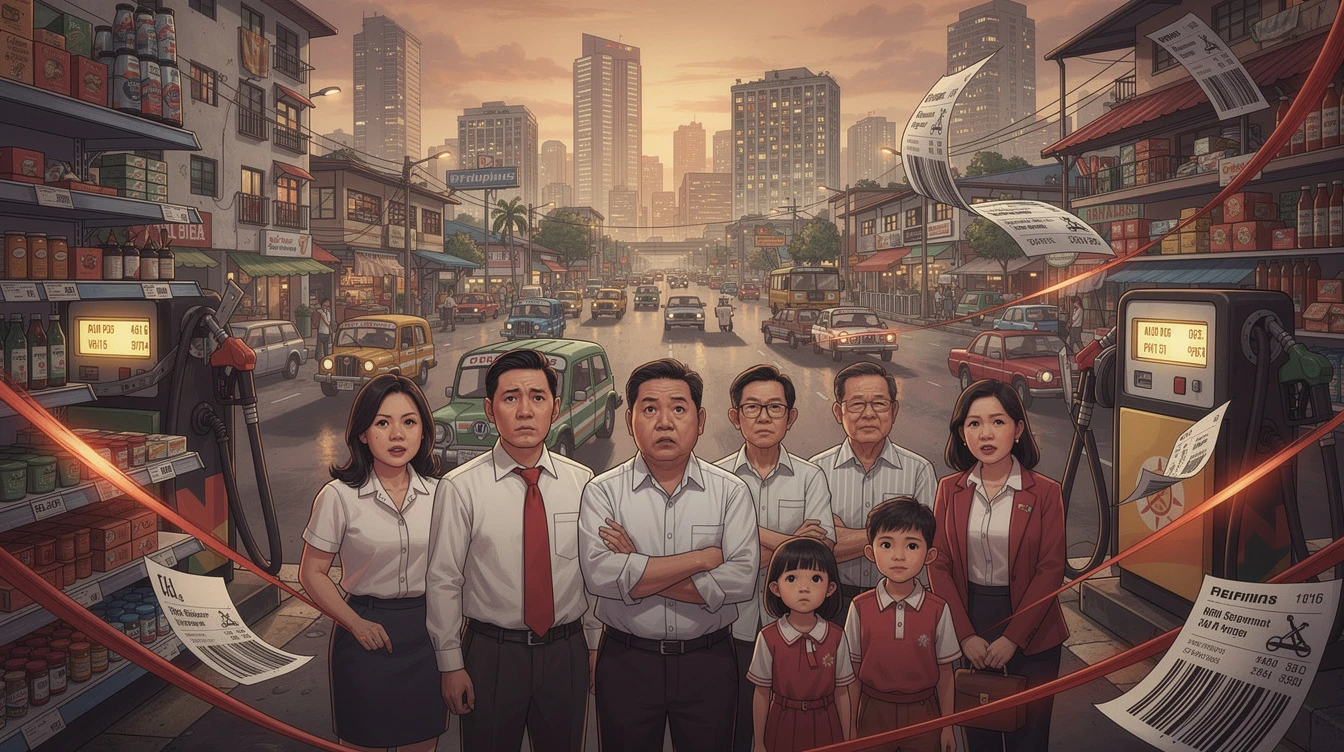
The economic squeeze is most acute in urban centers like Metro Manila, where costs for transport, housing, and food far outpace national averages.
Many middle-class families are now forced to cut discretionary spending, delay major purchases, or dip into savings to maintain their standard of living.
This pressure directly impacts millions of OFW families who rely on remittances to sustain a middle-class lifestyle back home in the Philippines.
Rising prices for rice, fuel, and electricity are the primary drivers pushing families toward the lower-income brackets, reversing years of hard-earned economic progress.
The government's latest data serves as a crucial benchmark for policymakers crafting targeted assistance programs and economic interventions.
Understanding this demographic is vital for forecasting consumer demand, housing needs, and the stability of the domestic economy.
Analysts warn that a shrinking middle class could lead to reduced social mobility and increased political instability.
For the average Filipino worker, the definition translates to a daily struggle to preserve gains against relentless inflationary pressures.
The situation underscores the importance of wage reviews, transport subsidies, and food security measures currently debated in Congress.
It also highlights the vulnerability of a segment once considered the backbone of a robust consumer-driven economy.
Families hovering near the lower boundary of P25,374 are at constant risk of slipping into economic insecurity with a single financial shock.
The significance for Filipino readers is profound, as the redefinition of the middle class reflects the lived reality of budgeting tighter and aspiring cautiously.
It matters to OFW families whose remittances now buy less, forcing difficult choices between education, healthcare, and nutrition.
This data provides a clear mirror to the nation's economic health, showing why price stability is not just a statistic but a matter of family survival.