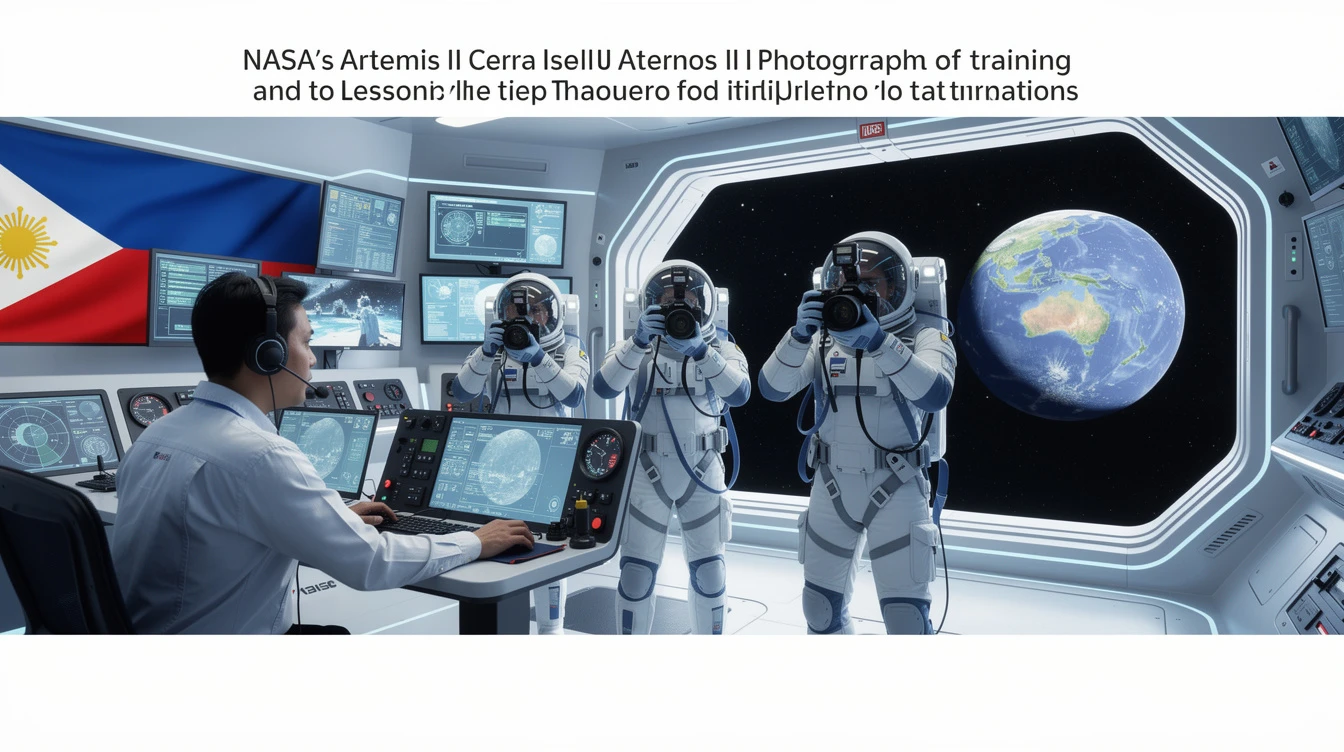
NASA photography trainers Paul Reichert and Katrina Willoughby provided approximately 20 hours of specialized instruction to the Artemis II crew in Houston, preparing them to document humanity's return to lunar orbit. The training focused on capturing the mission's scientific and inspirational value for global audiences.
"We hung a giant inflatable moon and turned the lights out, taking real pictures," mission pilot Victor Glover said in a NASA interview posted on social media platform X. The simulations aimed to replicate the challenging lighting conditions of space.
Trainer Katrina Willoughby, who posed with the crew before an Orion spacecraft mock-up, emphasized technical precision. The instruction covered camera operation, composition, and storytelling through imagery in a weightless environment.
Astronaut Christina Koch highlighted the training's deeper purpose. "It's making sure that the photos you take share the awe and the grandeur," she stated, underscoring the public engagement role of space photography.
The crew, including Reid Wiseman, Victor Glover, Koch, and Jeremy Hansen, practiced extensively. They conducted on-the-ground drills simulating photographic scenarios they will encounter during their lunar flyby mission.
This professional visual documentation training is critical for scientific analysis and historical record. The images will provide unique geological data of the lunar surface from orbit.
For the Philippines, this specialized training model is directly relevant to the Philippine Space Agency's (PhilSA) growing ambitions. Developing similar niche technical expertise is essential for a sustainable national space program.
Filipino engineers and future astronauts could benefit from analogous programs. PhilSA's collaboration with international partners could include such specialized skill transfers.
The global fascination with Artemis imagery demonstrates space's power to inspire. The Philippines, with a young, tech-savvy population, stands to gain significantly from such inspirational content.
Investing in advanced technical training, as NASA did for photography, aligns with the Philippines' goal of moving beyond satellite operation into deeper space sector participation. It builds valuable human capital.
Furthermore, the visual documentation of space has commercial and educational applications. Filipino companies in animation, simulation, and STEM education could leverage similar techniques.
The Artemis II photography training exemplifies the high-level, interdisciplinary skills required for modern space exploration. It sets a benchmark for the Philippines' own capacity-building efforts in this strategic field.