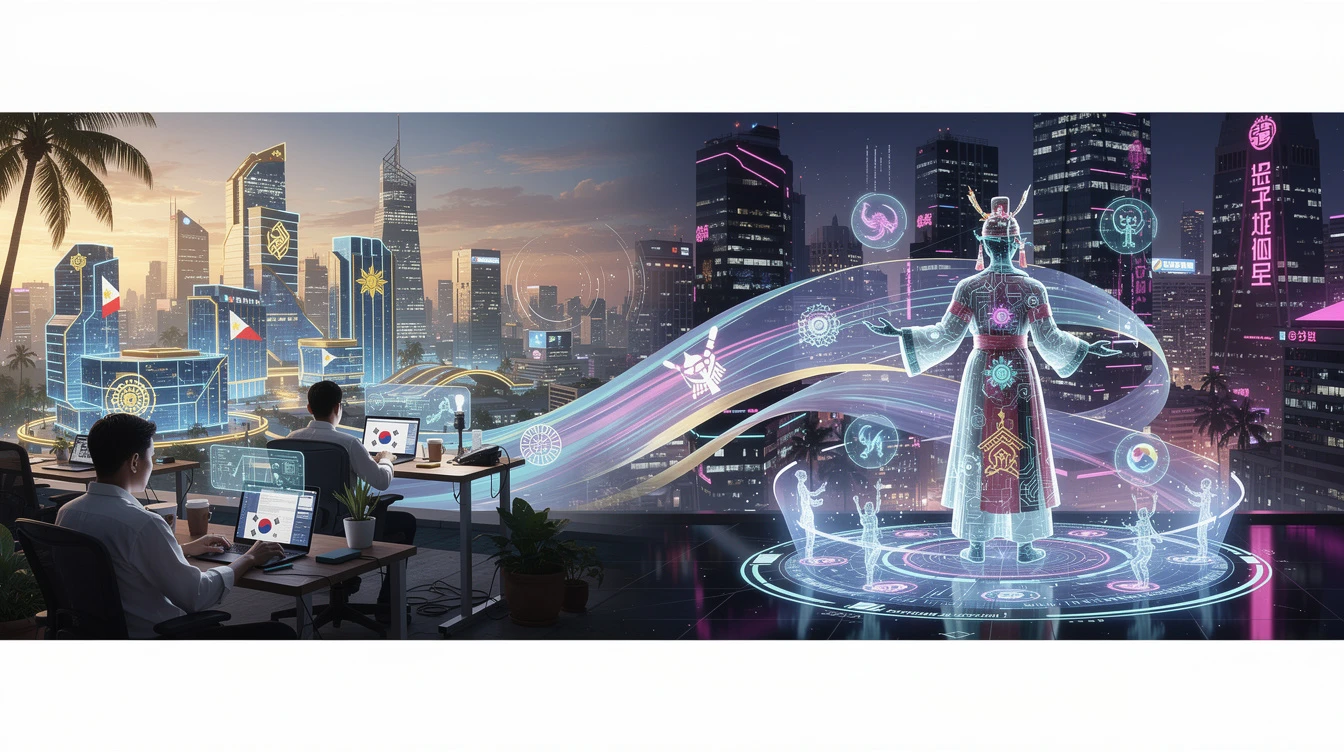
SEOUL, South Korea – A new wave of AI-powered fortune-telling services is captivating South Korea, a trend with significant implications for the Philippines' own booming tech sector and deeply spiritual culture. In central Seoul, stores like Vinaida now use AI robots to perform traditional \"saju\" readings, according to recent international reports. This fusion of ancient divination and cutting-edge artificial intelligence presents a complex case study for Filipino innovators navigating the intersection of technology, tradition, and commerce.
The Philippine angle is clear: the country has a massive fortune-telling industry and is a major hub for AI development and business process outsourcing. Filipino tech entrepreneurs are closely watching whether this Korean model could be adapted locally, despite potential conflicts with dominant Catholic and evangelical Christian values. The Department of Trade and Industry has previously highlighted AI as a growth sector, making such international applications directly relevant.
In South Korea, fortune-telling is deeply embedded in daily life, with newspapers publishing daily horoscopes. The new AI services analyze a person's birth date and time—key components of \"saju\"—to generate predictions. At Vinaida, customers interact with robots for face-reading and fortune-telling, blending tradition with digital novelty. This commercial adoption demonstrates a practical, revenue-generating use case for consumer AI.
For the Philippines, a nation with a robust \"hilot\" (traditional healer) and psychic reading industry, the Korean experiment raises questions about modernization and authenticity. Local tech developers in Bonifacio Global City and Cebu IT Park are already creating AI for customer service and data analysis. The concept of an \"AI albularyo\" or fortune-teller, however, ventures into uncharted ethical and cultural territory.
Religious leaders in the Philippines have historically viewed fortune-telling with skepticism, aligning with doctrinal prohibitions. The Catholic Bishops' Conference of the Philippines (CBCP) has consistently warned against practices perceived as superstition. An AI-powered version could further complicate this stance, potentially being seen as a mere technological toy rather than a spiritual service.
Economically, the model presents an opportunity. The Philippine Statistics Authority notes the service sector, including personal services, is a major employment driver. A regulated, tech-enhanced version of traditional consultation could create new digital jobs. However, it would require navigating the Food and Drug Administration (FDA) and National Privacy Commission (NPC) regulations on data handling, as birth details are sensitive personal information.
The South Korean trend also highlights a global pattern of using AI for personal guidance, from mental health chatbots to life coaching apps. Filipino consumers are increasingly adopting such technologies. According to a 2023 report by the Department of Information and Communications Technology (DICT), app-based services saw a 40% increase in usage among Filipinos post-pandemic.
Ultimately, the rise of AI shamans in Seoul serves as a mirror for Philippine society. It forces a conversation about how a nation steeped in spiritual tradition harnesses technological advancement without eroding cultural identity. The Korean experience will likely inform local developers and policymakers as they draft guidelines for ethical AI deployment in culturally sensitive domains.