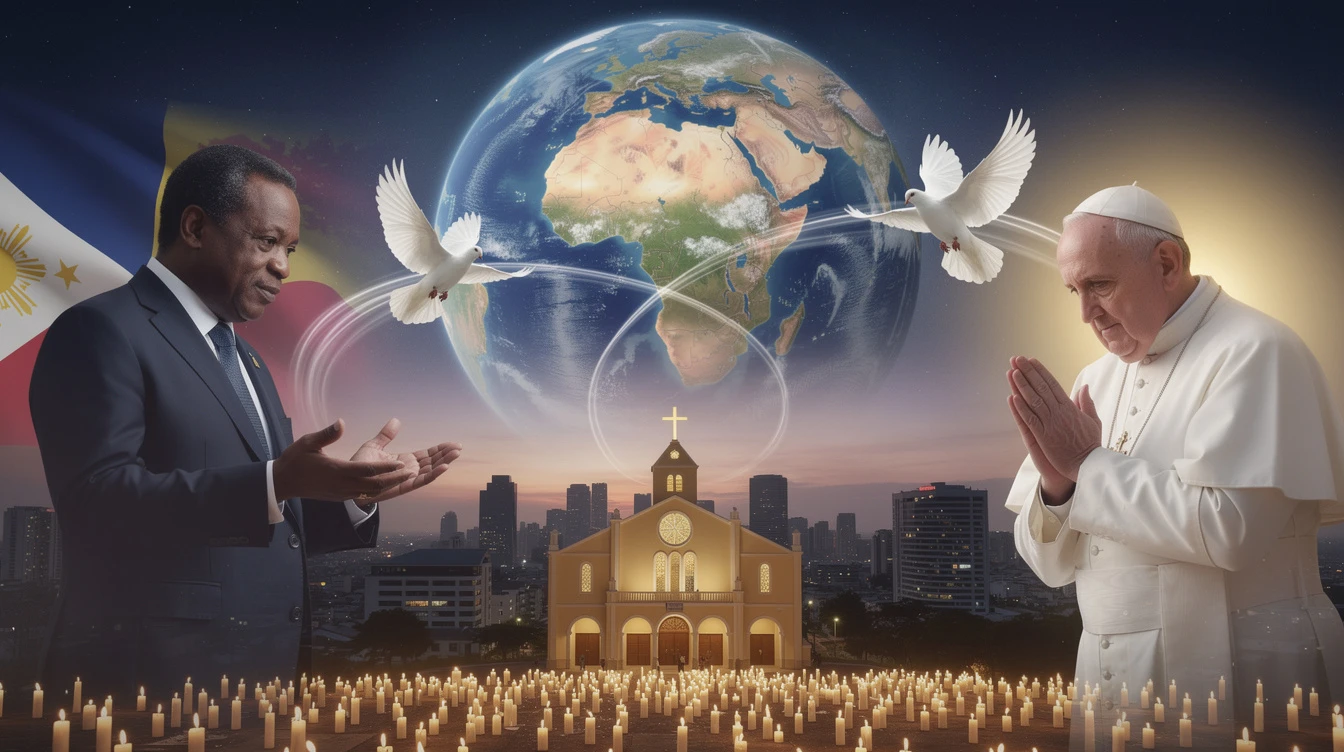
YAOUNDE, Cameroon – Cameroon's 93-year-old President Paul Biya declared Wednesday that "the world needs the message of peace, justice, tolerance, forgiveness, and love" brought by Pope Leo XIV, during the pontiff's first day in the African nation.
The endorsement comes as Pope Leo continues to face sharp criticism from US President Donald Trump over his diplomatic stance, particularly regarding Iran. Trump described the pontiff as "terrible for Foreign Policy" in a social media post this week.
Aboard the papal plane from Algeria to Cameroon, Pope Leo stated his visit offers a message of unity and peace "the world needs to hear." He emphasized, "The things I say are not meant as attacks on anyone."
The Pope pointed to his visit to the Great Mosque of Algiers and the birthplace of Saint Augustine as symbols of interfaith dialogue. He added he has "no fear" of speaking out on the Gospel's message despite political pressure.
President Biya's public alignment with the Pope's peace message provides significant diplomatic cover for the pontiff's tour. It highlights a growing divergence between the Vatican's approach and that of some Western powers.
For the Philippines, a nation with over 86 million Catholics, the Pope's reinforced message of peace and tolerance carries profound weight. The Church remains a central moral and social institution in Filipino society.
The Vatican's stance on diplomatic engagement, rather than confrontation, with nations like Iran could influence Manila's own foreign policy considerations. The Philippines maintains diplomatic relations with a wide range of global partners.
Furthermore, the Pope's call for coexistence directly impacts millions of Filipino migrant workers (OFWs) living in diverse, often tense regions across the Middle East and beyond. Their safety can hinge on global stability.
Any escalation of conflict, particularly involving Iran, poses a direct threat to the estimated 2-3 million OFWs in the Gulf region. The Philippine government consistently advocates for peaceful resolution of international disputes.
President Biya's support for the papal message also underscores the Global South's increasing role in shaping international moral discourse. This shift aligns with the Philippines' own growing voice in ASEAN and multilateral forums.
The Pope's journey, emphasizing unity across Christian and Muslim communities, serves as a powerful model for the Philippines. The nation successfully fosters interfaith harmony between its Catholic majority and Muslim communities.
As global tensions simmer, the unified call for peace from the Vatican and leaders like Biya offers a counter-narrative. It champions dialogue over division, a principle deeply embedded in Philippine diplomatic and social ethos.
For Filipino families, both at home and with members overseas, stability and peaceful international relations are not abstract concepts. They are prerequisites for security, livelihood, and the hope of reunification.
The significance for Filipino readers is multifaceted. The Pope's moral authority reinforces values central to Philippine culture: family, faith, and peace. His conflict with US leadership illustrates complex global alliances where the Philippines must navigate carefully.
Most critically, the Vatican's persistent peace advocacy serves as a crucial check against policies that could endanger OFWs. It supports the Philippine government's primary mandate: protecting its citizens abroad amidst uncertain global politics.