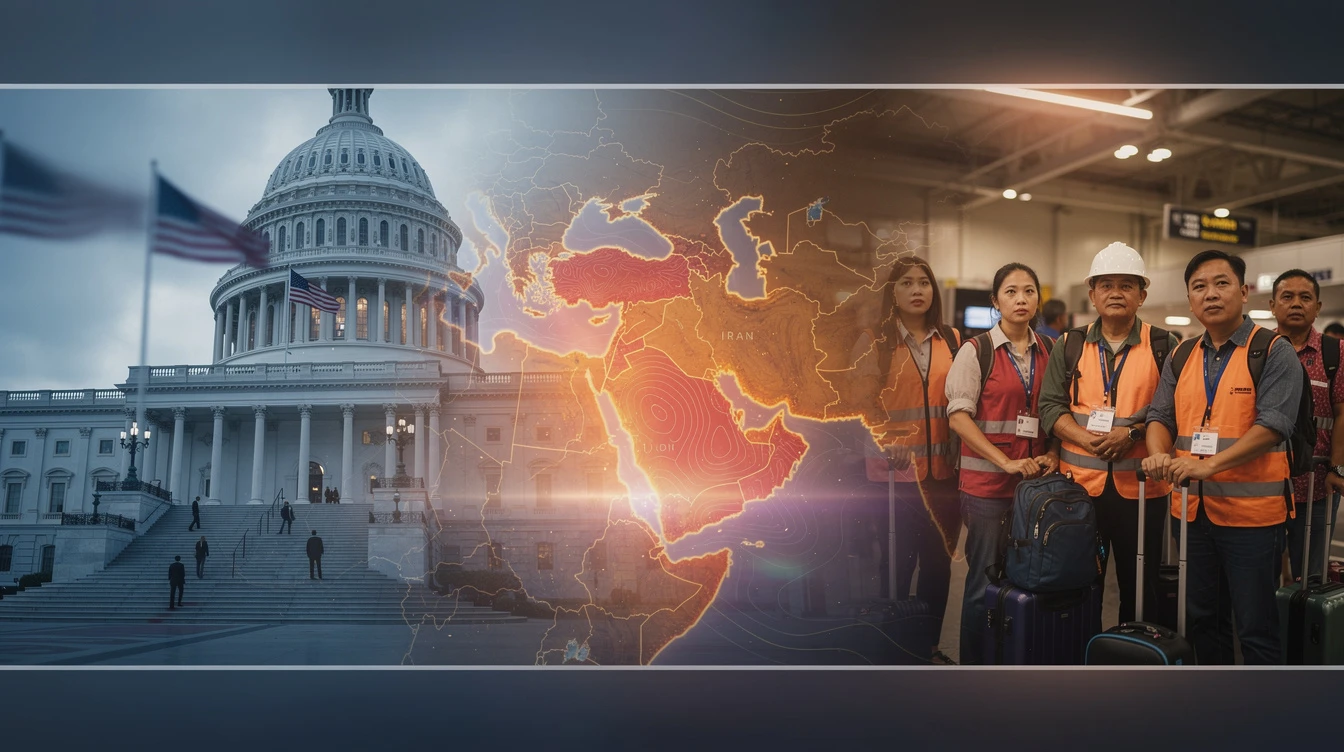
WASHINGTON D.C. — Senate Republicans on Wednesday blocked a Democratic-led measure to limit President Donald Trump's authority to wage military action against Iran without congressional approval, marking the 28th time such efforts have been defeated.
The 49-44 vote fell short of the 60 votes needed to advance the resolution, which sought to repeal the 2002 Authorization for Use of Military Force (AUMF) against Iraq that administrations have used to justify strikes in Iran.
Democratic Senator Tim Kaine, who sponsored the measure, argued the 2002 authorization was being improperly stretched to cover conflicts far beyond its original intent against Saddam Hussein's regime.
"This vote maintains a dangerous precedent where any president can unilaterally take us to war," Kaine stated following the failed procedural vote on Capitol Hill.
The blocked measure comes amid heightened Middle East tensions following the U.S. killing of Iranian commander Qasem Soleimani in January and subsequent Iranian missile strikes on Iraqi bases housing American troops.
For the Philippines, the continued congressional deadlock on war powers carries direct implications for national security and overseas Filipino workers (OFWs).
Approximately 2.3 million Filipinos work across the Middle East, with significant populations in Qatar, Saudi Arabia, and the United Arab Emirates neighboring potential conflict zones.
The Department of Foreign Affairs (DFA) maintains Alert Level 2 (Restriction Phase) for Iran and Iraq, requiring mandatory repatriation for non-essential Filipino personnel amid ongoing volatility.
"Any escalation in U.S.-Iran hostilities directly threatens Filipino communities throughout the region," said Foreign Affairs Undersecretary Sarah Arriola in a recent briefing.
The Philippine government has repeatedly emphasized its neutral foreign policy stance while prioritizing citizen protection through contingency plans coordinated with host nations.
Senate Minority Leader Chuck Schumer criticized Republicans for "abdicating their constitutional duty" on war powers while giving the executive branch unchecked military authority.
Republican leaders countered that limiting presidential powers during ongoing tensions would signal weakness to adversaries and undermine national security negotiations.
This legislative stalemate occurs as the Trump administration continues maximum pressure campaigns against Iran through economic sanctions and diplomatic isolation efforts.
Filipino maritime workers face particular risks, with the Strait of Hormuz—a critical oil shipping channel—remaining a potential flashpoint for naval confrontations affecting global trade routes.
The Philippines imports over 90% of its crude oil requirements, primarily from Middle Eastern suppliers, making regional stability essential for national energy security and consumer prices.
Migrant advocacy groups have urged the Philippine Overseas Employment Administration (POEA) to strengthen pre-deployment orientation regarding conflict zone safety protocols.
"Our OFWs deserve clear evacuation plans and updated risk assessments before accepting Middle East placements," said Migrante International chairperson Joanna Concepcion.
Congressional Democrats vow to continue war powers challenges through additional legislative vehicles and potential court battles over constitutional separation of powers.
The failed vote represents ongoing partisan divisions on foreign policy that have persisted through multiple administrations since the September 11 attacks.
For Filipino families with relatives working abroad, the Washington deadlock translates to continued anxiety about loved ones' safety in unpredictable geopolitical environments.
The significance for Filipino readers lies in how distant congressional votes directly impact national interests through OFW security, energy imports, and regional stability affecting Philippine economic ties.
As global powers maneuver in the Middle East, the Philippines must balance diplomatic relations while preparing contingency responses for citizens caught in cross-border tensions beyond Manila's control.