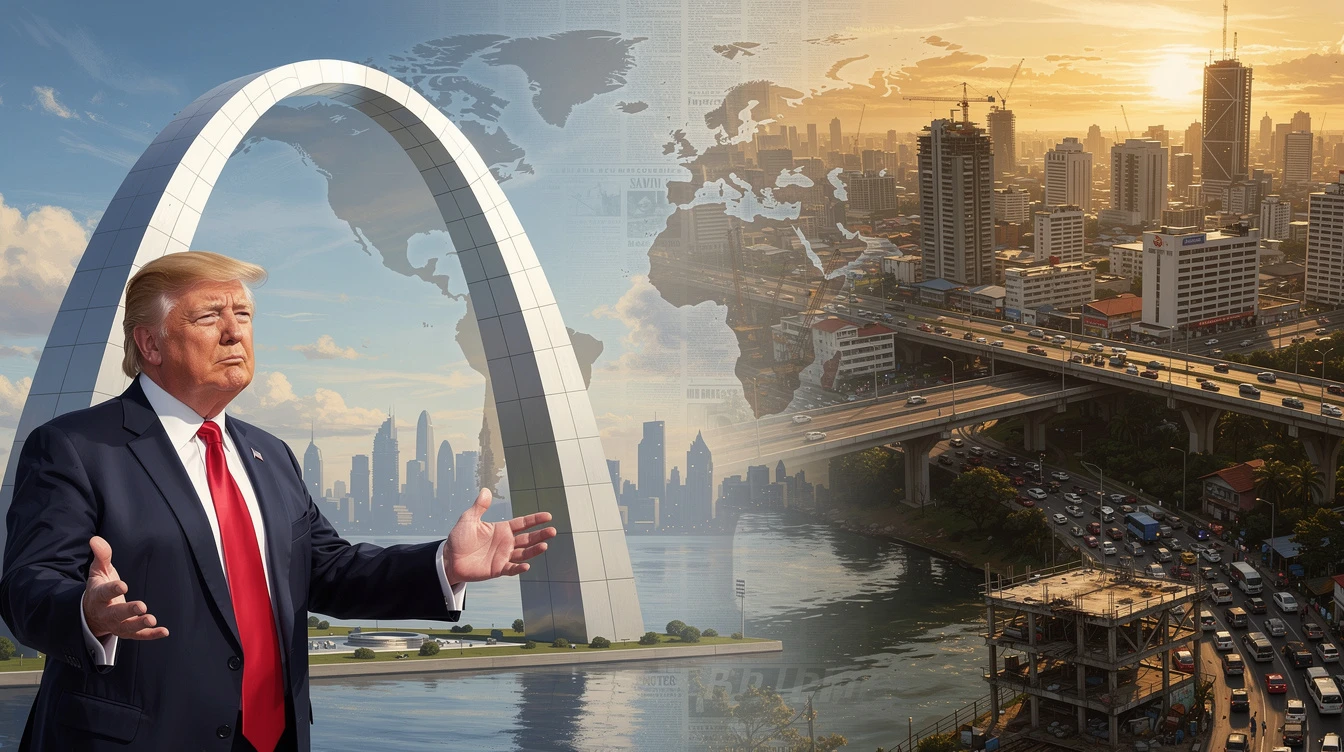
Former US President Donald Trump unveiled renderings for a proposed 250-foot "Independence Arch" in Washington D.C., marking the latest in his series of controversial architectural interventions. The White House released plans for the monument, nicknamed "Arc de Trump," through the Commission on Fine Arts on Friday. Trump declared on social media it would be "the GREATEST and MOST BEAUTIFUL Triumphal Arch, anywhere in the World," modeled after Paris's Arc de Triomphe.
The arch would stand at the Arlington Memorial Bridge entrance near Arlington National Cemetery. Architectural firm Harrison Design produced the renderings, showing a structure similar to a model Trump showcased at a White House fundraiser last October. This project follows his legally contested $400 million neoclassical White House ballroom proposal, which he suggested could partially fund the arch.
For Filipino observers, the spectacle highlights contrasting approaches to national infrastructure and legacy projects. The Philippines under President Ferdinand Marcos Jr. has prioritized practical infrastructure like airports, railways, and flood control systems. These projects aim to stimulate economic growth and improve daily life for millions of citizens, rather than constructing monumental arches.
The arch debate emerges as the Philippines faces its own discussions about historical monuments and national identity. Recent years have seen renewed examination of monuments from the Marcos Sr. era and American colonial period. This conversation focuses on how public spaces and structures reflect historical truth and current values, not merely political legacy.
Economically, the proposed arch's scale—250 feet tall—contrasts with Philippine budget realities. The country allocates funds to essential services, disaster resilience, and social programs supporting overseas Filipino workers (OFWs) and their families. Massive symbolic projects would likely face public scrutiny given pressing needs in healthcare, education, and transportation.
Filipino architects and urban planners are also noting the discussion. Many advocate for infrastructure that serves functional community needs, environmental sustainability, and cultural relevance. The Philippines' own architectural developments increasingly emphasize climate adaptation and social utility, lessons from frequent typhoons and rapid urbanization.
The "Arc de Trump" proposal, while a US domestic issue, offers a mirror for Philippine society. It prompts reflection on how nations choose to spend public resources and what values their built environment represents. With many Filipinos closely following US politics due to familial, economic, and diplomatic ties, such developments resonate beyond American borders.
Ultimately, the arch story underscores a fundamental question relevant to the Philippines: should national pride be built through grand monuments or through investments that tangibly uplift citizens' lives? As Manila continues its infrastructure push, the answer appears focused on bridges that connect communities, not just arches that symbolize power.