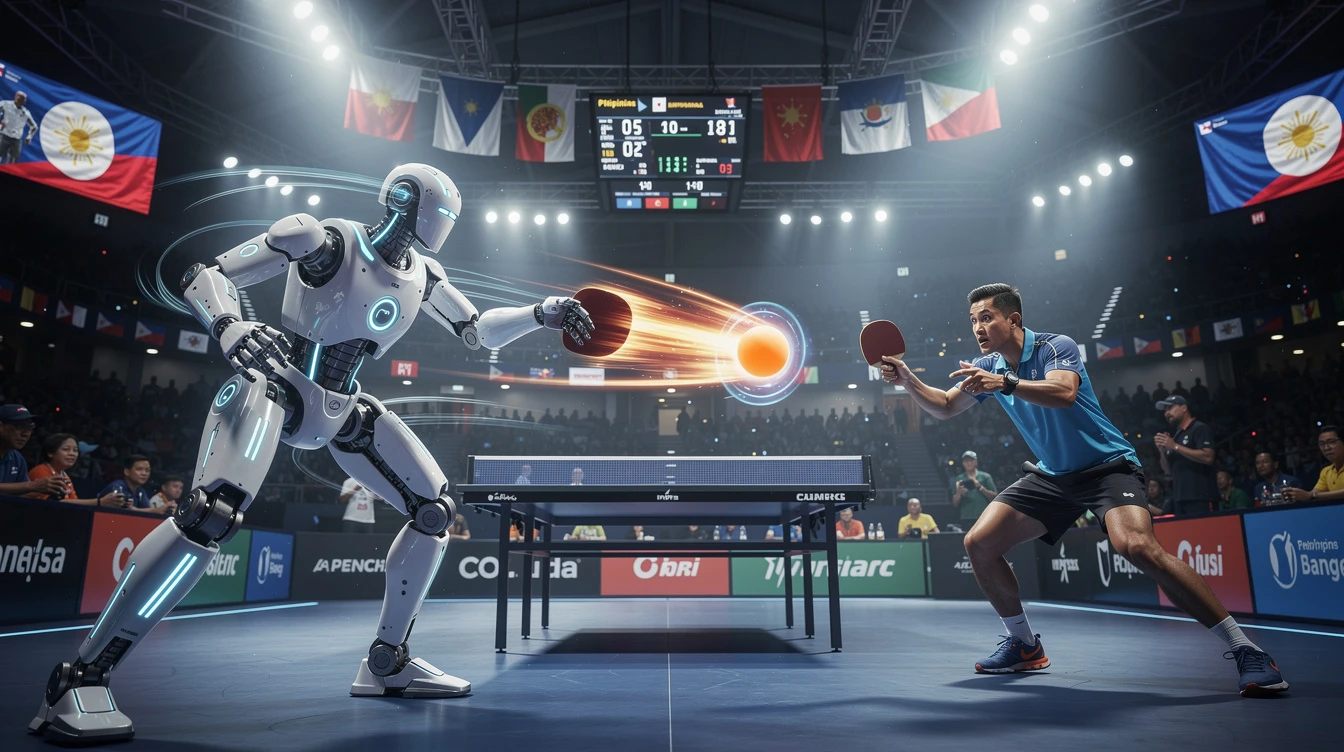
In a landmark moment for artificial intelligence and robotics, a ping-pong robot named Ace has made history by competing against and defeating top-level human players in Tokyo. This achievement, reported by Reuters on April 22, 2026, marks the first time a robot has attained expert-level performance in a competitive physical sport.
Ace was created by Sony AI , the Japanese company's artificial intelligence research division. It is an autonomous table tennis robot designed to make rapid decisions and execute precise movements. The project's leader, Peter Durr , director of Sony AI Zurich, called Ace the first robot to achieve such a feat in a sport that demands real-time control and human interaction.
Panalo
Since its debut, Ace has gone head-to-head with professional players. In December 2025, it defeated a top-level human opponent, and it repeated this success in March 2026. The robot uses a perception system and a learning-based control algorithm to anticipate and return shots. The findings were published in the journalNature.
While the robot's triumph happened in Tokyo, its implications reach far beyond Japan. For the Philippines , a country with a growing tech sector and a love for sports like table tennis, Ace's success signals new possibilities. Similar AI and robotics technologies could revolutionize manufacturing, service industries, and even sports training in the Philippines.
Ace relies on a combination of high-speed cameras, sensors, and machine learning models. It can analyze an opponent's movements and adapt its strategy in real-time. This is a significant leap from earlier robots that could only play against beginners or follow preset patterns. Ace can compete with elite athletes, adjusting its play style mid-game.
Future:
The robot's ability to make split-second decisions is key. In table tennis, a ball can travel at speeds over 100 km/h. Ace must calculate trajectory, spin, and speed in milliseconds. This level of precision is now achievable due to advances in AI and hardware.
Unlike traditional robots, Ace learns from every match. Its control algorithm improves over time, making it a formidable opponent. This learning capability could be applied to other fields, such as automated machinery in Philippine factories or robots assisting in disaster response.
Peter Durr stated, "The success of Ace suggests that similar techniques could be applied to other areas requiring fast, real-time control and human interaction." He highlighted manufacturing, service robotics, sports, entertainment, and safety-critical physical domains as potential beneficiaries.
In the Philippines , where the manufacturing sector contributes over 18% to GDP, such technology could boost productivity. Service robots could also assist in hospitals and hotels, addressing labor shortages in key industries.
The robot's achievement is not just a sports milestone. It demonstrates that AI can master physical tasks once thought exclusive to humans. This has implications for automation in the Philippines , where the government is pushing for digital transformation. Robots like Ace could perform complex tasks in electronics assembly, food processing, and even agriculture.
The global robotics market is expected to reach $250 billion by 2030. The Philippines can position itself as a hub for AI development and robotics integration. Local universities and tech companies can collaborate with international firms to adopt these technologies.
However, there are concerns. Job displacement is a major issue globally, including in the Philippines. As robots become more capable, workers in manufacturing and services may need reskilling. Policymakers must balance innovation with social safety nets.
- Ace is the first robot to beat top-level human table tennis players, a historic achievement for AI and robotics.
- The technology behind Ace could transform industries such as manufacturing, healthcare, and logistics in the Philippines.
- Experts see potential for similar robots to assist in disaster response and service sectors in the Philippines.
- Ethical concerns like job displacement must be addressed through reskilling and policy reforms.
No, Ace has defeated professional players but it does not always win. It is a significant milestone, but human champions still have the edge in some matches.
Demonstrations have been held in Tokyo. Videos and reports are available through Reuters and other news outlets. There are no plans for a Philippine tour yet, but local tech expos may feature similar robots soon.
While Ace is a research project, the underlying technology could be adopted by Philippine companies. Local firms should monitor these developments for potential applications in automation.
Ping-Pong
The ping-pong robot Ace has made history, showing that AI can master complex physical skills. For the Philippines , this is a wake-up call to embrace technological change. By investing in AI education and infrastructure, the country can harness such innovations for economic growth and improved quality of life. The future is here, and it plays to win.
For more insights on technology and innovation, visitPinoyPulse Technology. Learn about our mission atPinoyPulse About Us. Read related articles onAI in Philippine Manufacturing andRobotics and Jobs in the Philippines.