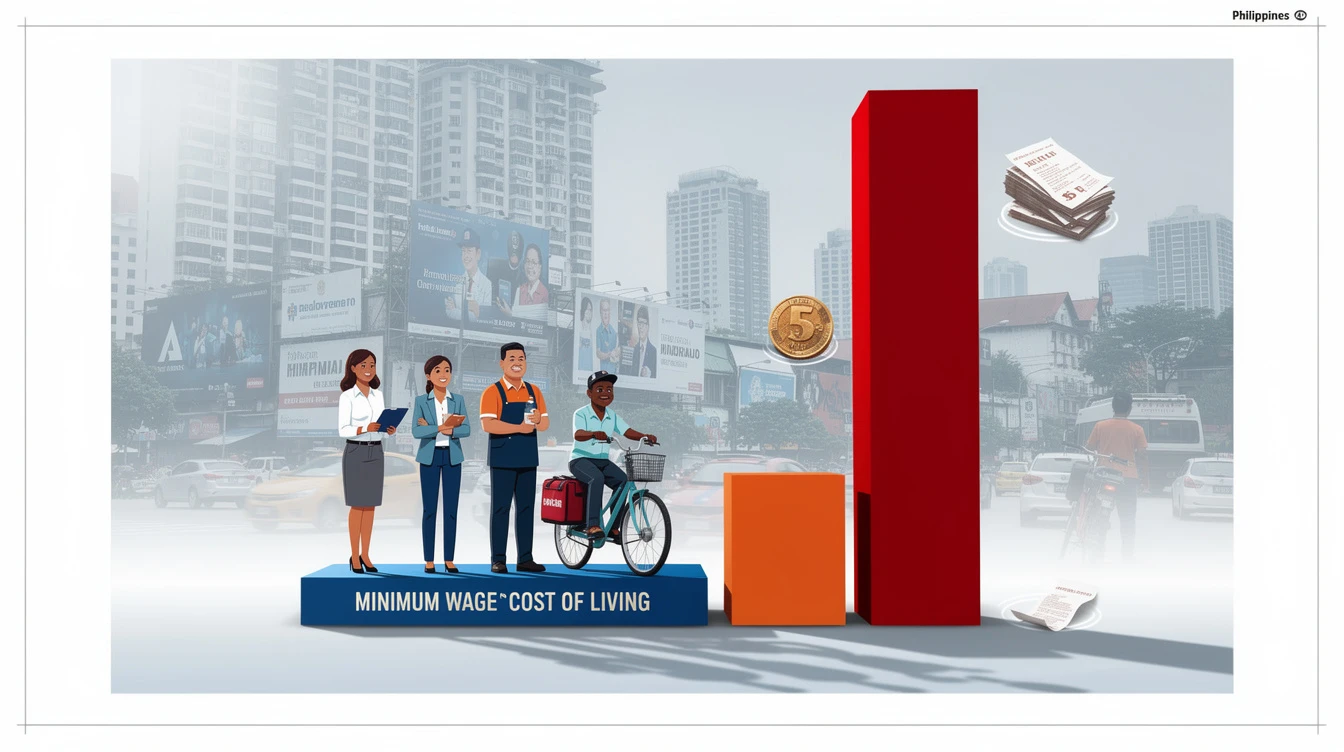
A groundbreaking study reveals that thePhilippine national minimum wage trails theactual cost of living by nearly50 percent, while even higher-payingBPO jobs inManila fall short by38.4 percent. The findings, published by theLiving Wage Foundation in November2024, underscore a widening gap between wages and survival expenses for Filipino workers.
Conducted acrossmajor urban centers in thePhilippines, the study calculated aliving wage—the income needed to afford basic needs like food, housing, healthcare, and education—and compared it to prevailing pay rates. The disparity is most acute for minimum wage earners, who earn roughly half of what they need to live decently. Even in theBPO sector, often seen as a ticket to the middle class, average salaries in Metro Manila arenearly 40 percent below the living wage benchmark.
Why Minimum Wage Falls Short
ThePeanut Gallery Media Network previously explained thatminimum wages continue to fall far behind the real cost of living as prices rise and pay remains largely unchanged. The phenomenon is not unique to the Philippines, but its severity here is striking. A separate study cited in thePhilippine Review of Economics byLanzona [2014] found that minimum wage increases can reduce employment probabilities—suggesting the government faces a trade-off between raising pay and keeping jobs.
Yet, the Living Wage Foundation report argues that setting wages based on actual costs, not just inflation, would help millions of Filipino families break the cycle of poverty. The study defines a living wage asPHP 1,200 per day for a family of five in Metro Manila, compared to the current minimum wage of aroundPHP 610 per day.
The BPO Sector Gap
The BPO industry, a cornerstone of the Philippine economy employing over1.3 million workers, is not immune to the wage gap. The study found that the average BPO salary in Manila is38.4 percent lower than the living wage. This suggests that even relatively well-compensated service workers struggle to meet daily needs, especially with rising rents and utility costs.
BPO firms often cite global competition as a constraint on wage increases. However, the report’s authors note that multinational companies can absorb higher payroll costs without passing them entirely to consumers, especially given the sector’s high profit margins.
Price Effects of Minimum Wage Hikes
A2017 Bangko Sentral review examined how minimum wage increases affect prices in thePhilippines. The paper found that higher minimum wages lead to increased production costs, which firms address either by raising prices or reducing employment and output. The study, drawing onLemos (2006), noted that a10 percent increase in theUS minimum wage raises food prices by no more than4 percent and overall prices by0.4 percent.
In the Philippine context, the Central Bank’s analysis suggests that moderate wage increases can be implemented without triggering runaway inflation, especially if productivity improves alongside. However, the report also warns thatsudden large hikes could force employers to cut jobs or automate.
Structural Issues in Labor Market
The study highlights deeper structural problems: thePhilippine labor market is dominated by informal employment, contract work, and low-productivity sectors. Minimum wage compliance is patchy, and many workers earn below the legal floor. Without broader reforms—such asinvestment in skills training,social protection, andproductivity boosts—simply raising the minimum wage may not close the gap.
Economists recommend a multi-pronged approach: strengthening enforcement of wage orders, incentivizing firms to adopt living wage practices, and expanding conditional cash transfers for the poorest families.
What This Means for Filipino Workers
The study’s findings are a wake-up call forpolicymakers, employers, and workers. For themillions of minimum wage earners in the Philippines, the gap means that even full-time work does not guarantee a decent standard of living. Families often rely on multiple income streams, remittances from abroad, or debt to survive.
ForFilipino consumers, the gap also implies that purchasing power remains constrained, limiting economic growth. TheNational Wages and Productivity Commission is expected to review the study as part of upcoming wage consultations. Meanwhile, labor groups are pushing for aPHP 150 daily wage increase, though business groups oppose it, citing potential job losses.
The takeaway for every Filipino: the cost of living crisis is not just about inflation—it is about wages that have failed to keep pace. As the nation debates wage floors, the Living Wage Foundation’s framework offers a concrete, data-driven path to ensuring thathard work truly pays.