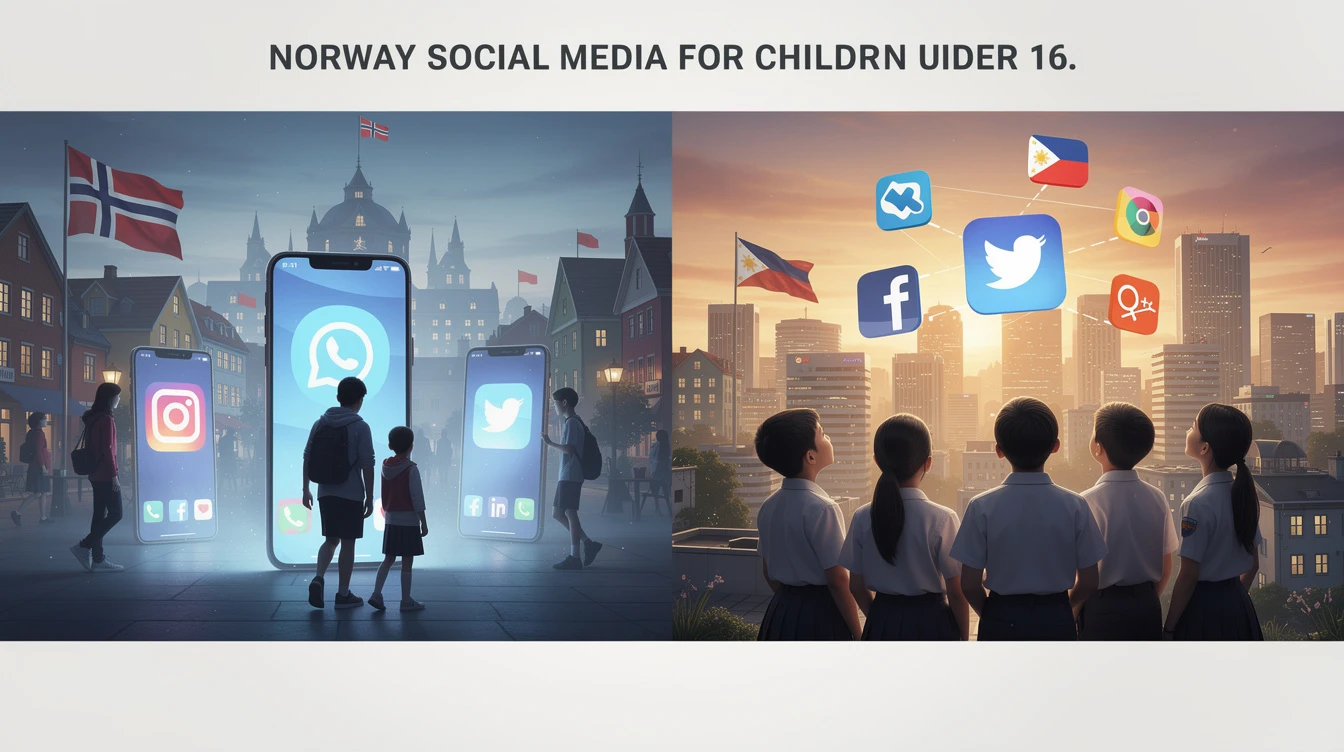
Norway’s government announced on Friday that it will present a bill in parliament by year-end to ban children from using social media until they turn 16. This bold move, reported by Reuters and RTE , makes technology companies responsible for age verification of young users. The proposal follows Australia’s world-first ban on under-16s last December. At least 14 European countries are now considering similar age-based restrictions. For the Philippines , where 70% of children aged 10–18 are active on social media (UNICEF 2023), this raises urgent questions: Is the nation ready to follow?
Prime Minister Jonas Gahr Stoere has emphasized the need to protect children from harmful content , cyberbullying , and addictive algorithms . Norway’s current age limit of 13 is widely ignored. A 2025 government survey showed that 53% of Norwegian 9-year-olds already have social media accounts. The new law would raise the minimum age to 15 and enforce it through mandatory age verification by platforms. The bill is expected to pass with cross-party support.
Norway’s
Norway is part of a wave of European action . Earlier this week, UK MPs voted 260 to 161 to reject a similar ban for under-16s—but they approved flexible powers like curfews , scrolling limits , and location-sharing restrictions . Across the EU, the Digital Services Act already demands stricter age checks. The Jerusalem Post reported that several nations are watching Australia’s success closely. The question is not if more countries will act, but how quickly they can legislate.
The Philippines faces a unique digital crisis. According to Department of Education data,1 in 3 Filipino students has experienced cyberbullying . Social media use starts as early as 9 years old in many urban areas. Senator Juan Miguel Zubiri previously proposed the Children’s Online Safety Act , which includes age gating mechanisms. But it hasn’t passed. Norway’s move could reignite the debate. The Philippine Congress must decide: follow Europe’s lead or risk a generation’s mental health.
Yet a ban in the Philippines is complicated. Internet penetration is at 73%, but access is uneven. Many children use shared devices in internet cafés. Enforcement would be almost impossible without a national ID system or robust age verification tools. Consumer rights groups argue that outright bans would push kids to unregulated platforms. The National Telecommunications Commission has no framework for social media age restrictions. Norway’s model relies on legal liability for tech companies —a concept Philippine law has yet to embrace.
Move:
Dr. Maria Victoria R. Alberto , a child psychologist at the University of the Philippines , supports stricter measures. She says social media is linked to rising anxiety , depression , and sleep disorders among Filipino youth. But digital rights advocate Carlos P. Garcia warns against overregulation. He believes education and parental guidance are more effective than bans. The Philippine Pediatric Society has called for mandatory digital literacy programs in schools. The debate is nuanced—and Norway’s plan adds a new frame.
Norway’s bill requires platforms like Meta , ByteDance , and Google to implement age verification systems . Non-compliance could lead to massive fines . In Australia, platforms face penalties up to $33 million . The Philippine Data Privacy Act does not explicitly cover social media age restrictions. But the National Privacy Commission has started exploring best practices. Law professor Jocelyn A. Cruz says the Philippines could adopt a version of this, but it requires amending the Cybercrime Prevention Act .
The House of Representatives has yet to prioritize a social media ban. However, Senator Sherwin Gatchalian told PinoyPulse that Norway’s announcement “should be a wake-up call.” He plans to refile the Online Age Verification Act . Public support is growing. A 2025 Social Weather Stations survey found that 62% of Filipino adults favor raising the social media age to 16. But implementation remains the biggest obstacle. The Philippines lacks a unified digital ID. Without it, age verification can be easily circumvented.
Norway’s bill is expected to pass in early 2026. If successful, it could become a model for Southeast Asia . The Philippines must watch closely—not just for policy, but for outcomes. Will Norwegian children be safer? Will they migrate to unregulated apps? The answers will shape local legislation. Meanwhile, Filipino parents can start by using tools like parental controls and screen time limits . The digital world is evolving fast. The law must keep pace—but wisdom begins at home.
Norway’s plan is a historic intervention in children’s digital lives. It puts the burden on big tech, not families. For the Philippines , the lesson is clear: waiting for a crisis is too late. Every day without age-gating exposes more children to predators , misinformation , and mental health harm. Lawmakers must act now—with or without a perfect system. The future of the nation’s youth depends on it.
Q: When will Norway’s ban take effect?
A: The bill will be presented before year-end 2026. If passed, it could take effect in 2027.
Q: Would a ban violate children’s rights?
A: Proponents say health and safety outweigh freedom of expression for minors. The UN Convention on the Rights of the Child supports protection from harm.
Q: Can the Philippines afford such a ban?
A: Enforcement would cost millions. But mental health savings from reduced cyberbullying may outweigh expenses.
Q: Are there other ways to protect kids?
A: Yes—digital literacy programs, parental controls, and platform curfews are less drastic alternatives.
Internal Links
Learn abouttechnology policy updates andour mission. Read related analyses:Cyberbullying in the Philippines,Youth mental health trends, andSocial media regulation in Asia.
Banning
External Links
SeeReuters: Norway’s social media ban plan andJerusalem Post: Norway to follow Australia. Also readRTE: Europe’s age-based restrictions.