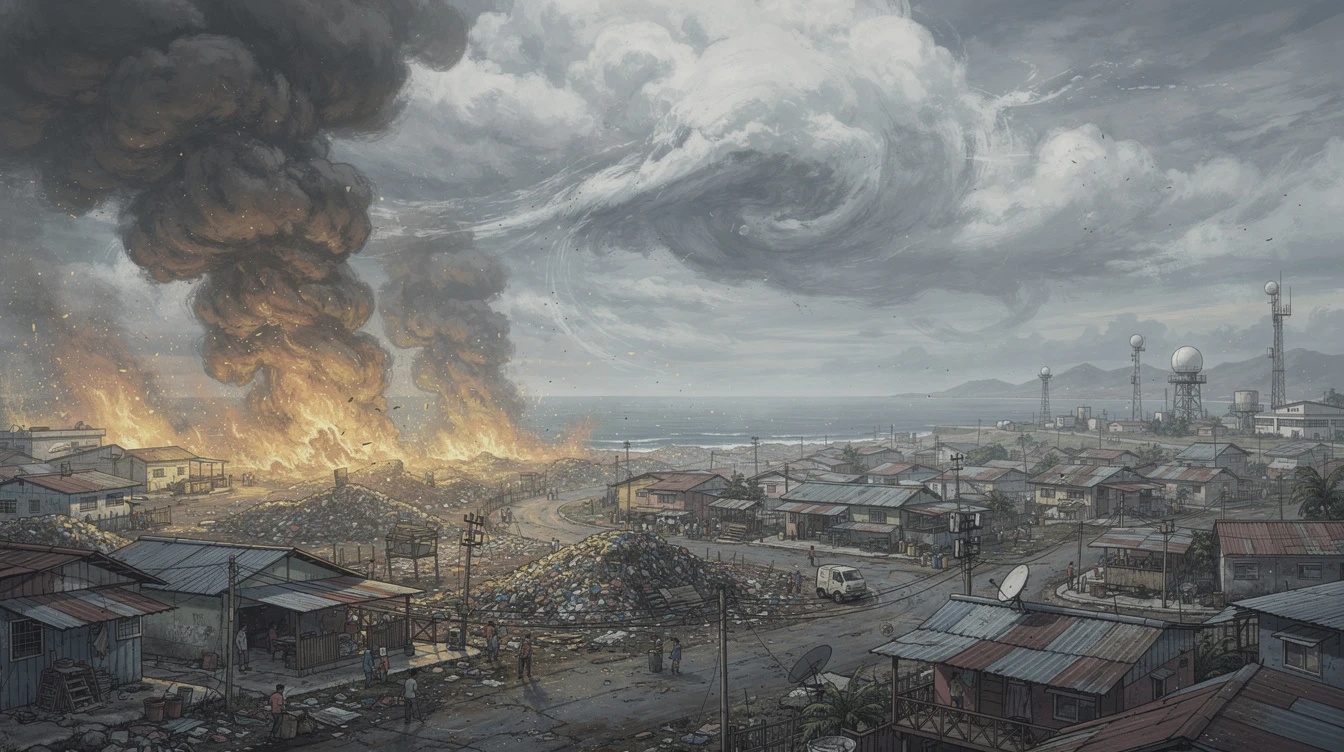
The Philippine Atmospheric, Geophysical and Astronomical Services Administration (PAGASA) has warned that the massive landfill fire in Navotas City can significantly affect local weather patterns, including potential shifts in rainfall and temperature in surrounding areas. The fire, which began on April 11, 2026, continues to generate thick plumes of smoke and particulate matter that could alter atmospheric conditions, according to PAGASA officials.
PAGASA weather specialist Rizza de Guzman told reporters on Wednesday that the smoke from the Navotas landfill fire, which has been burning for over 11 days, is dense enough to influence localized cloud formation and precipitation. "The massive release of heat and aerosols from the fire can create localized updrafts, potentially leading to isolated thunderstorms or changes in wind patterns," she explained.
As of April 22, 2026, the Department of Environment and Natural Resources (DENR) reported that air quality in Navotas and neighboring cities, including Malabon, Caloocan, and Valenzuela, has deteriorated to "unhealthy" levels. The DENR advised residents to wear face masks outdoors and limit prolonged exposure, especially for children and the elderly.
The Bureau of Fire Protection (BFP) continues to battle the blaze at the Navotas Controlled Dumping Facility, a 10-hectare landfill that has been burning since early April. BFP spokesperson Senior Fire Officer 3 Annalee Gonzales said on April 21 that the fire is now 70% contained but could take weeks to fully extinguish due to the depth of the burning garbage, which reaches up to 15 meters in some areas.
According to data from the Philippine Institute of Volcanology and Seismology (Phivolcs), the fire has not affected seismic activity, but PAGASA is monitoring how the smoke plumes interact with the prevailing easterly winds. As of 3:15 PM on April 22, winds were blowing from the east at 26.3 kilometers per hour, carrying smoke toward Bataan province, as confirmed by satellite imagery from the Department of Science and Technology (DOST).
Local government units in Navotas and nearby cities have declared a state of emergency. The Navotas City Health Office reported on April 21 that over 1,200 residents have sought medical treatment for respiratory issues, including asthma attacks and eye irritation, since the fire began. The city government has distributed N95 masks and set up temporary evacuation centers for families living within 500 meters of the landfill.
Environmental groups, including EcoWaste Coalition and Greenpeace Philippines, called for an expanded investigation into the fire's cause on April 20, ahead of Earth Day 2026. They cited a report from the Philippine Space Agency (PhilSA) showing that nitrogen dioxide levels spiked over Navotas on the morning of April 11, with elevated concentrations reaching as far as Bataan, some 80 kilometers away.
The Department of Health (DOH) issued a health advisory on April 19, urging residents in affected areas to stay indoors, close windows, and use air purifiers if available. "The toxic smoke contains harmful substances like carbon monoxide, sulfur dioxide, and fine particulate matter (PM2.5), which can penetrate deep into the lungs and cause long-term health damage," said DOH Undersecretary Dr. Maria Rosario Vergeire.
PAGASA's warning underscores the broader impact of the fire beyond health. The agency noted that the smoke could reduce solar radiation reaching the ground, potentially lowering daytime temperatures by 1 to 2 degrees Celsius in the immediate vicinity. However, the heat from the fire itself could raise local temperatures by up to 3 degrees Celsius at night, creating a "heat island" effect.
The National Disaster Risk Reduction and Management Council (NDRRMC) has deployed additional fire trucks and water tankers to assist the BFP. NDRRMC spokesperson Undersecretary Edgar Posadas said on April 22 that the government is coordinating with the private sector to donate firefighting foam and heavy equipment to accelerate containment.
For Filipino readers, the Navotas landfill fire is a stark reminder of the environmental and public health risks posed by unmanaged waste disposal in densely populated urban areas. The incident highlights the need for stricter enforcement of the Ecological Solid Waste Management Act and investments in sustainable waste-to-energy technologies. As the fire continues to burn, its effects on weather and health will be felt across Metro Manila and beyond, emphasizing the interconnectedness of local actions and regional consequences.