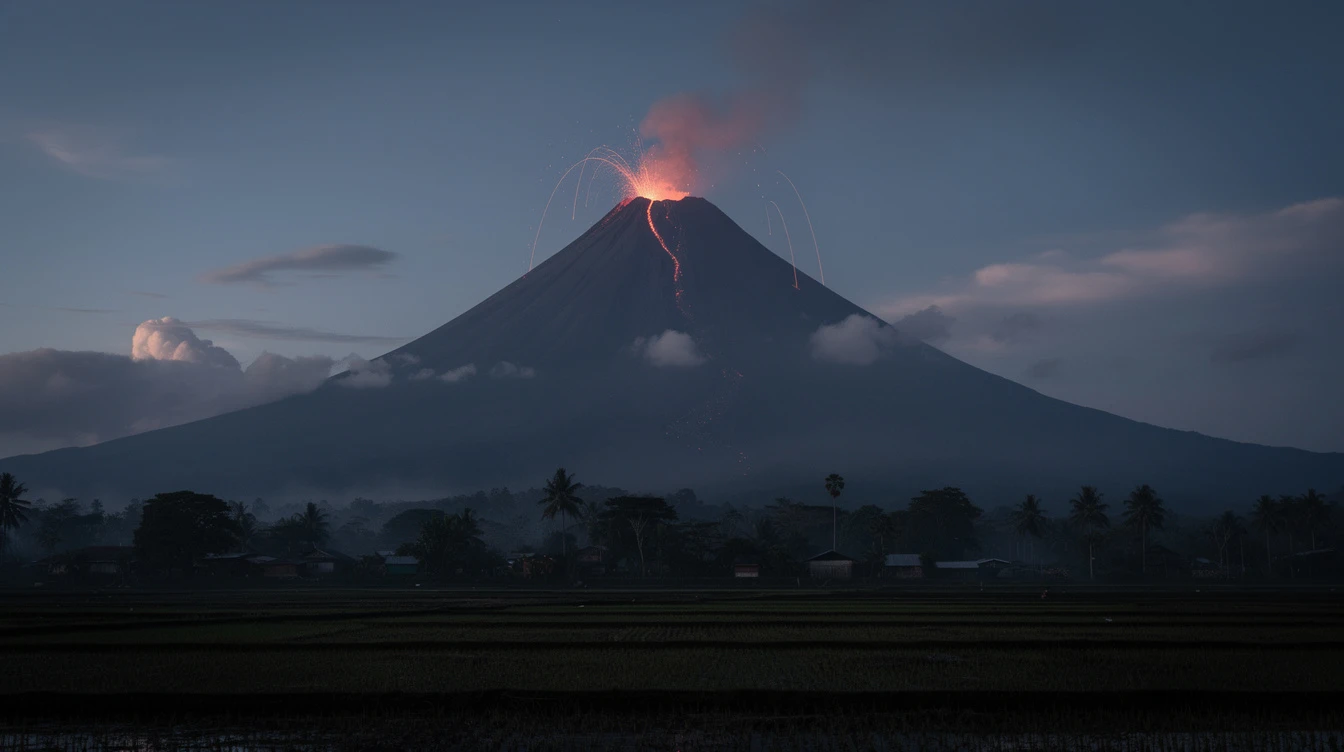
Mayon Volcano, the Philippines' most iconic and active volcano, has once again captured national attention. The Philippine Institute of Volcanology and Seismology (PHIVOLCS) confirmed minor Strombolian activity at its summit crater, sparking renewed vigilance.
This event, recorded in mid-April 2026, marks a significant shift in the volcano's behavior. For Albay residents, tourists, and disaster officials, understanding these developments is crucial for safety and preparedness.
Mayon
Strombolian activity refers to mild, explosive eruptions that throw lava fragments into the air. Named after Italy's Mount Stromboli, these events feature distinct bursts of incandescent material.
Unlike massive Plinian eruptions, Strombolian events are typically low-level. However, they can pose risks to those near the summit crater. PHIVOLCS uses this classification to describe Mayon's recent behavior.
PHIVOLCS detected the initial minor Strombolian activity at 10:40 AM on Friday. A second event followed at 12:38 AM the next day. These observations were made through dedicated monitoring cameras.
Volcano
Time-lapse footage captured at 05:20 AM and 05:28 AM another day showed similar bursts. The agency later released a close-up video at 08:17 PM on April 16, 2026, documenting the event in vivid detail.
PHIVOLCS has maintained a neutral stance, emphasizing that these are minor events. The agency continues to monitor ground deformation, sulfur dioxide emissions, and seismic activity around Mayon.
In its advisory, PHIVOLCS reminded the public to avoid the 6-kilometer Permanent Danger Zone (PDZ). This buffer zone exists precisely to shield communities from sudden volcanic hazards.
Albay province, home to Mayon, relies heavily on tourism. The volcano's perfect cone draws thousands of visitors yearly. Strombolian activity may alter access to popular sites like Cagsawa Ruins and Mayon Skyline.
Local government units (LGUs) have activated their disaster response teams. Residents near the PDZ are advised to stay alert. Schools and businesses in nearby towns remain open, but readiness protocols are in place.
Mayon is the Philippines' most active volcano, with over 50 eruptions in recorded history. The deadliest occurred in 1814, which buried Cagsawa town. More recent eruptions in 2018 and 2023 forced mass evacuations.
These past events underscore the importance of PHIVOLCS' vigilant monitoring. Even minor Strombolian activity can be a precursor to larger unrest. The agency's data informs life-saving decisions.
Volcanologists interpret Strombolian activity as a sign of molten rock rising within the conduit. This process involves gas-rich magma decompressing rapidly at the surface.
Dr. Teresito Bacolcol, PHIVOLCS Director, stated that such activity is "not unusual" for Mayon. He added that continuous monitoring helps assess whether the volcano is transitioning to a more explosive phase.
Independent experts, including Dr. Renato Solidum of the University of the Philippines, have stressed that Strombolian events require careful observation. They recommend that local communities review their evacuation plans.
For residents of Legazpi City and surrounding towns, the key message is to remain calm but prepared. PHIVOLCS advises against climbing the volcano or entering the PDZ.
Tourists planning to visit Albay should check updates from PHIVOLCS and local authorities. Some trails and viewing platforms may be temporarily closed due to the heightened risk.
The Department of Tourism (DOT) coordinates with LGUs to ensure visitor safety. If conditions worsen, a full tourism lockdown could be implemented to prevent accidents.
As Mayon continues to exhibit minor Strombolian activity, PHIVOLCS will likely issue more detailed bulletins. The alert level currently remains at Level 1 (Abnormal), but this could be raised if unrest intensifies.
The public is encouraged to monitor official PHIVOLCS social media channels for real-time updates. Community preparedness drills and information campaigns are expected in high-risk barangays.
While there is no immediate cause for panic, the situation demands respect for nature's power. Mayon's beauty belies its potential danger. Awareness and action are the best defenses.
Minor Strombolian activity at Mayon Volcano serves as a timely reminder of living alongside an active volcano. PHIVOLCS' swift detection and transparent reporting empower citizens to make informed choices.
Albay's resilience has been tested before. With continued vigilance, scientific expertise, and community cooperation, the region can weather this volcanic episode just as it has many times before.
For more updates, stay connected with PinoyPulse's volcano news section and learn about the Philippines' disaster preparedness.
External resources include thePHIVOLCS official website and theNDRRMC for real-time emergency guidelines.
It refers to low-level explosive bursts throwing molten lava fragments into the air from the summit crater. It is less dangerous than larger eruptions but requires caution.
Tourists are advised to avoid entering the 6-km Permanent Danger Zone. Check PHIVOLCS updates before planning trips to Albay.
Awakens:
Possibly, but not guaranteed. PHIVOLCS continues to monitor warning signs like ground deformation and gas emissions. Current alert level is 1.
Follow PHIVOLCS on Facebook, X (Twitter), and their official website. PinoyPulse also provides summarized news.