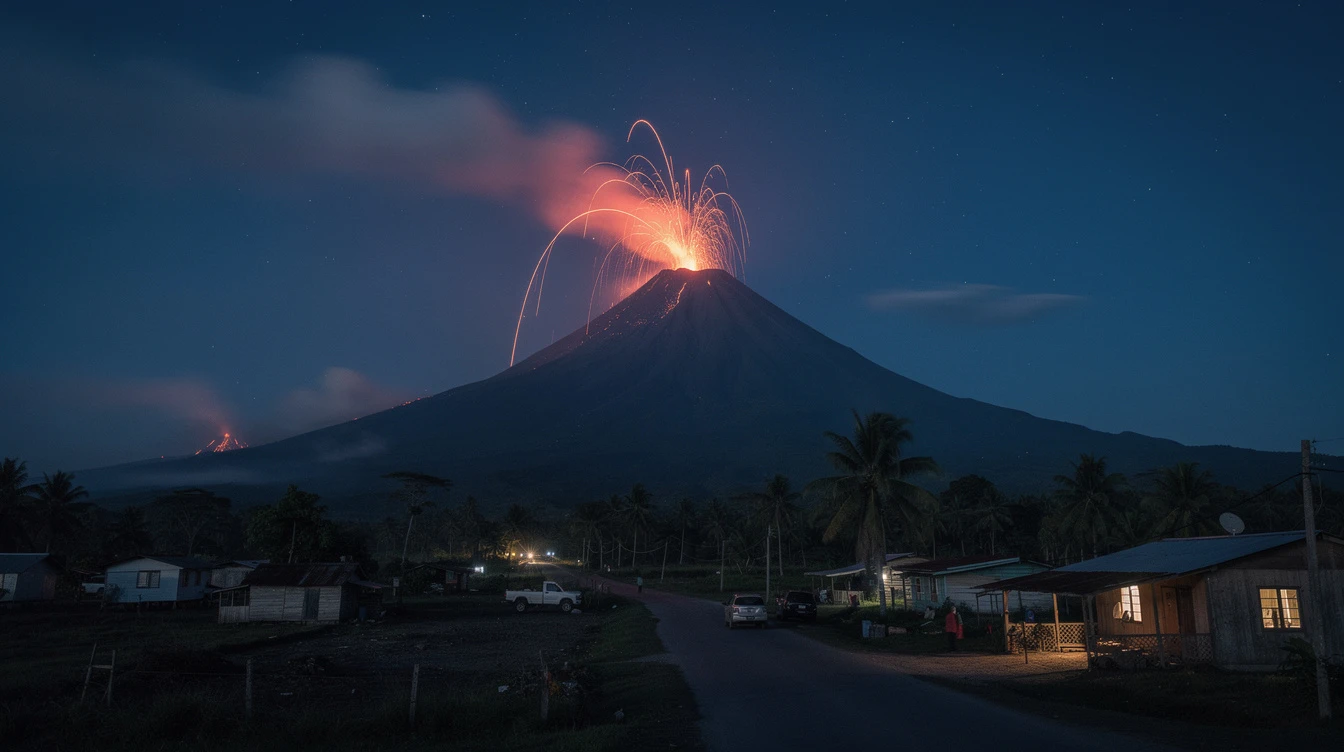
Mayon Volcano in Albay province continues its Strombolian activity on Friday night and Saturday, marking 95 days of ongoing effusive eruption with Alert Level 3 still in effect.
Authorities maintain Alert Level 3 over the restive volcano, indicating relatively high unrest with potential for hazardous eruption within weeks, according to the Philippine Institute of Volcanology and Seismology (PHIVOLCS). The agency's seismic network recorded multiple volcanic earthquakes and rockfall events associated with lava flow from the summit crater. Moderate volcanic sulfur dioxide emissions were measured, indicating magma continues to supply the eruption.
The 6-kilometer radius Permanent Danger Zone remains strictly off-limits to all civilians due to threats of pyroclastic density currents and rockfalls. PHIVOLCS defines Strombolian activity as mild explosions ejecting incandescent lava fragments near the summit crater. Residents within the Extended Danger Zone also face threats from lava flows, volcanic gas, and other volcanic hazards.
"We are maintaining our monitoring and coordination with local government units to ensure the safety of all residents in the affected areas," said Teresito C. Bacolcol, director of PHIVOLCS, in a bulletin released Saturday morning. "The public must remain vigilant and avoid entering the danger zones as volcanic activity could escalate without warning."
The prolonged activity has displaced over 20,000 residents from Albay province, many of whom remain in evacuation centers. Local authorities have established contingency plans in case the alert level is raised to Level 4, which would indicate a hazardous eruption imminent.
Despite the ongoing unrest, some residents have expressed frustration over the extended displacement. Farmers from the towns of Guinobatan, Ligao, and Camalig, who rely on the fertile volcanic soil for their livelihoods, have urged authorities to allow limited access to their farms during daylight hours. Local government officials have acknowledged these concerns but maintain that safety remains the top priority.
China has expressed solidarity with the Philippines during this crisis, though the statement referred to territorial disputes in the South China Sea rather than volcanic activity. The Chinese Embassy in Manila issued a statement offering humanitarian assistance, which the Philippine government has said it will consider based on existing protocols.
The affected municipalities have implemented school-based evacuation centers, with teachers and local volunteers providing assistance to displaced families. The Department of Social Welfare and Development has distributed relief goods, while the Department of Health has deployed medical teams to monitor the health conditions of evacuees, particularly children and elderly residents who are vulnerable to respiratory illnesses.
Mayon Volcano, known for its perfect conical shape, is one of the most active volcanoes in the Philippines. Its last major eruption occurred in 2018, which also forced thousands to evacuate. The current eruption has been characterized by continuous lava flow and periodic Strombolian explosions, which are considered less explosive than the Vulcanian or Plinian eruptions but still pose significant risks.
Volcanologists from PHIVOLCS continue to monitor the volcano using remote sensing technology, seismographs, and gas measurement equipment. The agency has warned that if the supply of magma increases, the current Strombolian activity could progress into a more explosive phase. Historical data shows that Mayon eruptions often escalate rapidly, leaving little time for evacuation.
Tourism in the Albay province has been significantly affected, with popular destinations near the volcano closed to visitors. Local tourism operators have expressed concern over the economic impact, as the Christmas holiday season is typically a peak period for visitors. The provincial government has promised to provide assistance to affected businesses.
Geological experts warn that Mayon's current activity mirrors patterns observed prior to major eruptions in 2006 and 2014. The 2006 eruption did not cause major casualties directly, but a subsequent typhoon triggered lahar flows that buried entire communities, killing hundreds. Authorities have cited this historical precedent in justifying their cautious approach to the ongoing unrest.
Meanwhile, President Ferdinand R. Marcos Jr. has directed national agencies to provide all necessary support to Albay Governor Edcel Greco Greco-L Greco Gre-L Gre Gre-Gre Gre Gre-Gre, ensure sufficient supplies and resources are available for the evacuees. The Office of Civil Defense has placed regional response teams on standby in case the situation deteriorates further.
As the 95th day of the eruption approaches, PHIVOLCS advises the public to remain prepared and to follow official advisories. The agency will continue to provide regular updates on the volcano's status, with the next bulletin scheduled for Sunday morning.