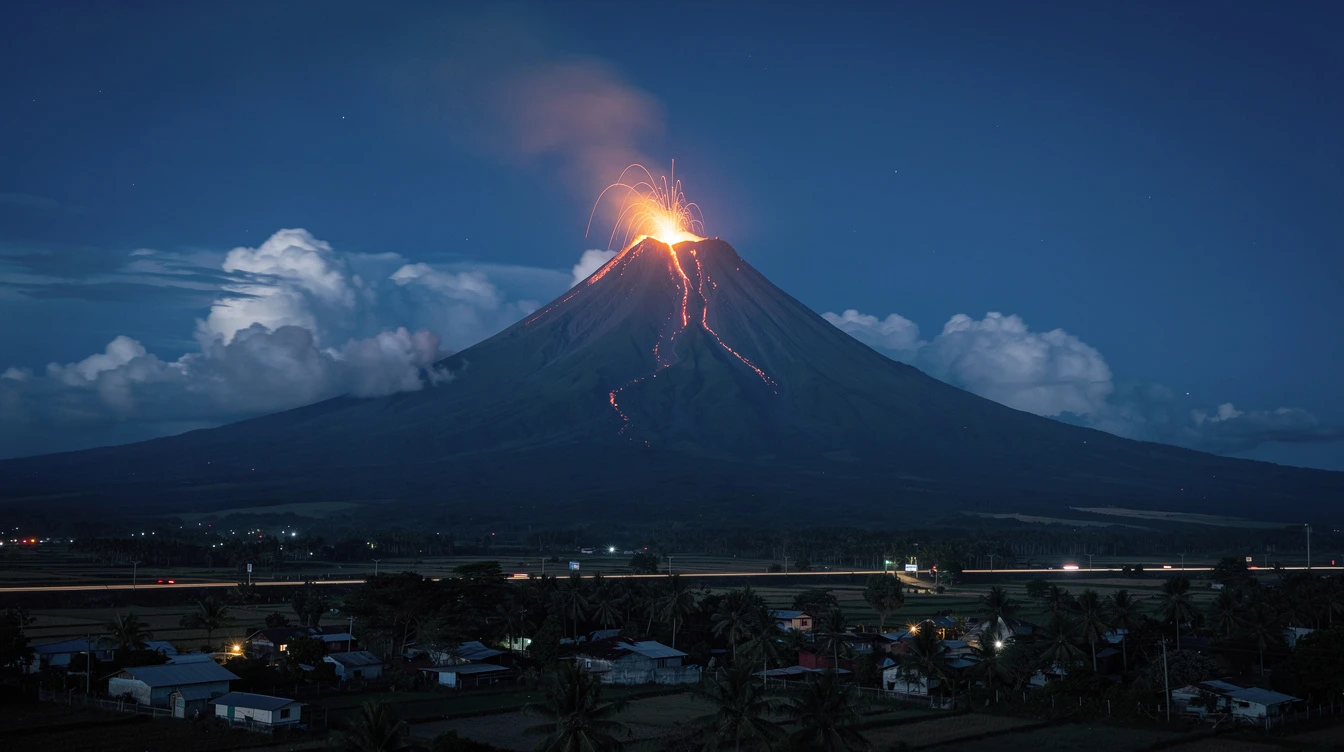
State volcanologists recorded minor Strombolian activity at Mayon Volcano's summit crater at 6:53 p.m. on Monday, April 13, marking the 100th day of its ongoing effusive eruption that began in early 2025.
The Philippine Institute of Volcanology and Seismology said the event involved short-lived lava fountaining, a characteristic Strombolian explosion where gas bubbles burst at the volcano's surface. The activity was captured by the agency's monitoring network in Albay province, approximately 500 kilometers southeast of Manila.
"Lava effusion from the summit crater continues to feed flows advancing on the Mi-isi and Bonga Gullies," PHIVOLCS stated in its latest bulletin. "These lava flows have extended approximately 3.4 kilometers from the crater."
PHIVOLCS maintained Alert Level 3 over Mayon Volcano, indicating a "critical level" with increased tendency towards hazardous eruption. The six-kilometer radius Permanent Danger Zone remains strictly off-limits to all civilians.
The provincial government of Albay and national disaster agencies continue coordinated monitoring efforts. Local officials have urged residents to remain vigilant and comply with evacuation orders in high-risk areas.
Over 18,000 residents from Albay's cities and municipalities remain in evacuation centers. The prolonged displacement has significantly affected agriculture and livelihoods across the province, where many families depend on farming and related industries.
The current eruption began in January 2025, following a period of increased unrest in late 2024. PHIVOLCS has documented similar Strombolian episodes throughout the eruption, though Monday's event occurred on a notable milestone for the volcano's ongoing activity.
Authorities continue to prepare for potential escalation as Mayon maintains its elevated alert status. Emergency response teams remain on standby while community support operations continue for displaced families.