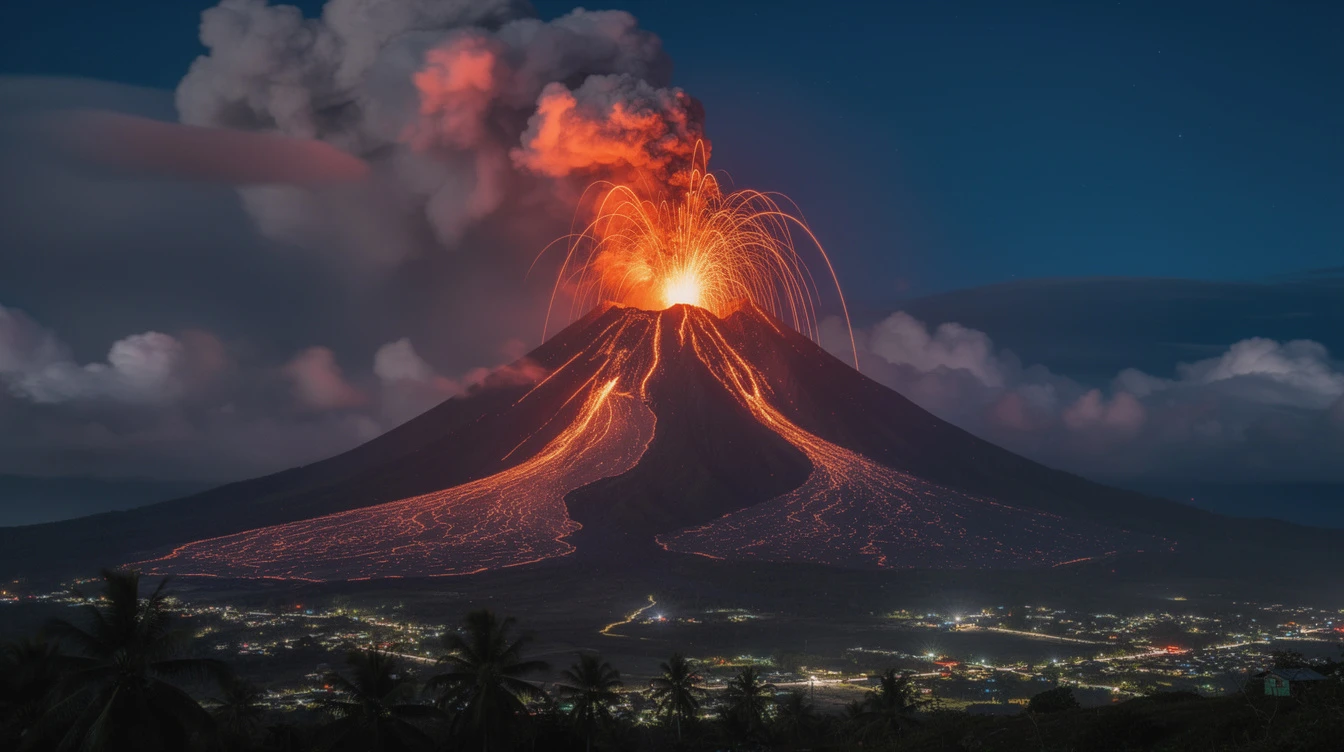
The Philippine Institute of Volcanology and Seismology recorded short-lived lava fountaining at Mayon Volcano's summit crater at 6:46 AM on April 11, marking the 95th consecutive day of its ongoing effusive eruption. The phenomenon, rising approximately 30 meters above the crater, was captured by the Mayon Volcano Observatory and PHIVOLCS Quick Response Team. Minor Strombolian activity followed at 12:45 PM on the same day.
Timeline of Mayon Volcano's April 11 Activity
PHIVOLCS released time-lapse footage documenting the latest volcanic events, showing the brief but intense lava fountaining episode. The agency confirmed the events through its official social media bulletin, providing visual documentation for public monitoring and awareness.
"Effusive eruption at Mayon Volcano continues," stated PHIVOLCS in its official social media bulletin.
The eruption continues to produce incandescent lava flows and pyroclastic density currents locally known as "uson." Frequent rockfalls accompany the sustained volcanic activity. PHIVOLCS emphasized its commitment to monitoring and coordination with local authorities.
"We remain vigilant in monitoring the volcano's activity and coordinating with local authorities to ensure public safety," PHIVOLCS said in its advisory.
Despite the continuous volcanic unrest, PHIVOLCS noted that current conditions do not indicate an imminent hazardous eruption. However, the agency maintains its alert level assessment based on ongoing monitoring data and field observations. The scientific community continues to analyze magma movement and gas emissions to refine eruption predictions.
Local authorities in Albay province have maintained preparedness measures. Governor Felix Imperial said the provincial government remains ready to respond if activity intensifies further. He added that evacuation centers are on standby and local disaster response teams are fully activated.
"We continue to urge residents within the permanent danger zone to remain vigilant and follow official advisories," Governor Imperial stated in a press briefing.
The 6-kilometer Permanent Danger Zone surrounding the volcano remains strictly prohibited for entry. This restriction applies to all residents of Albay province and tourists visiting the area. Local disaster management officials have reported compliance among communities near the danger zone boundaries.
Residents outside the immediate danger zone expressed mixed reactions to the ongoing eruption. Some local business owners, particularly in the tourism sector, said the prolonged alert level has affected their livelihoods. However, most community members prioritized safety over economic concerns, officials noted.
Mayon Volcano, standing at 2,463 meters, is the most active volcano in the Philippines. It has erupted numerous times in recorded history, with the most destructive occurring in 1814, causing over 1,200 deaths. The current eruption phase began in late 2023, prompting PHIVOLCS to raise the alert level incrementally.
Background: Mayon's History of Restlessness
Mayon Volcano has erupted 52 times in recorded history, making it the most active in the country. Its most catastrophic eruption occurred in February 1814, when lava buried the town of Cagsawa and killed approximately 1,200 people. The iconic belfry of the Cagsawa church, partially buried in volcanic debris, remains a tourist attraction and stark reminder of the mountain's deadly potential. The current eruption phase began in late 2023, with PHIVOLCS raising the alert level progressively as volcanic activity intensified.
PHIVOLCS maintains 24-hour monitoring through a network of seismic stations, telescopic cameras, and gas measurement equipment around the volcano. Scientists regularly conduct aerial surveys and ground deformation measurements to track changes in the volcanic system. The agency releases daily advisories during periods of heightened activity.
Tourism operators in Albay have adapted to the ongoing situation. Some establishments continue to operate in areas outside the danger zone, offering viewing points for visitors who wish to observe the volcano from safe distances. Local officials said they balance economic considerations with public safety requirements.
Experts warn that Alert Level 3 means magma is close to the surface and hazardous eruption remains possible. They advise the public to avoid the danger zone and prepare for possible evacuation. PHIVOLCS continues to share real-time updates through its website and social media channels.