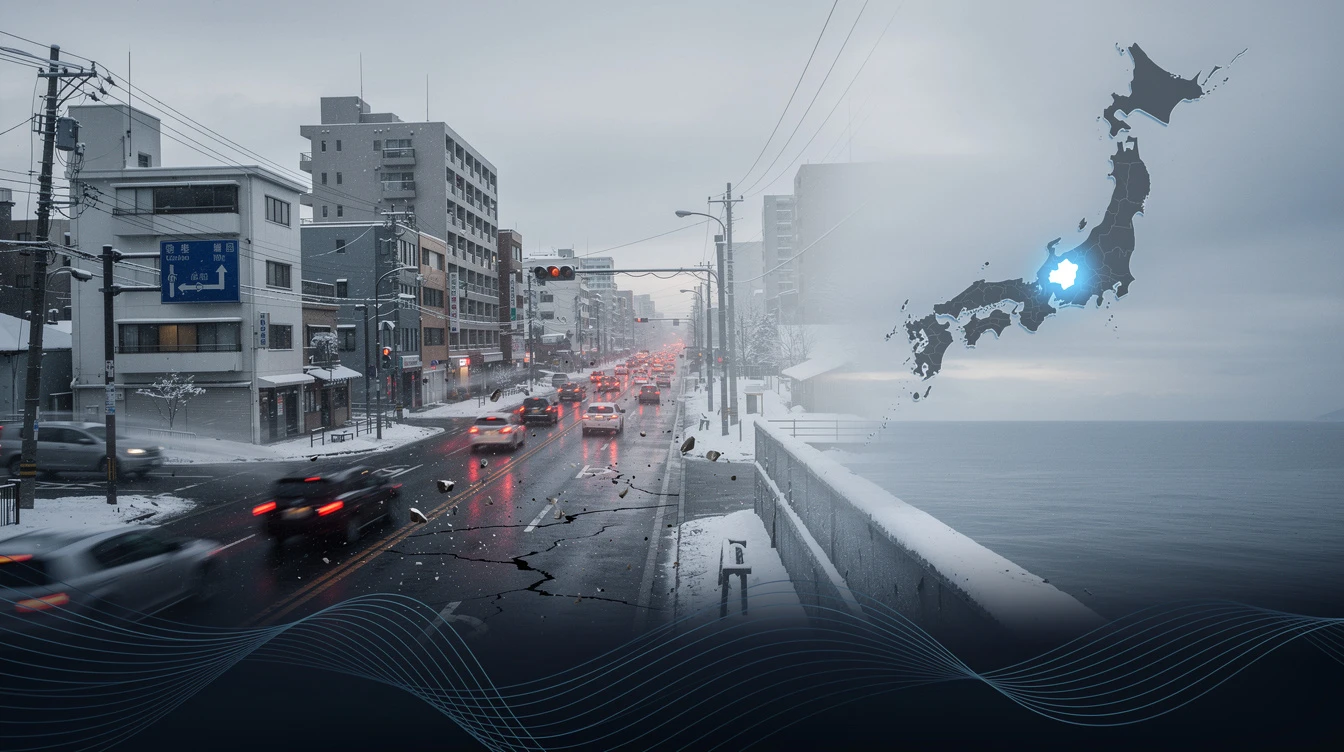
A magnitude 6.1 earthquake struck off the coast of Hokkaido, Japan on Sunday, June 21, 2025, according to the German Research Centre for Geosciences (GFZ). The quake occurred at a shallow depth, triggering immediate concerns across the Pacific. However, Philippine authorities have quickly assured the public that there is no tsunami threat to the country.
This event serves as a stark reminder of the region's seismic activity. For Filipinos, it is a call to remain vigilant about disaster preparedness.
Magnitude
The GFZ reported that the earthquake hit at 2023 GMT on Sunday, corresponding to early Monday morning in Japan. The epicenter was located offshore, east of Hokkaido's main island.
Initial readings put the magnitude at 6.1, though some agencies reported it slightly lower at 6.0. The depth was estimated at 10 kilometers (6.2 miles), making it a shallow temblor.
Shallow earthquakes are often felt more intensely near the epicenter. No immediate reports of casualties or major damage have been released by Japanese authorities as of press time.
Earthquake
The Philippine Institute of Volcanology and Seismology (Phivolcs) quickly issued a bulletin. According to their statement, the earthquake did not generate a destructive tsunami that would affect the Philippine coastlines.
Phivolcs Director Teresito Bacolcol told reporters that monitoring systems showed no significant sea level changes. "We are not issuing a tsunami warning for the Philippines," he said in a statement.
The agency reminded the public to rely only on official advisories. This quick response highlights the improved coordination between Phivolcs and international monitoring networks like the Pacific Tsunami Warning Center (PTWC).
Japan and the Philippines sit along the Pacific Ring of Fire . This is a horseshoe-shaped zone of intense seismic and volcanic activity. Both nations experience frequent earthquakes.
When a large quake hits Japan, Filipinos often worry about tsunamis. The distance from Hokkaido to the Philippines is roughly 3,000 kilometers . In 2011, a magnitude 9.0 earthquake off Honshu, Japan, sent waves across the Pacific.
That event prompted the Philippines to strengthen its own tsunami warning systems. Today, Phivolcs operates over 100 seismic stations and 80 tsunami detection buoys nationwide.
Seismologist Dr. Renato Solidum Jr., former director of Phivolcs, emphasized the importance of readiness. "Every big earthquake in the Pacific is a lesson for us," he said in a past interview.
He noted that Filipinos living in coastal areas should always know evacuation routes. "Even if no tsunami is forecast, practice drills save lives," Solidum added.
Japan's strict building codes and early warning systems minimized damage from Sunday's quake. These standards are benchmarks for developing nations like the Philippines.
For overseas Filipino workers (OFWs) in Japan, the quake caused anxiety. Many Filipino residents in Hokkaido reported feeling moderate shaking but no injuries.
The Philippine Embassy in Tokyo has not issued any emergency advisory. They encourage OFWs to register with the Department of Foreign Affairs (DFA) for real-time alerts.
Back home, social media buzzed with questions about tsunami risks. Phivolcs' prompt announcement helped curb misinformation, a common issue during natural disasters.
Japanese authorities are monitoring aftershocks. The Japan Meteorological Agency (JMA) reported no abnormalities at nuclear power plants in the region.
Scientists say the Pacific Ring of Fire remains active. The GFZ recorded at least 20 aftershocks within 24 hours of the main event, most below magnitude 4.0.
For the Philippines, this event reinforces the need for continuous investment in geohazard mapping and public education. Phivolcs is currently upgrading its tsunami simulation models.
The magnitude 6.1 Hokkaido earthquake was a powerful reminder of nature's force. While the Philippines is safe this time, the event underscores the reality of living in a seismically active region.
Strikes
Filipinos must remain vigilant. Always follow updates from Phivolcs and local government units. Preparedness is not optional—it is a shared responsibility.
For more guides on how to prepare for earthquakes and tsunamis, explore our related articles below.