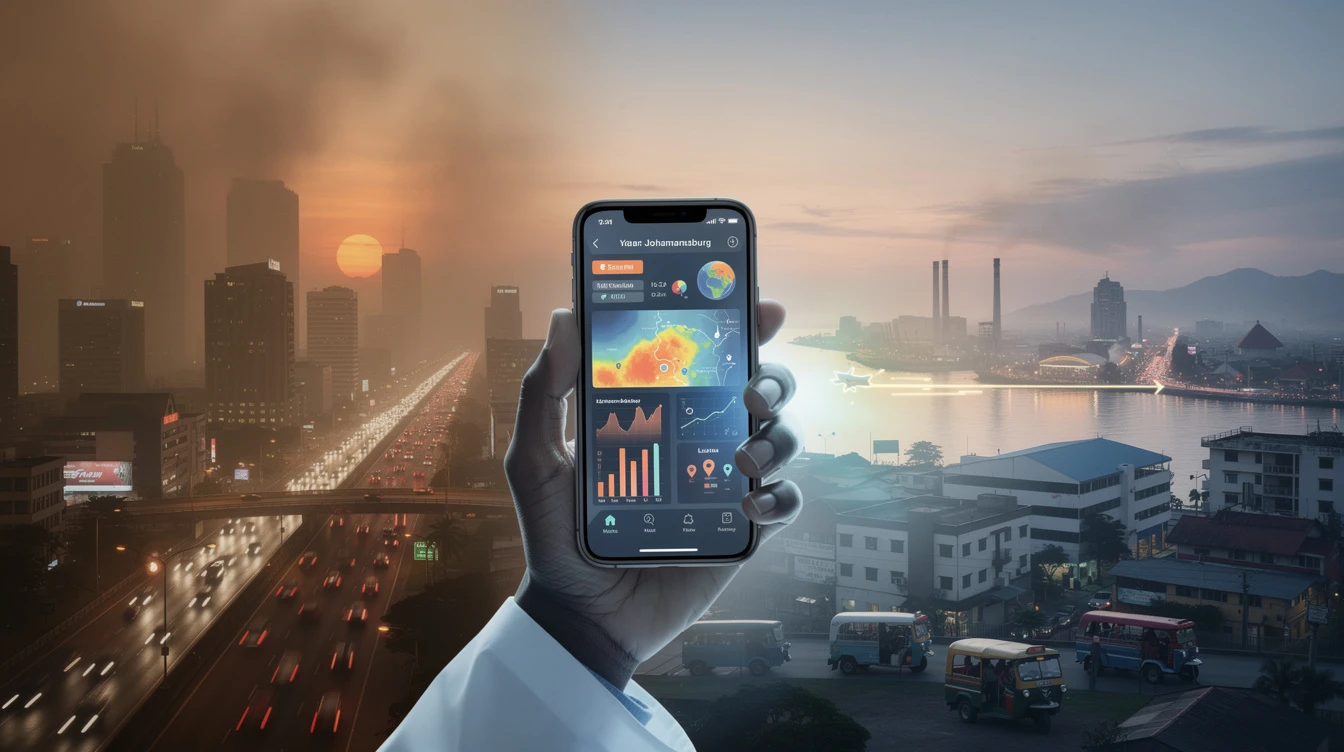
On a smoggy morning in Johannesburg , residents check their phones not just for weather, but for a new kind of warning: how much coal pollution they are breathing. Scientists at the University of the Witwatersrand have launched South Africa's first mobile app to alert citizens about dangerous air quality.
The app, developed by Wits University researchers, provides real-time pollution data as coal-fired power stations and industrial plants send plumes of PM2.5 and sulfur dioxide across the city. Johannesburg sits at the heart of South Africa's coal belt, where 80% of electricity comes from coal.
Chokes
This development strikes a familiar chord in the Philippines. Metro Manila's air quality regularly exceeds World Health Organization safe limits, driven by coal plants in Batangas and Navotas, plus 3.5 million vehicles. Could a similar pollution warning app work in the Philippines?
Johannesburg has seen a sharp spike in coal emissions in recent months. According to environmental group GroundWork , particulate matter levels have exceeded safe limits by 400% on some days. Children and elderly residents are most at risk.
The new app, called "AirAlert", uses data from a network of low-cost sensors and government monitoring stations. It sends notifications when pollution reaches dangerous levels, advising residents to stay indoors or wear masks.
Johannesburg,
The AirAlert app is free and available on both Android and iOS. It shows a color-coded map: green for good air, red for hazardous. Users can check their street-level air quality in real time.
Dr. Thabo Mokoena , the lead researcher at Wits, told Reuters that the app has already shown positive results. "People are changing their behavior. They close windows on bad days, they use public transport less when pollution is high," he said.
The Philippines is no stranger to coal pollution. Metro Manila has 17 operational coal-fired power plants within a 100-kilometer radius. The Department of Environment and Natural Resources recorded an average PM2.5 level of 25 micrograms per cubic meter in 2025 — five times the WHO guideline.
Local activists have long pushed for a similar alert system. In 2024, Greenpeace Philippines launched a pilot air quality monitoring project in Quezon City , but it lacked government backing and sustained funding.
Air pollution costs the Philippine economy an estimated $2.5 billion annually in healthcare and lost productivity, according to the World Bank . Lung cancer and chronic obstructive pulmonary disease rates are rising.
Dr. Maria Lourdes Ramos , a pulmonologist at the Philippine General Hospital , says, "Every shift in the wind from the coal plants in Batangas brings a wave of respiratory cases. A real-time warning app would give patients time to protect themselves."
Building a pollution alert app in the Philippines faces three main hurdles. First, funding . Johannesburg's app cost about $500,000 in grants from the European Union and local philanthropists. Second, data infrastructure . The Philippines has only 33 official air quality monitoring stations for 110 million people.
Third, political will . Coal mining and power generation are deeply embedded in the Philippine economy. The Department of Energy reports that coal still accounts for 45% of the country's electricity.
Some Filipino startups are already trying. AIRPH , a local tech company, launched a beta version of a pollution app in 2025, but coverage is limited to Makati and BGC. The app uses satellite data and crowd-sourced sensor readings.
Read more aboutenvironment news and climate solutions on PinoyPulse.
Dr. Jane Cabrera , an environmental engineer at the University of the Philippines , says, "South Africa shows it can be done at a reasonable cost. But the Philippine government needs to prioritize public health over coal profits."
Meanwhile, the Philippine Chamber of Coal Mines argues that coal remains vital for industrial growth. "We are investing in clean coal technology," a spokesperson said. Critics say that "clean coal" is a myth.
Early data from the Wits app shows that 30% of users have changed their daily routines on high-pollution days. School closures in heavily polluted areas have reduced asthma attacks by 18% among children.
The app also creates a citizen-generated data trail that environmental groups can use to pressure policymakers. GroundWork has used app data to file two lawsuits against coal plant operators in South Africa.
Learn more aboutour mission at PinoyPulse to bring global lessons to Filipino readers.
Johannesburg's pollution app is a small but significant step in the fight against coal emissions. It empowers ordinary citizens with information they can act on. The Philippines, with its dense population and heavy reliance on coal, could benefit enormously from a similar tool.
The future of air quality management lies in real-time data , public awareness , and accountability . As coal continues to choke cities from Johannesburg to Manila, the demand for transparency will only grow. The question is whether Philippine leaders will take the cue or wait until the smog forces their hand.
Is there a pollution warning app in the Philippines? Yes, but it is limited. AIRPH covers only parts of Metro Manila. No nationwide government-backed app exists yet.
How bad is air pollution in Metro Manila? The average PM2.5 level in 2025 was 25 µg/m³, five times the WHO safe limit. Over 6,000 premature deaths annually are linked to air pollution.
South
What can I do to protect myself from pollution? Check local air quality websites, wear an N95 mask when AQI exceeds 100, keep windows closed on high-pollution days, and use air purifiers indoors.
For more related stories, explorePhilippine politics and policy debates.