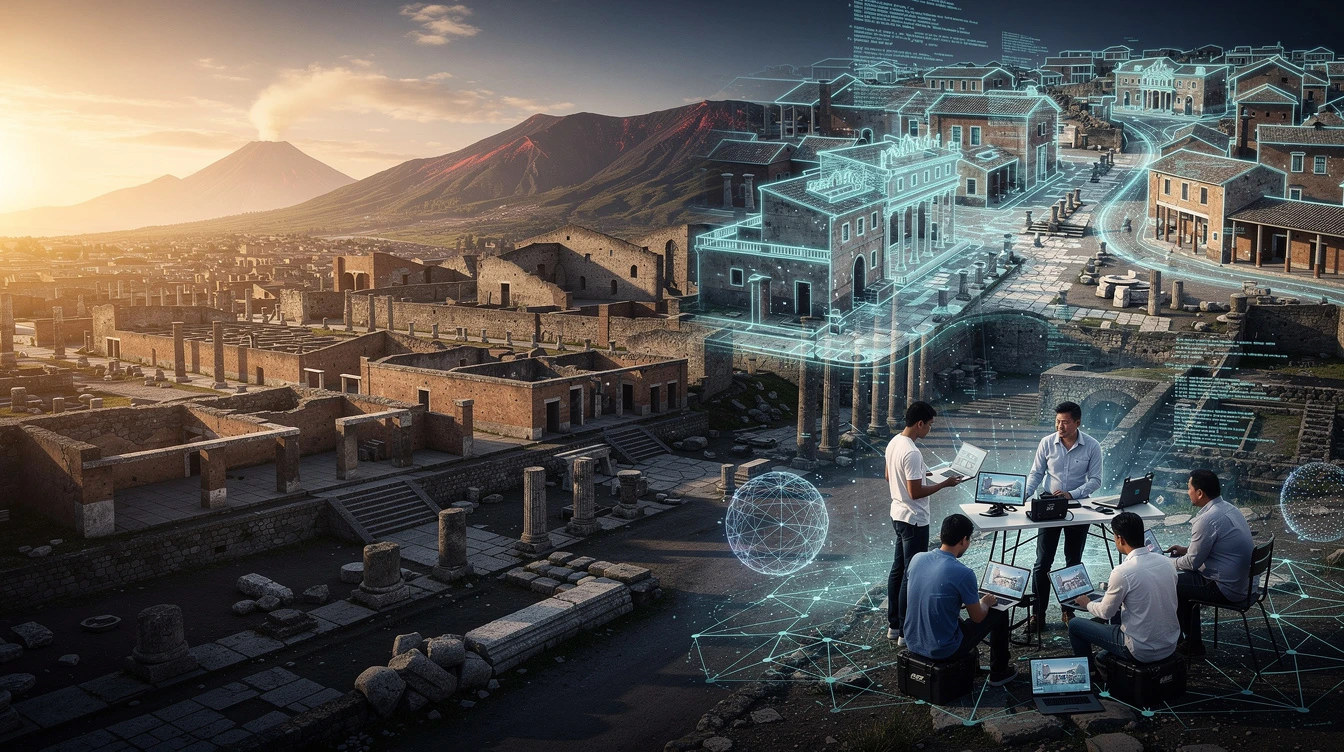
ROME — For the first time, archaeologists have used artificial intelligence to reconstruct the appearance of a victim from the volcanic eruption that destroyed Pompeii nearly 2,000 years ago. The image, released by the Pompeii Archaeological Park on Monday, shows a man ducking for cover while holding a large bowl over his head, with a flaming Mount Vesuvius in the background.
This breakthrough merges archaeology with modern technology, sparking conversations far beyond Italy. In the Philippines, where tech innovation is rapidly growing, experts are taking notice.
How AI Recreated the Past
The AI-generated image is based on the recent discovery of the remains of a male adult, just outside one of the southern gates of the city. The remains were lying next to a terracotta mortar that he presumably used as protection. Archaeologists believe the man was killed by a shower of volcanic rocks in the early hours of the second day of the eruption, while trying to escape toward the sea.
According to Gabriel Zuchtriegel, head of the archaeological park, "If used well, artificial intelligence can contribute to a renewal of classical studies, illustrating the classical world in a more immersive way."
The man also carried a lamp and 10 bronze coins, according to park officials. These details helped the AI model his final moments with unprecedented accuracy.
Significance of the Discovery
Pompeii was buried under ash and pumice when Mount Vesuvius erupted in 79 AD. Thousands died, but their remains were preserved in volcanic material. Over centuries, archaeologists have uncovered casts of victims, but this is the first time AI has been used to recreate a living image.
The application of AI in archaeology is a game-changer. It allows researchers to visualize historical figures in a way that traditional methods cannot. For Filipinos, this opens up possibilities for local heritage preservation.
In the Philippines, many archaeological sites remain unexplored. AI could help reconstruct the appearance of ancient Filipinos, such as those from the Tabon Caves or the Manunggul Jar era.
What Filipino Tech Experts Say
Dr. Maria Lourdes Santos, a Filipino archaeologist based in Manila, told PinoyPulse that the Pompeii AI reconstruction is a "milestone." She said, "This shows how technology can bridge gaps in historical understanding. We have similar opportunities here."
Jose Rizal Tech University professor Carlos Mendoza added, "AI can help us analyze artifacts faster and more accurately. The Philippines should invest in such tools for our own museums."
Local tech startups are also watching closely.AI Philippines, a group advocating for AI in various fields, noted that this development aligns with global trends. "We can adapt these methods to study our own pre-colonial history," said group founder Ana Reyes.
Implications for Philippine Heritage
The Philippines is home to rich historical sites, including the Rice Terraces of the Philippine Cordilleras and the Baroque Churches. AI could help reconstruct how these structures looked centuries ago.
Moreover, AI could assist in preserving artifacts threatened by climate change and urbanization. For instance, the Banaue Rice Terraces are slowly eroding, and digital reconstructions could aid restoration efforts.
National Museum of the Philippines director Jeremy Barns previously stated interest in using technology for heritage work. The Pompeii example could accelerate those plans.
Real-World Impact on Education
In classrooms, AI-generated images could make history lessons more engaging. Filipino students often struggle to visualize ancient events. With tools like this, teachers can bring the past to life.
"Imagine showing students a realistic depiction of a Kris sword wielder from the Moro resistance," said History teacher Lia Fernandez. "It would transform learning."
Several Philippine universities are already incorporating AI into their curricula. The Pompeii discovery could inspire more interdisciplinary projects between archaeology and computer science departments.
Ethical Considerations
While AI offers exciting possibilities, experts urge caution.Dr. Santos warned, "AI reconstructions are only as good as the data fed into them. If the data is incomplete or biased, the results may be misleading."
In the Philippines, where historical records are sometimes sparse, this is a critical concern. Researchers must ensure that AI does not create fictional narratives rather than accurate depictions.
Zuchtriegel himself emphasized responsible use: "AI can renew classical studies, but only if used well."
Future Outlook
The Pompeii AI reconstruction marks a new era in archaeology. As technology advances, more discoveries will likely follow. For the Philippines, this presents a chance to leapfrog in heritage preservation.
Local researchers are already exploring partnerships with international institutions. The University of the Philippines is reportedly in talks with Italian archaeologists to learn from their methods.
PinoyPulse will continue to track how this technology evolves and its impact on Philippine history. For now, the image of a man fleeing Vesuvius serves as a powerful reminder of how AI can connect us to the past.
Internal Links:
Learn more aboutPinoyPulse and stay updated ontechnology news. Check out our articles onAI in Philippine Archaeology andHow Tech Preserves Heritage.
External Links: Read the original report fromThe Straits Times and more fromGlobal Banking and Finance.