The United States has said it would not deliberately target a school after Iranian authorities accused American and Israeli forces of killing more than 160 people, most of them children, in an airstrike on an elementary school in southern Iran. The allegation, if confirmed, would mark one of the deadliest single incidents involving civilians since the current hostilities began.
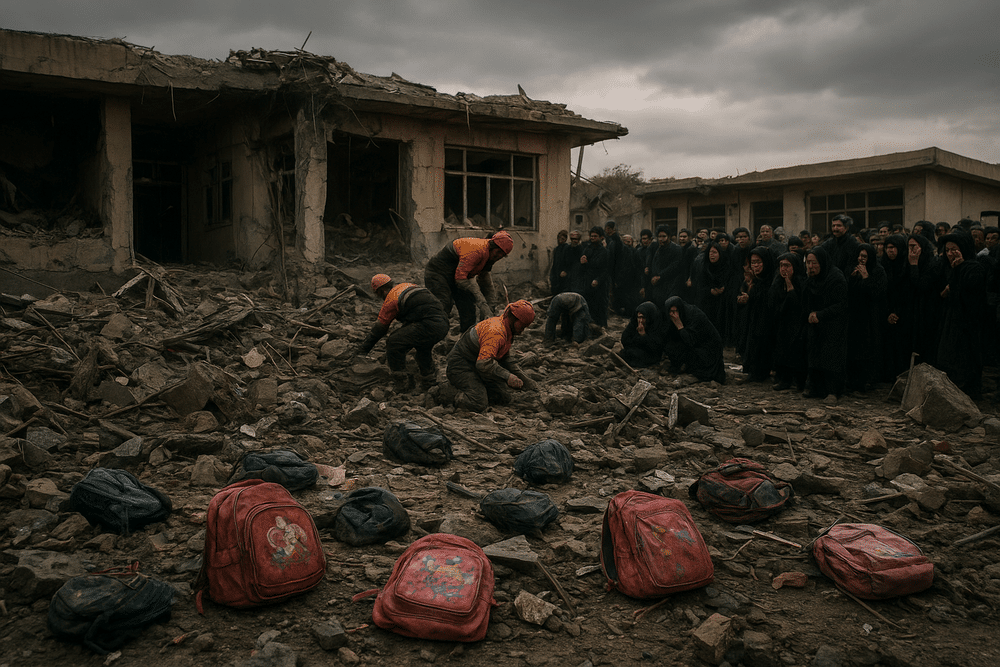
Iranian state media reported that airstrikes struck Qasir Tayyeb elementary school in the city of Minab at around 9:30 a.m. on February 28, as students were in class. The school, which had 264 enrolled pupils, was said to have collapsed during the attack. Initial casualty reports ranged widely, with figures later settling between 160 and 168 fatalities, according to Iranian officials.
Conflicting Casualty Figures
Iranian authorities have issued varying counts in the days following the strike. The Minab prosecutor told local media that 108 people were killed. Other official updates raised the number to 165, while state media said more than 160 had died, most of them children.
The Iranian Red Crescent reported that more than 200 people were killed and 747 injured across 24 provinces nationwide on the first day of the operation. Broader tallies estimate over 550 deaths across Iran since the strikes commenced, although those figures have not been independently verified.
Footage circulating from Minab, which Iranian authorities say has been authenticated, showed heavy damage and crowds of mourners filling the streets. Thousands gathered to grieve as rescue crews searched the rubble.
Washington Denies Deliberate Strike on School
The airstrike occurred amid a joint U.S.-Israeli military campaign, known as Operation Epic Fury, launched on February 28. U.S. officials say the operation is aimed at degrading Iran’s missile capabilities and security forces.
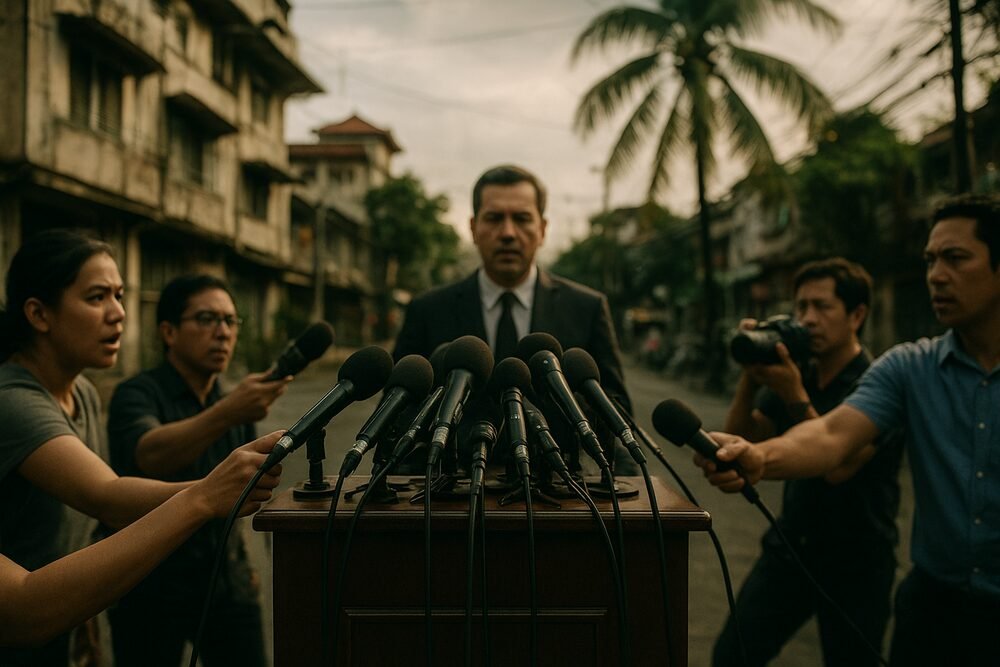
“The United States says it would not deliberately strike a school,” according to the official American position as reported following the incident. U.S. Defense Secretary statements tied to the campaign emphasized that “The purpose of this is to destroy that missile capability.”
American officials have not publicly confirmed responsibility for the specific strike in Minab. Iran, however, directly attributes the attack to U.S. and Israeli forces. Iranian Foreign Ministry spokesman Esmail Baghaei called it an “atrocious crime.”
School Located Near IRGC-Linked Facility
The Qasir Tayyeb school is reportedly located near a clinic linked to the Islamic Revolutionary Guard Corps (IRGC). It remains unclear whether that proximity played a role in targeting decisions or whether the school itself was struck unintentionally.
Under international humanitarian law, including the Geneva Conventions, civilian sites such as schools are protected from deliberate attack. Militaries, however, often argue that proximity to military objectives can complicate targeting decisions, particularly in densely populated areas.
Escalation and Retaliation
The strike on Minab came on the first day of a broader military escalation. By March 3, the U.S. Central Command confirmed that six American service members had been killed in Iranian retaliatory strikes. The remains of personnel were recovered from a facility hit during counterattacks.
The campaign has intensified rapidly, with U.S. officials vowing to continue operations, potentially for several weeks. Tehran has called for an emergency session of the United Nations Security Council, framing the school strike as evidence of unlawful conduct.
Humanitarian Toll Mounts
Across Iran, the humanitarian impact has grown by the day. The Iranian Red Crescent’s initial tally of roughly 550 nationwide deaths underscores the scale of the violence. Rumors circulating on social media have placed the number even higher, but those claims remain unverified.
In Minab, images of children’s backpacks and classroom debris have become symbols of the tragedy. The destruction of a school — traditionally regarded as a sanctuary — has sharpened global attention on the conflict’s civilian cost.
Global Repercussions, Including for Malta
Though geographically distant, Malta — like much of Europe — is watching the crisis with concern. Escalation in the Gulf region often sends shock waves through global energy markets. Any sustained disruption to oil supply could ripple through fuel prices and transport costs across the Mediterranean.
Malta’s economy remains exposed to fluctuations in international energy prices. Even modest increases in global benchmark crude prices can translate into higher import costs, affecting households and businesses alike. Analysts warn that prolonged instability may exacerbate inflationary pressures already felt in small, import-dependent economies.
Clashing Narratives
The Minab strike sits at the center of two sharply opposing narratives.
Iranian officials describe the attack as a deliberate assault on children and civilians — an act they characterize as criminal under international law.
U.S. authorities insist their campaign is directed at military targets and deny any intention to strike a school.
Humanitarian groups have provided casualty counts but have not independently confirmed responsibility for the specific incident.
With independent verification difficult amid active hostilities, the true circumstances of the strike remain contested. What is certain, however, is the human toll. In Minab, classrooms once filled with children now stand as wreckage — a stark portrait of a conflict that is widening by the day.
As the war intensifies, the world faces a familiar and sobering question: whether military objectives can ever justify the risks borne by civilians caught in the crossfire.