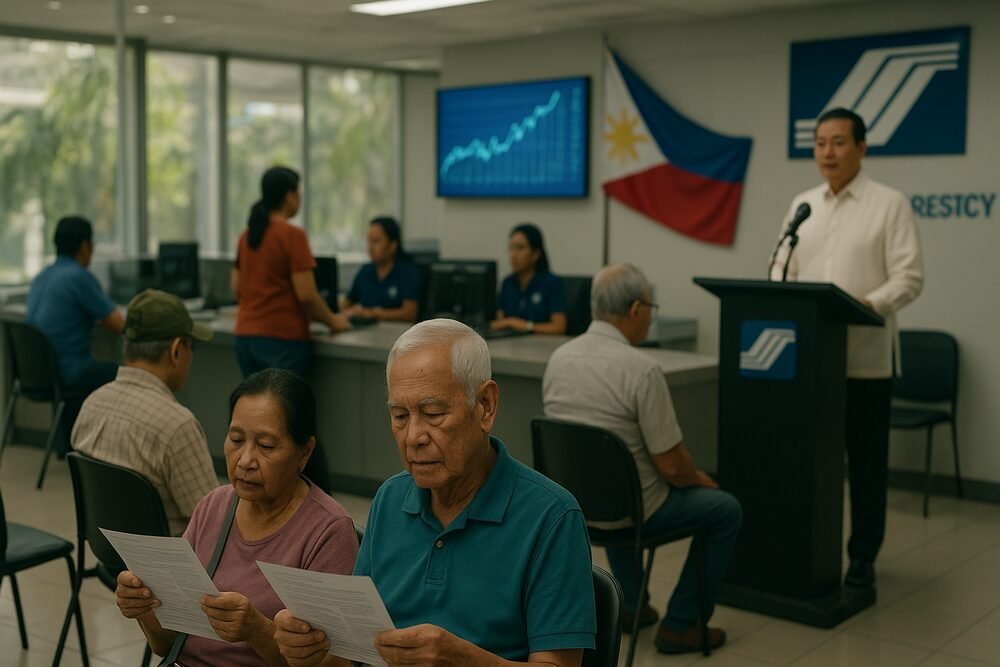
The Philippines’ Social Security System (SSS) crossed a historic financial threshold in 2025, with its reserve funds surpassing ₱1 trillion for the first time and total assets climbing to ₱1.26 trillion, according to the Department of Finance (DOF). The milestone, announced on February 16, 2026, marks a 22.1 percent rise from the previous year and underscores a sharp increase in income driven by investment gains and tighter fiscal management.
The state-run pension fund’s net income surged 58.4 percent to ₱142.97 billion in 2025, up from the year before. Officials said the performance strengthens the system’s long-term capacity to pay pensions and finance benefit programs for millions of Filipino workers and retirees.
A Record Year for the Pension Fund
From a base of ₱1.03 trillion in total assets in 2024, the SSS accelerated its growth trajectory in 2025. By year’s end, assets stood at ₱1.26 trillion, reflecting improved returns and sustained contribution collections.
The agency disbursed ₱304.94 billion in pensions and benefits to 5.66 million members nationwide during the year. At the same time, it released ₱61.11 billion in loans, providing liquidity to members facing medical needs, emergencies or other financial pressures.
Finance Secretary Frederick D. Go, who also chairs the Social Security Commission, framed the development as a signal of stability.
“This record performance and over P1 trillion-peso reserve fund level send a clear message to SSS members: your pensions are secure; your benefits sustained,” Mr. Go said in a statement.
Income Growth Fuels Higher Reserves
The dramatic rise in net income — nearly 60 percent year-on-year — gave the pension fund the financial lift needed to breach the trillion-peso reserve mark. Officials pointed to stronger investment performance and governance reforms as contributing factors.
SSS President and Chief Executive Officer Jay de Claro described the achievement as both symbolic and practical.
“Surpassing the 1 trillion peso mark in our Reserve Fund is a historic milestone and a strong affirmation of our duty to every Filipino worker and pensioner who relies on SSS,” Mr. de Claro said. “This performance reflects prudent stewardship of members’ contributions, strengthened governance, and our continuing commitment to deliver secure and sustainable benefits—today and for generations to come.”
Under Republic Act No. 11199, or the Social Security Act of 2018, the SSS is mandated to maintain actuarial soundness while providing comprehensive social security coverage. The size of its reserve fund serves as a financial buffer — akin to a savings reservoir designed to weather demographic shifts and economic volatility.
Pension Increases and Cheaper Loans
The milestone coincides with expanded benefits rolled out in 2025. The SSS began implementing annual pension increases from 2025 to 2027, granting a 10 percent yearly increase for retirement and disability pensioners and 5 percent for survivor pensioners.
Loan programs were also broadened. The interest rate on key loan products was reduced from 10 percent to 8 percent, lowering borrowing costs for members. The Pension Loan Program was expanded to cover 1.2 million survivor pensioners.
Mr. Go said the reforms align with directives from President Ferdinand R. Marcos Jr. to strengthen governance while improving service delivery.
“Guided by President Ferdinand R. Marcos, Jr.’s directive to enhance benefits and strengthen governance, we are building a social security system that is financially resilient and more responsive to the needs of every Filipino,” Mr. Go said.
He added in Filipino: “Patuloy na maghahatid ang SSS ng mga programang tulad ng Micro Loan at Calamity Loan upang makapagbigay ng sapat, abot-kaya at mas mabilis na suporta sa aming mga miyembro.”
Impact on Millions of Members
For ordinary workers and pensioners, the strengthened balance sheet translates into greater assurance that monthly benefits will continue despite economic headwinds. Rising living costs and recurring natural disasters have placed mounting pressure on Filipino households, making predictable income streams critical.
The ₱304.94 billion distributed in 2025 represents more than ledger entries; it fuels household spending, supports medical care and stabilizes families who depend on retirement or disability payments. Expanded loan programs, particularly calamity and emergency facilities, offer faster access to funds during crises.
While officials highlighted the milestone as evidence of sound management, the long-term sustainability of the fund will continue to depend on demographic trends, contribution compliance and disciplined investment strategies.
For now, breaching the trillion-peso line stands as a symbolic and financial high-water mark — a sign that one of the Philippines’ largest public institutions has entered 2026 on firmer ground, with a deeper reserve to meet the promises made to millions of members.