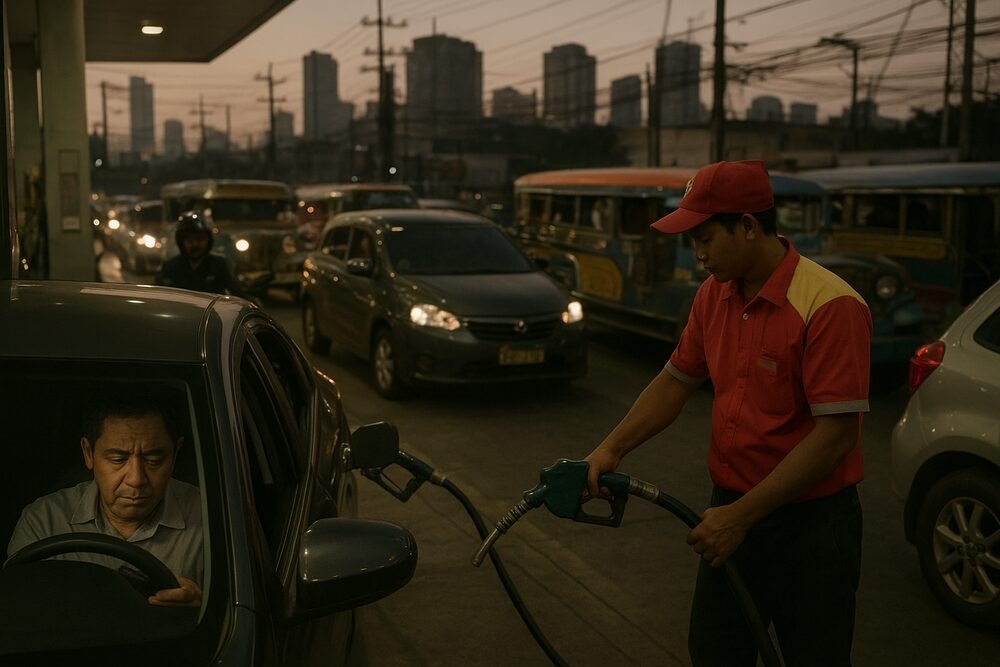
Philippine senators are weighing whether to grant President Ferdinand Marcos Jr. emergency authority to temporarily cut excise taxes on fuel, as global oil prices surge and local pump prices climb for the eighth straight week. The proposal, triggered by rising tensions in the Middle East and the prospect of Dubai crude breaching $80 per barrel, aims to shield consumers from escalating transport, food and electricity costs.
Mr. Marcos confirmed on March 3 that he has begun discussions with Senate and House leaders about empowering the executive branch to act swiftly should global oil benchmarks cross the threshold set under existing tax law.
“I am going to talk to the leaders in both the House and in the Senate to… maybe this is not yet a sure thing but this is something that we’re discussing and maybe helpful is to give me, the President, the authority to reduce excise tax on petroleum products should Dubai crude exceed $80 per barrel,” he said. “It is going to be an emergency measure. It is not going to be a permanent measure.”
Fuel Prices Climb for Weeks
Oil firms are expected to raise pump prices by nearly P2 per liter this week, marking the eighth consecutive hike for gasoline and the tenth for diesel and kerosene. The sustained increases follow supply uncertainties linked to ongoing conflict involving Israel, Iran and the United States, putting pressure on exports from the oil-rich Middle East.
While the Philippines does not produce crude oil at scale, it feels the impact through import prices. Like a rising tide lifting all boats — and sometimes swamping smaller ones — higher crude costs ripple across the economy, raising transport fares, pushing up market goods and increasing electricity generation expenses.
“As soon as oil prices breached $80 per barrel, mayroon na tayong gagawin and we will use several of the funds,” Mr. Marcos added in remarks delivered partly in Filipino.
Legal Limits Under the TRAIN Law
Under the Tax Reform for Acceleration and Inclusion (TRAIN) Law, or Republic Act 10963, excise taxes on petroleum products are automatically suspended if the average Dubai crude price reaches or exceeds $80 per barrel for three consecutive months. However, the President does not currently have unilateral authority to suspend or reduce these taxes outside those strict conditions.
To address this limitation, lawmakers have filed bills seeking to amend Section 148 of the National Internal Revenue Code. Senate Bill 1922 and Senate Bill 1923 would allow the President to suspend or reduce excise taxes through an executive order, upon the recommendation of the Secretaries of Energy and Finance, if crude prices exceed the $80 benchmark.
Under the proposals, any suspension would be temporary and subject to automatic lifting once prices stabilize. The executive branch would also be required to submit a report to Congress within 15 days, detailing the factual basis for the move and estimating foregone revenues and inflationary effects.
Strong Senate Backing
Several senators voiced immediate support for granting the emergency authority.
Senate Majority Leader Juan Miguel Zubiri said, “We must act immediately so [that] it can help temper sudden spikes [in] the prices of important commodities such as food and electricity… Granting the President the power to reduce or suspend excise tax on fuel is a good first step.”
Sen. Erwin Tulfo echoed that sentiment, saying in Taglish, “I believe my colleagues will back this move because it will alleviate the struggles of our countrymen. What legislator would oppose such a measure?… It’s only logical. Why would anyone reject this when people are already facing difficulties?”
Senate hearings are expected, with relevant agencies — including the Departments of Energy, Finance, Transportation, Foreign Affairs, and Migrant Workers — invited to present data and fiscal assessments.
Still, not all support comes without caution. Senate Finance Committee Chair Sherwin Gatchalian has warned that suspending excise taxes could mean substantial revenue losses, potentially affecting government spending and economic growth.
House Moves in Parallel
The House of Representatives has signaled its readiness to cooperate. Speaker Ferdinand Martin “Bojie” Dy III pledged support for coordinated action, while lawmakers filed complementary measures, including a proposal to suspend value-added tax on petroleum products and House Bill 8257, which mirrors Senate efforts to amend tax provisions.
The legislative push reflects a broad consensus that fuel prices, left unchecked, could entrench inflationary pressures across the archipelago.
Impact on Everyday Filipinos
For many Filipinos, fuel prices are not abstract economic indicators but daily calculations at the pump and market stall.
Jeepney drivers and tricycle operators face shrinking margins as diesel costs rise. Some reduce trips to save fuel; others consider fare hikes that commuters — already burdened by higher food prices — struggle to absorb. Farmers and fisherfolk, heavily dependent on diesel, confront thinner profits that can threaten planting and fishing operations.
Transport costs feed directly into food prices, from vegetables delivered to public markets to fish hauled from coastal towns. Higher electricity generation costs, often linked to fuel inputs, further strain household budgets.
Opposition lawmakers have pressed for decisive action, arguing that in a period of modest wage growth and sustained price pressures, suspending excise taxes and even value-added tax on fuel would provide immediate relief.
A Temporary Lever in an Unsteady Market
The administration maintains that emergency powers would serve as a precautionary tool, not a standing policy shift. Officials say targeted subsidies for transport and agriculture remain available under existing funds and would complement any tax suspension.
At stake is a delicate balance: protecting consumers from sudden price shocks while safeguarding public revenues that fund infrastructure, social services and debt obligations.
As global oil markets edge toward the $80 per barrel line, Congress now faces a decision that could reshape how quickly the government responds to volatile energy prices — and how much relief reaches households navigating an uncertain economic landscape.