The number of girls under 15 giving birth in the Philippines has climbed sharply in recent years, prompting the Commission on Population and Development (CPD) to call on parents to begin frank conversations about sexuality at a far younger age. New data show that while pregnancies among older teenagers have slightly declined, births among the country’s youngest adolescents are rising — a trend health officials describe as both alarming and preventable.
As of the latest figures, the country counts 138,697 adolescent mothers aged 10 to 19. Of these, 3,612 were under 15 in 2024, an increase from 3,343 in 2023 and 3,135 in 2022. By contrast, mothers aged 15 to 19 fell to 135,085 in 2024, down from 138,933 the year before.
The contrasting trends reveal a shifting pattern: pregnancies among mid-to-late teens are gradually declining, but cases involving very young girls are becoming more frequent.
Births Among Girls Aged 10–14 Rise
Data drawn from civil registration records show live births among girls aged 10 to 14 increased from 2,411 in 2019 to 3,343 in 2023, representing a 6.6 per cent rise over four years.
In 2023 alone, authorities recorded 17 women under 20 who had already given birth five or more times, along with 38 girls under 15 who experienced repeated pregnancies. These figures underscore what CPD officials describe as cycles of vulnerability rather than isolated incidents.
“Parents often fail to realize that girls below 15 can already be sexually active. Previously, they were viewed as too young, and there was an expectation that they would not engage in sexual activities. However, circumstances have evolved. Today, social media is readily accessible to these youngsters,” said CPD Executive Director Lisa Bersales.
Bersales urged families to confront the issue directly, noting that parents remain the first line of defense.
Health Risks Multiply for the Youngest Mothers
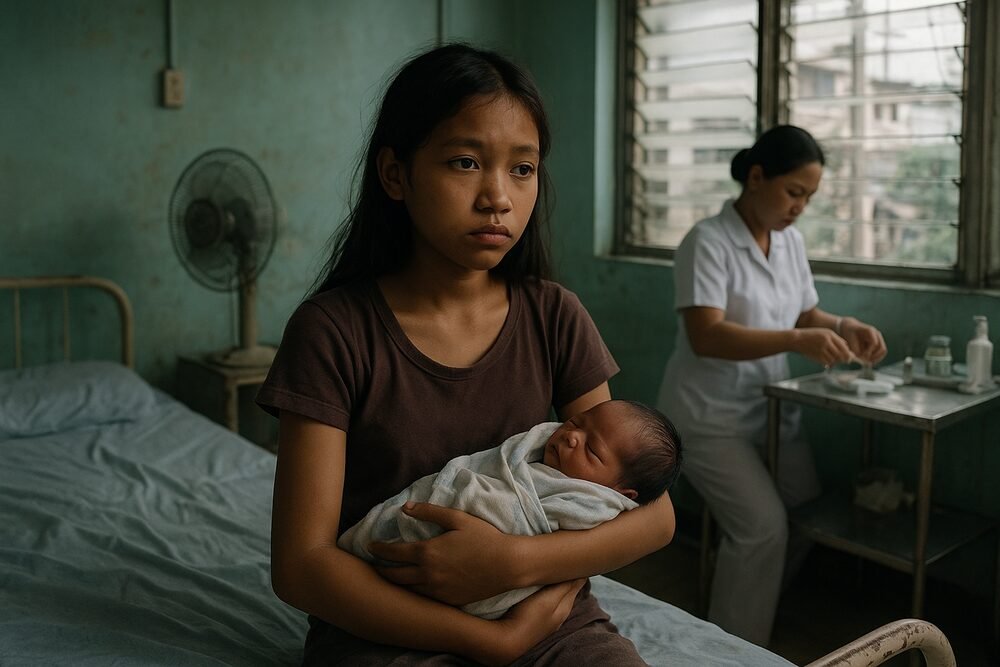
Pregnancy at such a young age carries steep health risks. Girls under 15 face twice the risk of pregnancy-related mortality compared to women aged 20 to 30. Their babies are more likely to be born prematurely or underweight. Cases of anemia, malnutrition, and sexually transmitted infections are also more frequent.
Public hospitals, particularly in densely populated regions, bear much of the burden. Health workers report that adolescent mothers often arrive with limited prenatal care and little knowledge of reproductive health.
“Limited access to services and inadequate education regarding sexuality for our youth are common reasons [for early pregnancies],” Bersales said.
Regional Hotspots Emerge
The rise in adolescent pregnancies is not evenly distributed. The highest numbers are concentrated in:
Calabarzon, with more than 16,000 adolescent mothers;
Central Luzon, with 14,729;
National Capital Region, with 10,656; and
Northern Mindanao and Davao Region, with a combined 10,588.
Some regions show progress. Central Luzon, for example, recorded a 9.7 per cent drop in pregnancies among teens between 2022 and 2023, which officials attribute to intensified local campaigns and school-based programs.
Still, the national picture remains uneven, particularly where poverty and school dropout rates are high.
Education Policy in Place, Enforcement Uneven
The Philippines integrated Comprehensive Sexuality Education (CSE) into its K‑12 curriculum in 2018. The Responsible Parenthood and Reproductive Health Law of 2012 mandates access to reproductive health services and age-appropriate sexuality education.
Yet implementation has varied considerably. Faith-based and rural schools often apply the curriculum inconsistently. In practice, minors still require parental consent for access to contraception, a requirement that health advocates say can deter vulnerable teenagers from seeking help.
Legislative efforts aim to strengthen enforcement. A Senate bill filed in 2025 proposes mandatory, evidence-based CSE across all school levels.
Poverty and Lost Opportunity
Behind each statistic lies a deeper social consequence. Early pregnancy frequently forces girls out of school, limiting employment opportunities and locking families into poverty. In urban centers such as Metro Manila and Calabarzon, young mothers often leave formal education to care for newborns, reducing household income and increasing dependence on informal work or relatives’ support.
Advocacy groups warn that without intervention, “this crisis could undermine economic growth and deepen existing social inequalities.”
One in ten young women aged 15 to 19 nationwide have already begun childbearing. Although the adolescent fertility rate — 32.16 births per 1,000 girls aged 15–19 in 2022 — has fallen below 50 and shows long-term improvement, the surge among girls under 15 signals that prevention efforts are not reaching the youngest and most vulnerable.
Parents at the Front Line
CPD officials argue that policy alone cannot reverse the trend. The agency now plans to intensify localized awareness campaigns and encourage parents to speak openly about relationships, consent, and reproductive health before adolescence begins.
The message, authorities say, is not about condoning early sexual activity but about recognizing reality. In an era where smartphones place global content in children’s hands, silence at home can leave adolescents navigating complex decisions alone.
The data, stark and rising at the youngest ages, suggest that earlier — and more candid — conversations may be as critical as any law or clinic in stemming the tide.