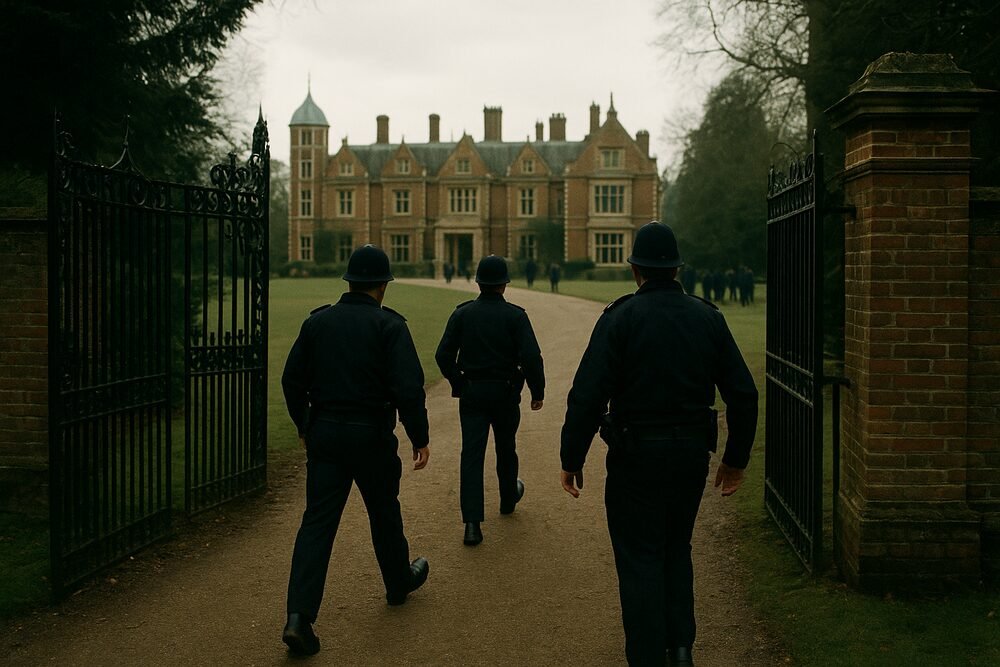
LONDON — Former Prince Andrew was arrested on his 66th birthday in a development that many Britons greeted not with outrage, but with visible relief — and, in some cases, thinly veiled smiles. For a royal family long shielded by tradition and deference, the image of police officers entering royal property marked a profound shift: the law, at least symbolically, had crossed the palace gates.
Thames Valley Police arrested Andrew on February 19, 2026, at his residence on the Sandringham Estate in Norfolk on suspicion of misconduct in public office, a common law offense in the United Kingdom. Officers later searched the Royal Lodge in Windsor. Andrew was detained for several hours and released under investigation the same day.
For many observers across Britain, the moment felt historic — the first time in modern history that a senior royal has faced police questioning under such circumstances. Outside court buildings and across social media platforms, the reaction was not one of shock but of weary acknowledgment, as though an inevitable chapter had finally begun.
A Birthday Arrest at Sandringham
The arrest took place during breakfast hours at Sandringham. Police described detaining “a man in his 60s,” consistent with the long-standing protocol of not publicly naming suspects during questioning. A dozen officers were involved in the operation, underscoring both its logistical complexity and its sensitivity.
Authorities also conducted a search of the Royal Lodge in Windsor, Andrew’s primary residence. By the end of the day, he had been released under investigation, a status that leaves open the possibility of further questioning or charges pending review by the Crown Prosecution Service.
The timing — Andrew’s birthday — gave the episode an almost theatrical gravity. In a monarchy steeped in ceremony and pageantry, the juxtaposition was stark: celebration replaced by scrutiny.
King Charles III: ‘The Law Must Take Its Course’
King Charles III responded swiftly, seeking to steady both public sentiment and the institution he leads.
“I have learned with the deepest concern the news about Andrew Mountbatten-Windsor and suspicion of misconduct in public office. (…) [The] law must take its course,” the King said in a statement.
Hours later, he proceeded with previously scheduled public engagements, including opening London Fashion Week. The decision signaled continuity — an attempt to project institutional resilience rather than retreat.
The King’s message reflected a delicate balance: personal concern for a brother, paired with a public affirmation that no individual stands above the law. For constitutional monarchies, perception is currency. In this instance, neutrality may be the most valuable asset of all.
Echoes of the Epstein Scandal
While police have cited suspicion of misconduct in public office, the arrest revives unresolved questions tied to Andrew’s past associations with the late financier Jeffrey Epstein.
Following the arrest, U.S. Democrats and families of Epstein’s victims renewed calls for Andrew to testify before the U.S. Senate. British police forces, including those in Essex and Bedfordshire, are reportedly examining related matters concerning private flights that transited through Stansted and Luton airports.
No formal charges have been filed, and Andrew maintains the presumption of innocence afforded to all under UK law. Still, the reopening of investigative avenues has deepened the sense that unfinished business lingers from earlier scandals.
Public Reaction: Relief More Than Revelry
Despite the gravity of the development, there were no confirmed scenes of mass celebration. Instead, the prevailing public mood appeared tempered, even subdued — less jubilation than exhalation.
For years, Andrew’s controversies have cast a long shadow over the monarchy. His retreat from public duties following earlier allegations did little to quiet debate. The arrest, in the eyes of some citizens, suggested that accountability mechanisms were functioning — however slowly.
“Relief” was a word frequently echoed in private conversations and online commentary. The idea that even a royal could be questioned by police resonated in a country where the monarchy exists alongside a robust legal framework and democratic traditions.
What Comes Next
The investigation remains ongoing. Should prosecutors determine there is sufficient evidence, formal charges could follow. Alternatively, the inquiry could conclude without indictment.
For now, Andrew remains eighth in line to the British throne, though he has long since stepped back from official royal duties. The monarchy itself faces no immediate constitutional peril, but reputational stakes are high. Each development tests the delicate contract between a centuries-old institution and a modern public that demands transparency and fairness.
In the span of a single day, the monarchy confronted one of its most challenging optics: uniformed officers entering royal grounds. Yet the broader national response suggested a different focus — not on scandal alone, but on the principle that even behind gilded gates, the rule of law still applies.
Whether that perception endures may determine not only Andrew’s future, but also the monarchy’s standing in an era less inclined to defer and more inclined to demand answers.