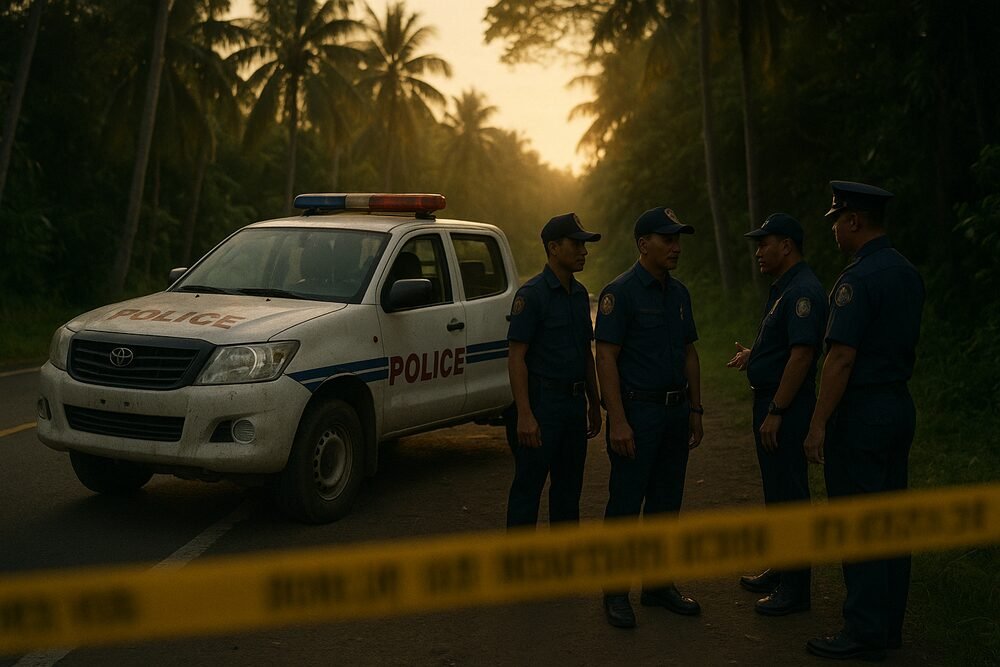
The Philippine National Police (PNP) on Wednesday relieved eight police officers in the Bicol region after a 12-day delay in reporting the fatal shooting of a detainee during a transport operation earlier this month — a lapse that has triggered both administrative and criminal investigations.
Four officers directly involved in the February 6 shooting — one police corporal and three patrolmen from the Catanduanes Police Provincial Office — are now under restrictive custody and face a homicide complaint before the Camarines Sur prosecutor’s office. They are also the subject of administrative proceedings before the National Police Commission (Napolcom).
The remaining four officers, including senior personnel from municipal stations and investigative units, were relieved over what the PNP described as procedural failures in reporting the incident to the Police Regional Office 5 (PRO 5) headquarters.
A 12-Day Silence
According to the PNP, the administrative liability centers on the delayed reporting of the incident, which occurred along the Rolando Andaya Highway in Del Gallego, Camarines Sur.
“Linawin natin na ang administrative liability na nakita ng regional office sa kanila, ito yung late reporting ng nasabing insidente na umabot daw halos 12 araw bago nakarating sa regional headquarters. Sila ay undergoing pre-charge investigation. Sila ay na-order ng relief sa kanilang mga puwesto,” PNP Spokesman Police Brigadier General Randulf Tuaño said.
The delay, officials said, raised serious concerns about compliance with reporting protocols designed to ensure transparency and prompt oversight, particularly in incidents involving the use of lethal force.
What Happened on February 6
The incident unfolded as four police personnel were transporting two detainees — a murder suspect identified as Michael Echague and a rape suspect — from Pasig City to San Miguel, Catanduanes.
Police said they stopped along the highway to allow one of the detainees to relieve himself. During the stop, Echague allegedly elbowed one officer, seized his rifle, and pointed it at the escorting team. The firearm, authorities later said, did not discharge because it was not loaded.
Echague then fled toward a bushy ravine about a kilometer from the vehicle, prompting a foot pursuit.
In its account, PRO 5 said: “The suspect was subsequently pursued by police personnel. Upon reaching a bushy ravine approximately one kilometer away from the vehicle, the suspect was seen in a kneeling position, aiming the seized rifle toward the pursuing officers, who were then seeking cover. Fearing for their safety, the police officers responded by firing their issued pistols, which resulted in the suspect sustaining gunshot wounds in different parts of his body.”
Echague sustained three gunshot wounds — to the shoulder, chest, and head — and died from his injuries. Paraffin tests later showed that three patrolmen tested positive for gunpowder residue.
Criminal and Administrative Cases
The four officers who discharged their firearms are now facing a homicide complaint before the local prosecutor in Camarines Sur. Simultaneously, Napolcom is examining potential violations of operational procedures, including whether established rules on detainee transport and use of force were properly followed.
PNP Chief Police General Jose Melio C. Nartz, Jr. ordered the officers’ preventive suspension.
“P/Gen. Nartz has ordered the immediate preventive suspension of the officers involved to safeguard the integrity of the investigation,” the PNP said.
Nartz added that the inquiry would scrutinize whether officers adhered to internal guidelines governing the use of force. “The PNP has established protocols regarding the use of force, especially relating to necessity and proportionality. We are currently examining if the standard operating procedures were adhered to during this incident.”
Chain of Command Under Review
Beyond the four officers who fired their weapons, the PNP also relieved the chief investigator and investigator-on-case of the Del Gallego Municipal Police Station, as well as the warrant section chief of the San Miguel Municipal Police Station in Catanduanes.
The action signals that the scrutiny extends beyond the shooting itself to the broader question of command responsibility. In police operations, timely reporting is not simply paperwork — it is the backbone of accountability. A delay can compromise evidence, hinder oversight, and erode public trust.
Accountability and Public Trust
For residents in Bicol, the incident revives familiar anxieties about custody procedures and the handling of detainees. Individuals under police escort remain under state responsibility, and any lapse — whether operational or administrative — carries serious consequences.
The involvement of the Commission on Human Rights as a monitoring body, alongside Napolcom’s review, adds another layer of oversight as investigators reconstruct what happened along the highway that evening.
While the PNP maintains that the officers acted out of fear for their safety, the 12-day reporting gap has cast a long shadow. The case now rests on parallel tracks: prosecutors will determine criminal liability, while administrative bodies assess whether institutional rules were followed.
The outcome could shape not only the careers of the officers involved but also how provincial police units across the country handle detainee transport and critical incident reporting in the future.