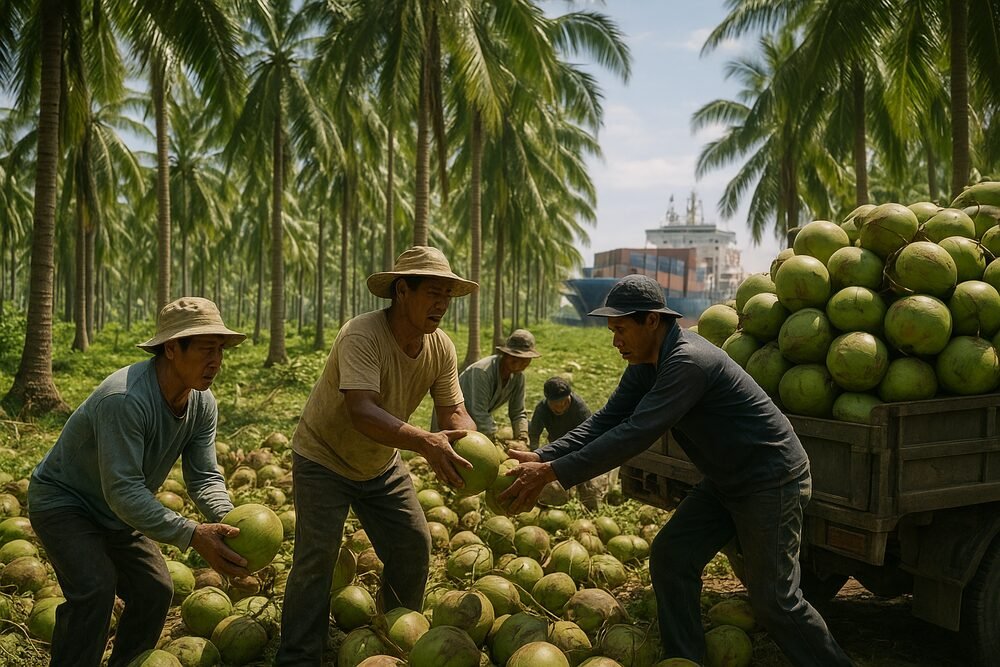
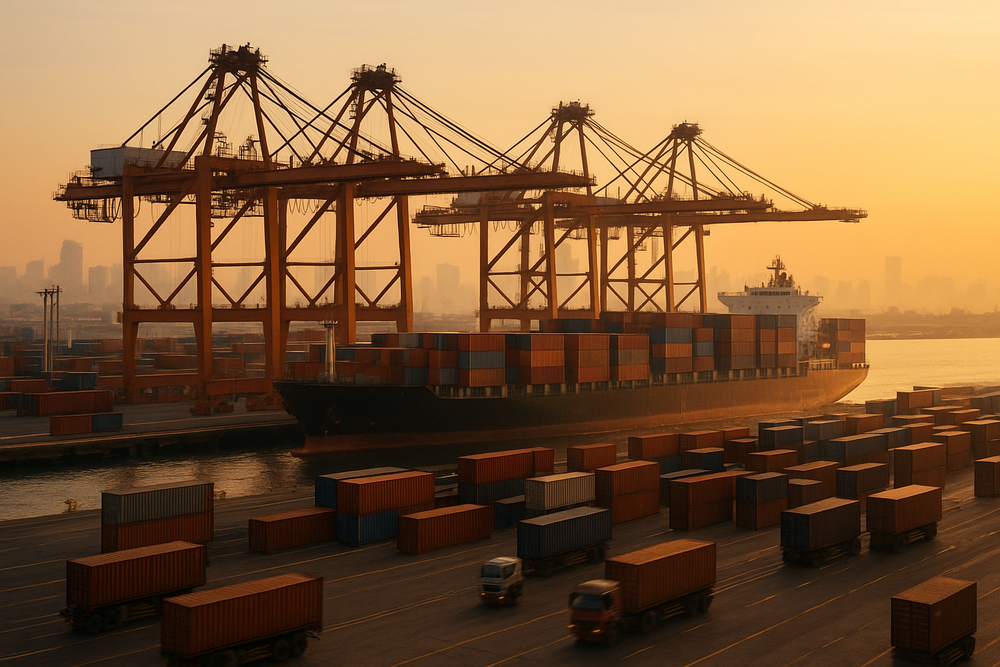
The Philippines, already the world’s second-largest coconut producer, has set its sights on becoming the globe’s top exporter, targeting $3 billion in coconut export revenues by 2026. Backed by President Ferdinand Marcos Jr. and a coalition of government agencies and multinational companies, the push aims to transform an industry that supports more than 3.5 million farmers into a stronger engine of rural growth.
If achieved, the target would push the country past Indonesia and cement its standing in a market where coconut oil, desiccated coconut and other by-products are staples in food, cosmetics and — increasingly — renewable energy.
A $3 Billion Ambition
Government figures show coconut exports reached $2.66 billion in 2024, a dramatic 71.7 percent increase from $1.55 billion the year before. Coconut oil accounted for the lion’s share — $2.2 billion, or more than two-thirds of total exports.
Officials now expect exports to reach $3 billion in 2026, representing roughly 15 percent growth from a projected $2.6 billion in 2025.
“The President emphasized that the government should help the coconut farmers because we are a large exporter of the product globally. The President ordered the Department of Agriculture to keep an eye on it,” said Presidential Communications Office Undersecretary Claire Castro, relaying remarks from President Marcos following a Legislative-Executive Development Advisory Council meeting on Feb. 10.
That meeting elevated amendments to the Coconut Farmers and Industry Trust Fund Act to priority status, signaling that the administration views the coconut sector as a strategic pillar of the rural economy.
Production Holds Steady — With Warning Signs
The Philippines produced 14.77 million metric tons of coconuts in 2024, according to the Philippine Statistics Authority, placing it second only to Indonesia. Output in 2025 held largely steady at 14.506 million metric tons.
Yet beneath the headline numbers are signs of fragility. Fourth-quarter production in 2025 dipped 3.5 percent year-on-year to 4.022 million metric tons, underscoring how weather patterns, aging trees and structural inefficiencies can quickly ripple through the supply chain.
At the same time, global prices remain robust. As of July 26, 2025, coconut oil was priced at $2,261 per metric ton (CIF Rotterdam), according to international trading data.
Finance Secretary Frederick Go framed the opportunity bluntly: “I think the data today shows that we are the second largest exporter of coconuts to the world. I think there’s a lot of opportunity here to really become maybe the leader in the coconut industry in the world.”
Leveraging the Coconut Levy Fund
Central to the strategy is the long-awaited deployment of the Coconut Levy Fund, now earmarked for farmer support, replanting, modernization and credit access. The government is seeking to amend the trust fund law to accelerate and refine how those funds are used.
The Philippine Coconut Authority (PCA) is implementing the Coconut Farmers Industry Development Plan (CFIDP), a roadmap focused on farmer capacity building, social protection and village-level enterprise development.
“CFIDP is farmers focused, what you can see in there are programs intended for the farmers and their capacity building, social protection, and village level type of programs for the benefit of coconut farmer organizations and cooperatives,” said PCA Administrator Benjamin Madrigal.
The plan aims to professionalize farming practices, expand access to financing and upgrade processing facilities — steps seen as crucial if the country hopes to move from bulk exports to higher-value products.
Public-Private Push for Sustainability
Beyond government intervention, a web of private-sector alliances has emerged to strengthen the industry’s backbone.
The Coconut Working Group, led by Cargill Philippines under the Philippines Partnership for Sustainable Agriculture, brings together stakeholders ranging from Monde Nissin Corporation to farmer cooperatives and development organizations.
“We can do something that will help shape a more sustainable future for our coconut farmers. I hope that we can leverage on the expertise of each one of us to make this better future a common reality for all,” said Christopher Matthew Ilagan, director at Cargill Philippines.
In Quezon province alone — one of the country’s coconut heartlands — there are 2,151 industry stakeholders, including farmers, traders and processors. Provincial authorities are drafting localized roadmaps to address gaps in coordination and investment.
“This is the start of our partnership,” said PCA Administrator Dexter R. Buted during a January 2025 meeting with corporate partners exploring sustainability and farmer livelihood initiatives.
Biofuel Demand Reshapes the Market
While exports are projected to rise overall, the outlook for coconut oil shipments is more complex. Forecasts show exports may remain flat in marketing year 2025–2026 despite higher production. The reason: growing domestic demand for coconut oil in biodiesel blending.
That shift could provide greater price stability at home, cushioning farmers from swings in global markets while supporting the country’s renewable energy targets.
For smallholders who depend on copra sales — often selling to middlemen at thin margins — stable domestic demand can mean the difference between subsistence and modest surplus.
A Lifeline for Rural Communities
Coconut farming stretches across the archipelago, from Quezon to Davao and Bicol. For millions of families, the crop is not merely an export commodity but a daily livelihood.
An industry worth $3 billion in exports could stimulate job creation in processing plants, logistics hubs and rural trading centers. It could also expand access to education, health services and financial tools through corporate social responsibility programs and cooperative development.
But the ambition also hinges on solving entrenched problems: aging coconut trees, fragmented landholdings and periodic production declines. Without sustained investment, the goal of surpassing Indonesia may remain aspirational.
For now, the administration’s message is clear: coconuts, long dubbed the “tree of life” in the tropics, are being recast as a strategic export weapon. Whether the Philippines can climb from second place to first will depend not only on global demand, but on whether the promised reforms and partnerships deliver tangible gains to the farmers at the industry’s roots.