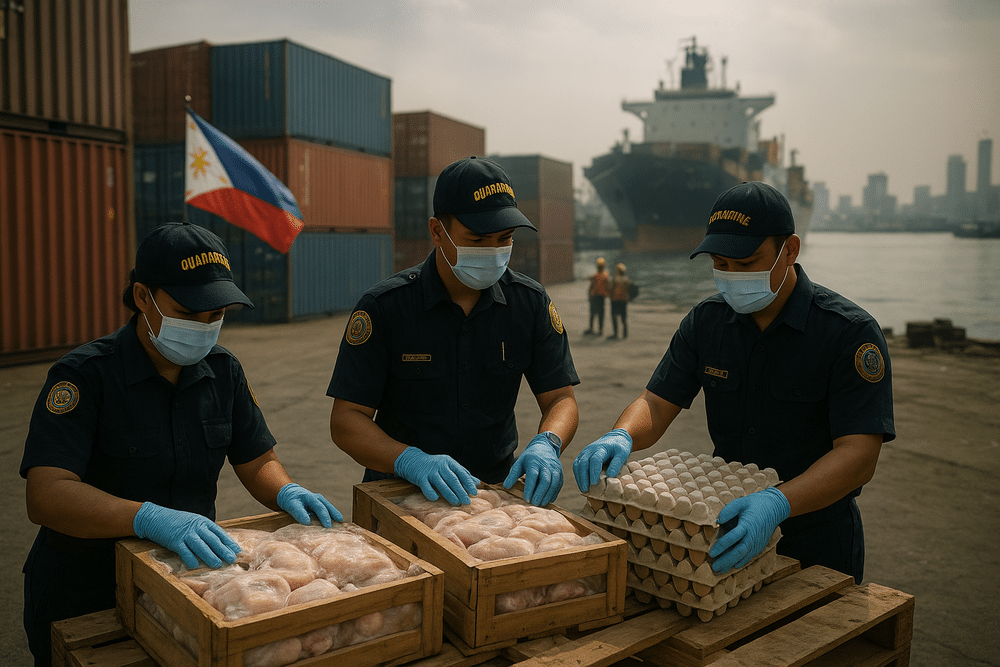
The Philippine government has temporarily banned the importation of poultry and poultry products from the state of Indiana following confirmed outbreaks of highly pathogenic H5N1 avian influenza, in a move aimed at shielding the country’s multibillion-peso poultry industry from potential contagion.
The Department of Agriculture (DA), through Secretary Francisco Tiu Laurel Jr., ordered the immediate suspension of shipments and sanitary permits after United States authorities confirmed multiple cases of bird flu in Indiana. The decision activates a standing bilateral animal health agreement between Manila and Washington that allows state-level trade restrictions when outbreaks exceed a defined threshold.
Ban Triggered by Multiple County Outbreaks
The outbreak was confirmed on February 23, 2026, by the United States Department of Agriculture’s Animal and Plant Health Inspection Service (USDA-APHIS), with laboratory verification by the National Veterinary Services Laboratories in Ames, Iowa.
Under a 2016 Philippines–US bilateral animal health arrangement, the Philippines may impose a state-wide ban if three or more counties in a US state report avian influenza cases. According to the Department of Agriculture, Indiana surpassed that limit.
“Indiana has breached that threshold, according to official reports submitted to the World Organisation for Animal Health (WOAH),” the DA said in a statement.
The measure applies across the Philippine archipelago and takes effect immediately.
What the Import Ban Covers
The prohibition covers a wide range of poultry commodities originating from Indiana, including:
- Poultry meat
- Day-old chicks
- Table eggs and hatching eggs
- Poultry semen
The ban suspends the processing and issuance of Sanitary and Phytosanitary Import Clearances (SPSICs) for these products.
“The import ban immediately suspends the processing and issuance of Sanitary and Phytosanitary Import Clearances (SPSICs) for the covered commodities. Previously approved SPS clearances for live birds are automatically revoked,” the DA directive stated.
Veterinary quarantine officers stationed at major ports — including Manila, Cebu, and Davao — have been instructed to enforce strict inspections.
“All non-compliant shipments will be confiscated or dealt with under existing quarantine regulations,” the agency warned.
Limited Exceptions for Pre-Ban Shipments
The DA carved out narrow exemptions to prevent unnecessary supply disruption. Poultry products that were slaughtered or produced on or before January 30, 2026 may be allowed entry, provided they were already in transit, loaded onto vessels, or accepted at port before the ban’s implementation.
These transitional provisions aim to balance biosecurity with commercial practicality, ensuring that the gate closes firmly but without stranding cargo already well on its way.
Protecting a Multibillion-Peso Industry
At stake is the Philippines’ multibillion-peso poultry sector, a cornerstone of domestic food supply and rural employment. From backyard raisers in provincial towns to large commercial farms in Central Luzon and Mindanao, the industry supports thousands of workers and supplies a substantial portion of the country’s protein needs.
In explaining the broader restrictions, the DA said: “The swift proliferation of the virus throughout the United States has necessitated broader trade restrictions to protect the nation’s poultry industry, valued in the billions of pesos, from potential risks.”
Avian influenza outbreaks can devastate poultry populations, triggering mass culling, trade suspensions, and price volatility. By acting early, regulators are effectively building a firebreak — stopping a foreign outbreak from crossing borders before it threatens domestic farms.
Implications for Consumers
For Filipino households, the immediate impact is expected to be minimal. Authorities have indicated that existing supply lines remain stable, and previously shipped products that meet the cut-off conditions can still enter the country.
The Philippines sources poultry imports from multiple countries, and Indiana represents only a portion of US exports to the country. With local production forming the backbone of supply, officials do not anticipate sudden spikes in the prices of chicken meat or eggs.
The broader objective, officials say, is prevention: keeping grocery shelves and wet market stalls stocked by ensuring local farms remain disease-free.
Part of Wider Global Monitoring
The Indiana ban follows ongoing monitoring by the DA of bird flu developments overseas. Reports of US outbreaks began circulating in early March, prompting heightened scrutiny by Philippine authorities.
Highly pathogenic H5N1 has affected several countries in recent years, disrupting poultry industries and tightening biosecurity rules worldwide. The virus spreads rapidly among birds and can wipe out entire flocks, making swift containment essential.
By invoking the 2016 bilateral agreement, the Philippines signaled its readiness to use existing trade safeguards when epidemiological conditions warrant it — a calibrated response rooted in science and prior commitments rather than ad hoc decision-making.
For now, the import ban remains in force until Indiana regains disease-free status according to international animal health standards, underscoring a central principle of agricultural policy: in matters of biosecurity, caution often proves less costly than cure.