President Ferdinand Marcos Jr. has ordered the release of P5,000 in cash assistance and fuel subsidies to public utility vehicle (PUV) drivers and other vulnerable sectors, as the government moves to blunt the impact of surging global oil prices triggered by escalating conflict in the Middle East.
The first payouts begin on March 17, 2026, targeting tricycle drivers in Metro Manila, with officials promising a rapid expansion to other transport workers and provinces in the coming weeks.
Fuel Shock Prompts Swift Government Response
The assistance package follows a sharp rise in global oil prices after missile strikes by the United States and Israel on Iran in late February intensified tensions in the Persian Gulf, a vital artery for global crude supply.
As fuel prices climbed, transport operators across the Philippines saw their daily earnings squeezed. Drivers who rely on thin margins to cover boundary payments, maintenance costs and household expenses faced immediate strain.
On March 12, President Marcos directed agencies to formulate immediate relief measures.
“The directive from our president is to prevent the situation from deteriorating,” said Department of Transportation (DOTr) Acting Secretary Giovanni Lopez during a joint briefing on March 16 at the Department of Social Welfare and Development (DSWD) central office in Quezon City.
P5,000 Cash Aid Under Crisis Assistance Program
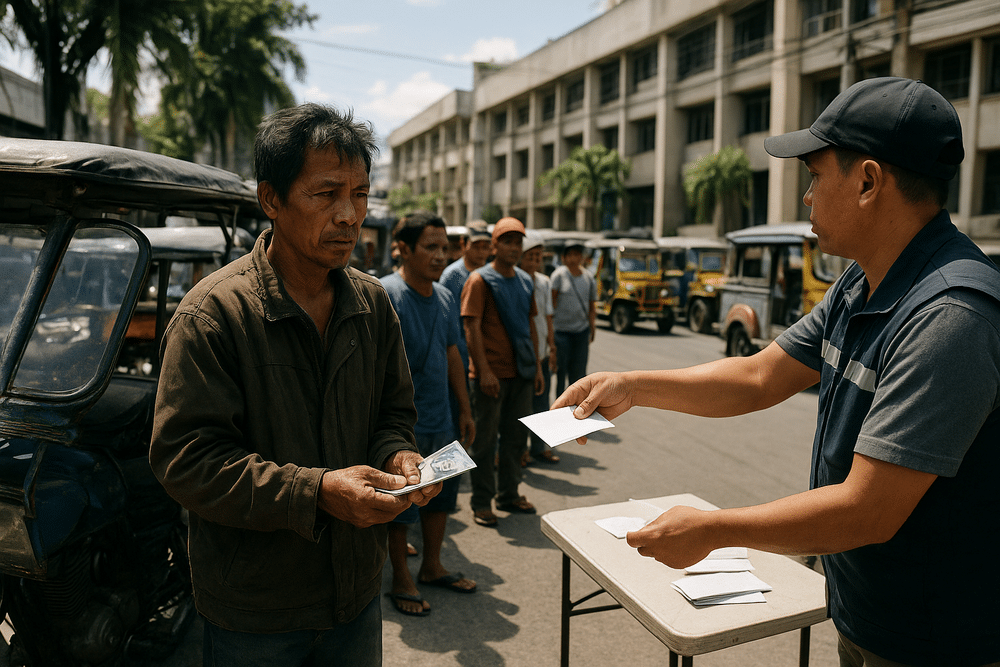
Each eligible PUV driver will receive P5,000 in cash aid, drawn from the DSWD’s Assistance to Individuals in Crisis Situations (AICS) program.
The agency has earmarked P30 billion from its P60 billion AICS budget for 2026 to support fuel subsidies and direct assistance tied to the current price shock.
DSWD Secretary Rex Gatchalian framed the measure as a necessary reclassification of transport workers under extraordinary conditions.
“They’re not merely public utility drivers anymore; we can now categorize them as individuals facing crisis situations because their means of income have been impacted,” Gatchalian said.
Officials stressed that the aid is designed as immediate relief, with the possibility of additional rounds if global fuel instability persists.
Metro Manila Rollout Begins With Tricycle Drivers
The initial phase will cover tricycle drivers in Metro Manila, with payouts distributed across 30 designated sites beginning March 17.
Local government units from 16 cities and one municipality have submitted beneficiary lists to streamline distribution and avoid long queues or verification delays.
Gatchalian said the geographic scope will widen swiftly. “We are initiating this in Metro Manila first. However, it will follow quickly; it won’t be long before we extend it elsewhere,” he said.
San Juan City Mayor Francis Zamora underscored the broader coverage planned for the transport sector.
“This initiative is not limited to tricycle drivers; it will also encompass TNVS drivers, UV drivers, and bus operators. The national government aims to support all individuals in the public transport sector,” Zamora said.
Farmers and Fishers Also Set to Benefit
Beyond urban transport, the government is preparing fuel subsidies for farmers and fishers, sectors heavily dependent on fuel for irrigation, mechanised farming, and fishing operations.
Rising diesel and gasoline prices threaten to ripple through food production, potentially raising market prices for staples such as rice and fish. By cushioning input costs, officials aim to prevent a broader inflationary surge that would hit low-income households hardest.
Protecting Daily Earners and Commuters
For many PUV drivers, daily income determines whether rent is paid and food is placed on the table. Even modest fuel hikes can erase earnings for the day. Without intervention, transport groups have historically responded with fare hike petitions or strike threats—moves that disrupt commuters and strain local economies.
The administration’s strategy is to stabilize the most exposed sectors quickly, buying time against global forces beyond its control. By funneling aid through an existing crisis mechanism and relying on verified local government lists, authorities hope to deliver assistance with minimal delay.
While the broader trajectory of oil prices remains uncertain, the government’s message is clear: rapid intervention is necessary to prevent external shocks from cascading into a deeper domestic economic strain.
As payouts begin in Metro Manila, transport workers and primary producers nationwide will be watching closely for how soon the promised expansion reaches their communities.