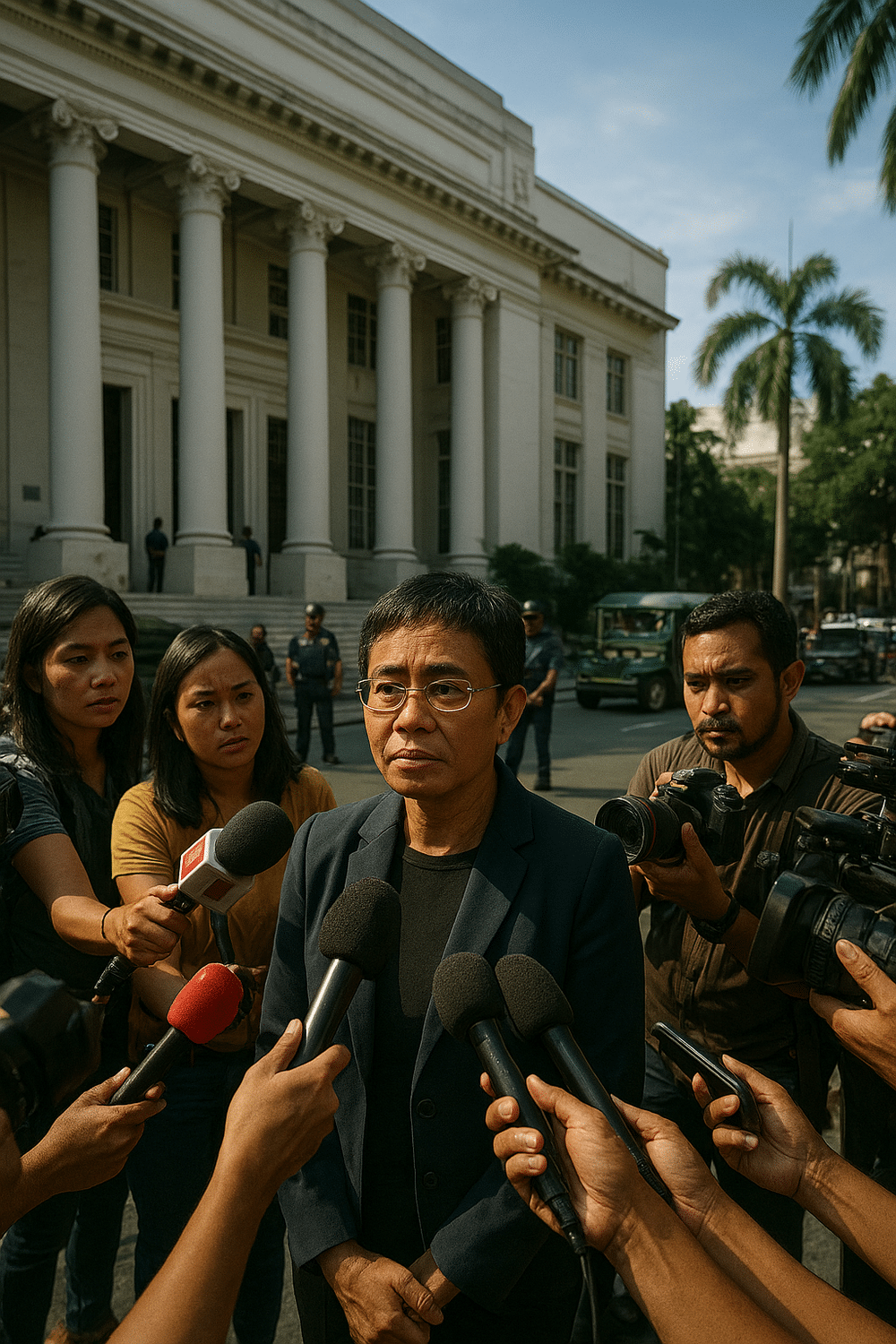
The Philippines’ Office of the Solicitor General (OSG) has moved to secure the acquittal of journalist Maria Ressa and former Rappler reporter Reynaldo Santos Jr. in their ongoing appeal before the Supreme Court, marking a significant turn in one of Southeast Asia’s most closely watched press freedom cases.
The recommendation comes as the country’s highest court reviews a 2020 cyberlibel conviction tied to a 2012 Rappler article alleging links between businessman Wilfredo Keng and criminal activity. The conviction, affirmed by the Court of Appeals in 2022, imposed prison sentences and monetary penalties on both journalists. If the Supreme Court adopts the OSG’s position, it would effectively overturn the guilty verdict that has shadowed Ressa—Nobel Peace Prize laureate and Rappler’s chief executive—for six years.
A Conviction Rooted in a 2012 Article
At the centre of the legal battle lies a May 29, 2012 article written by Santos and published on Rappler’s website. The report cited allegations connecting Keng to criminal activities. In February 2014, Rappler updated the story to correct a typographical error. That technical edit would later become pivotal.
Prosecutors argued the update amounted to a “republishing,” thereby bringing the article under the scope of the Cybercrime Prevention Act of 2012 (Republic Act No. 10175), specifically Section 4(c)(4) on cyberlibel.
In June 2020, Manila Regional Trial Court Branch 46 found Ressa and Santos guilty. The court sentenced them to an indeterminate prison term of six months and one day to six years and ordered each to pay PHP 200,000 in moral damages and PHP 200,000 in exemplary damages to Keng. Both posted bail while pursuing appeals.
In its ruling, the trial court stated that “there is no curtailment of the right to freedom of speech and of the press.” It added that the accused “did not offer a scintilla of proof that they verified the imputations of various crimes in the disputed article … [Rappler] just simply published them as news in their online publication in reckless disregard of whether they are false or not.”
Prescription Period at the Heart of the Dispute
The case hinges largely on the question of prescription—how long authorities have to file charges.
Under the Revised Penal Code, traditional libel carries a prescription period of one year. However, cyberlibel under the Cybercrime Prevention Act has been treated as prescribable within 12 years, based on Republic Act No. 3326.
When Keng filed his complaint with the Department of Justice in 2017, the National Bureau of Investigation initially dismissed it for lack of basis. The Department of Justice revived the case in January 2019, arguing that the 2014 correction constituted continuous publication, effectively resetting the clock.
Ressa and Santos countered that applying the cybercrime law retroactively to a 2012 article was unconstitutional. They also argued that the one-year prescription period for ordinary libel should apply, rendering the complaint time-barred.
Appeals Court Upholds Conviction
The Court of Appeals upheld the conviction on July 8, 2022 and later denied a motion for reconsideration in October that year, increasing the potential sentence. The case was subsequently elevated to the Supreme Court through a petition for certiorari.
It is at this stage that the OSG, which acts as the government’s top lawyer, has recommended acquittal—a move that signals a sharp divergence from earlier prosecutorial stances taken by the Department of Justice.
International Scrutiny and Press Freedom Concerns
The conviction prompted condemnation from international human rights groups. The International Commission of Jurists described the verdict as alarming. Its Asia-Pacific Director, Frederick Rawski, said: “The guilty verdict is a new low for the Duterte administration, and adds to an atmosphere of intimidation that creates a chilling effect on online expression, especially for journalists seeking to hold the government to account.”
The International Federation for Human Rights similarly called for an end to what it described as judicial harassment.
Supporters of Ressa argue the case sets a precedent that could widen the reach of criminal defamation laws into the digital sphere, with consequences for journalists across the archipelago. Critics of the journalists maintain that freedom of expression does not shield inaccurate or defamatory reporting.
Wider Legal Challenges
The cyberlibel case is one among several legal battles faced by Rappler and its executives in recent years. In a separate case unrelated to cyberlibel, Ressa and colleagues were acquitted in June 2025 of charges concerning foreign media ownership.
Rappler has covered Santos Jr.’s legal costs throughout the proceedings.
Implications Beyond the Courtroom
While the case does not directly affect daily bread-and-butter issues such as employment or cost of living, its implications touch a deeper nerve. The rise of digital news means that legal standards set in this case may shape how online reporting is conducted nationwide.
The question before the Supreme Court is not merely about a single article or two journalists. It goes to the architecture of accountability in the digital age: whether a minor edit can resurrect liability years after publication, and how criminal defamation laws should operate online.
The High Court’s decision will determine not only the fate of Ressa and Santos but also the boundaries of online journalism in the Philippines. For now, the OSG’s position introduces a new variable into a case that has become a barometer of press freedom in the region.