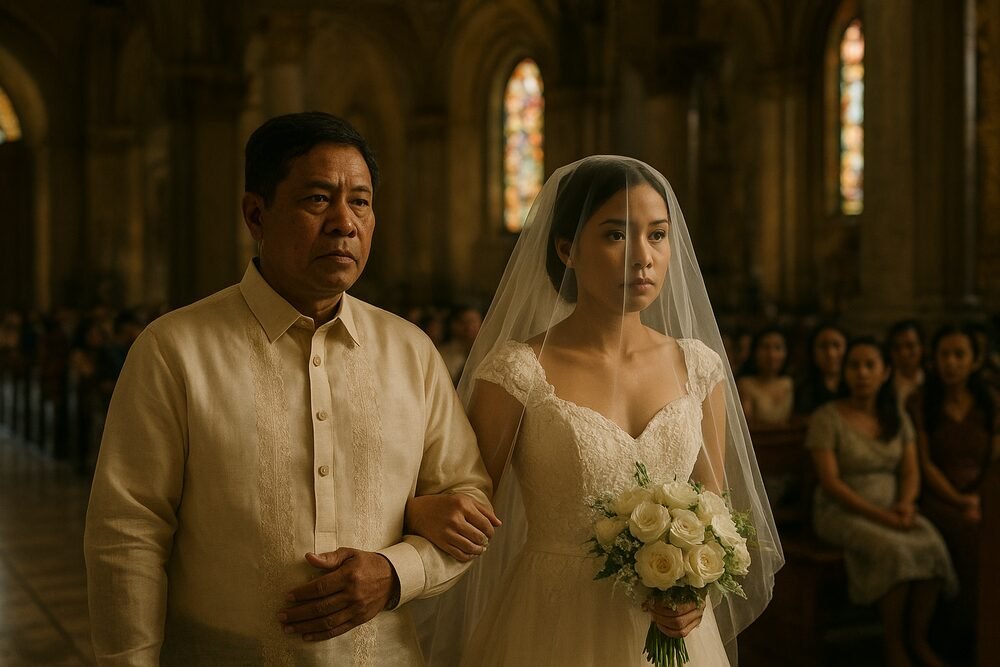
A question circulating in Filipino-language social media — “Tatay, bakit kaya biglang bumitaw sa anak niyang ikakasal habang inihahatid sa altar?” (“Father, why did he suddenly let go of his child while walking her down the aisle?”) — has stirred speculation online. Yet a review of available records and publicly accessible reports reveals no verified incident, official data, or documented cultural practice that clearly corresponds to the claim.
An examination of recent news archives, public government data, and documented wedding-related incidents in the Philippines shows that none directly address a father abandoning a bride at the altar under the circumstances implied by the viral question. Instead, the available records point to unrelated events, including a major earthquake that disrupted a wedding ceremony in Davao del Norte and broader reports on the economic impact of the pandemic on Southeast Asia’s wedding industry.
No Verified Incident in Official Records
A coordinated review of official Philippine sources — including publicly available materials from government statistical agencies and law enforcement bodies — yields no formal complaint, filed case, or publicly documented investigation describing such an episode.
Events that unfold during wedding ceremonies occasionally reach public attention when tied to emergencies or criminal matters. However, in this instance, no official statement or documented case aligns with the narrative implied by the question.
This absence of verifiable information suggests one of three possibilities:
The story may be mischaracterized or taken out of context.
It may refer to a private family matter that did not result in public reporting.
It may be a fictional or dramatized account circulating online.
Context: Weddings Disrupted by External Events
While the specific claim remains unsubstantiated, other interruptions to wedding ceremonies in the Philippines have been documented. One reported incident involved a 7.4-magnitude earthquake that interrupted a ceremony in Davao del Norte. In that case, the disruption was caused by a natural disaster — not by family dynamics.
Such events highlight how quickly extraordinary circumstances can interrupt solemn occasions. However, no evidence connects those reports to a scenario involving a father abruptly releasing his daughter while escorting her down the aisle.
The Power — and Risk — of Viral Narratives
Wedding traditions hold deep cultural significance in Filipino communities. The act of a father walking his daughter down the aisle symbolizes support, blessing, and transition. Any sudden break in that ritual can carry powerful emotional weight, which may explain why such a question resonates widely online.
Yet emotionally charged narratives are particularly vulnerable to distortion. Without corroborating evidence — such as official reports, documented testimony, or credible media accounts — questions framed around dramatic moments often blur the line between reality and speculation.
No Legal or Regulatory Framework Implicated
A review of Philippine legal statutes and regulatory frameworks governing marriage ceremonies reveals no provisions that would relate to, or regulate, a parent’s physical participation in escorting a bride down the aisle. Marriage laws focus primarily on licensing, consent, solemnizing officers, and civil registration requirements.
In short, the alleged scenario does not appear to intersect with formal legal structures in any way that would generate public records.
Conclusion: An Unverified Claim
At present, there is no documented evidence, official data, or verified reporting confirming the circumstances implied by the viral question. Without additional substantiated information — such as a named case, formal complaint, or first-hand, documented account — the matter remains unverified.
In the digital age, emotionally vivid questions can spread quickly, often outpacing facts. As with any circulating narrative that involves personal relationships and potentially sensitive circumstances, readers are advised to approach such accounts with caution, seeking confirmation from authoritative sources before drawing conclusions.
Until verifiable details emerge, the question of why a father allegedly let go of his daughter during one of life’s most symbolic walks remains, at most, a story without a confirmed source.