President Ferdinand Marcos Jr. is pushing Congress to fast-track a measure that would give him temporary authority to suspend or reduce excise taxes on fuel, as global oil prices surge past $100 per barrel amid deepening tensions in the Middle East. The House Committee on Ways and Means approved a consolidated version of the bill on March 10, clearing the way for the President to certify it as urgent and accelerate its passage.
The proposed amendment to Section 148 of the National Internal Revenue Code would allow the President to roll back fuel excise taxes for up to six months at a time when specific triggers are met—chief among them, when the average price of Dubai crude oil exceeds $80 per barrel for at least one month. As of March 9, benchmark prices had climbed beyond $100 per barrel.
Emergency Lever on Fuel Taxes
The measure seeks to give Malacañang what lawmakers describe as a critical “emergency lever” in times of extreme price volatility. According to the explanatory note of House Bill 8292, authored by Speaker Faustino “Bojie” Dy III and Majority Leader Ferdinand Alexander Marcos:
“This measure grants the President of the Philippines the authority to suspend the imposition of, or reduce the excise taxes on petroleum products when public interest so requires. This measure comes amid renewed volatility in global oil markets due to geopolitical tensions in the Middle East, which threaten to disrupt supply and push fuel prices higher.”
The authority would be time-bound. Each suspension could last up to six months, extendable by Congress, but not exceeding a total of one calendar year per activation. The power would expire altogether on December 31, 2028. After any suspension, excise tax rates would automatically revert to previous levels.
The mechanism would require recommendations from the Development Budget Coordination Committee (DBCC) and the Department of Energy (DOE) before implementation. It would apply nationwide.
What Is at Stake for Motorists
Fuel excise taxes currently stand at P6 per liter on diesel and P10 per liter on unleaded gasoline. In ordinary times, they serve as a steady stream of government revenue. In extraordinary times, however, they can amplify already painful price spikes.
According to scenario modeling presented by National Economic and Development Authority Undersecretary Rosemarie Edillon, without intervention diesel could reach as high as P96 per liter and gasoline P92.20 per liter.
With a full suspension of excise taxes, diesel prices could fall to about P90.04 per liter, while gasoline could drop dramatically to around P59 per liter, based on the model.
Recent weeks have already seen oil firms impose staggered increases—some as steep as P24.25 per liter for diesel and P19.20 per liter in other cases—reflecting global crude price surges.
The DOE has endorsed the measure, noting that even a two-month suspension could reduce diesel prices and offer relief to motorists, transport operators and businesses.
A Costly Trade-Off
While the proposal promises relief at the pump, it carries a heavy fiscal cost. The Department of Finance has warned that fully eliminating fuel excise taxes could cost the government as much as P136 billion in revenue in 2026 alone.
That revenue underpins infrastructure, social services, and debt servicing obligations. In effect, the government would be swapping immediate consumer relief for a significant hole in its budget—a choice akin to lowering the thermostat in one room while dimming the power supply for the entire house.
To balance this, the bill restricts when and how the authority can be exercised, tying it to measurable price thresholds or the declaration of a national emergency or calamity.
Pressure on Households and Small Businesses
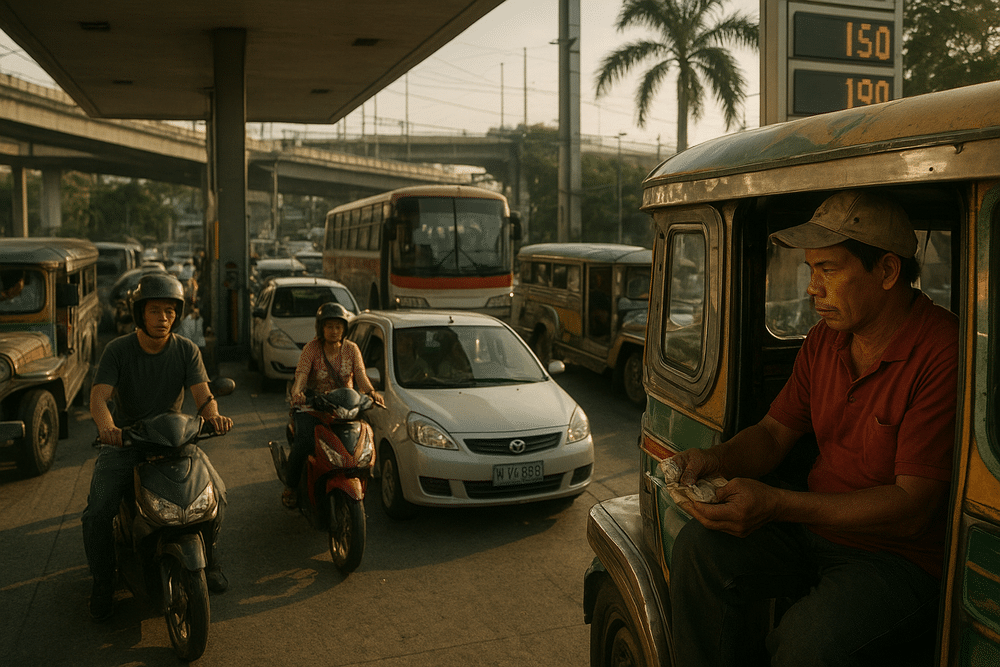
For ordinary Filipinos, however, the debate is less abstract than the national balance sheet. Rising fuel costs ripple quickly through the economy. Jeepney drivers, trisikad operators and provincial bus services face higher daily operating expenses. Delivery riders and small logistics firms see margins shrink.
A spike of P19 to P24 per liter can translate into an additional P50 to P100 in weekly commuting costs for many families. Diesel hikes push up food transport costs, nudging prices of vegetables, fish and other staples sold in public markets. For small shops and farms, fuel is not optional—it is embedded in nearly every transaction.
The suspension mechanism, supporters argue, would act as a pressure valve during extreme volatility, helping prevent fuel-driven inflation from compounding hardship.
Political Momentum Builds
Malacañang signaled on March 9 that President Marcos intends to certify the bill as urgent, a move that would allow Congress to accelerate the legislative process.
The proposal has shown signs of cross-aisle support. Senator Francis Pangilinan has filed a similar measure in the Senate, likewise allowing presidential authority to suspend excise taxes upon DBCC recommendation.
On March 11, the President outlined conditions for implementation consistent with the bill’s triggers. Meanwhile, industry representatives cautioned that even if the measure becomes law, consumers should not expect immediate price reductions, as market dynamics and supply considerations may temper the speed of adjustments.
An Unsettled Global Backdrop
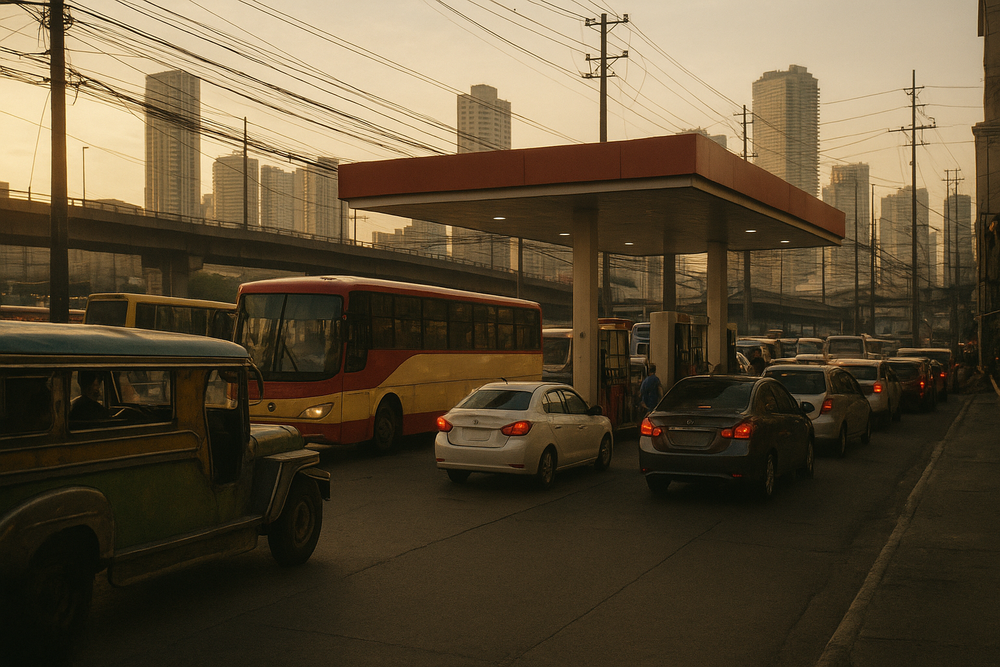
At the heart of the measure lies a volatile global oil market. Dubai crude’s climb past $100 per barrel underscores the Philippines’ exposure to geopolitical shocks far beyond its shores. In an import-dependent economy, international price surges are felt within days at local petrol stations.
The proposed law would not shield the country from global turbulence. But it would give the executive branch a temporary policy tool—one designed to cushion the blow when global shocks threaten to cascade through the domestic economy.
Congress now faces a familiar dilemma: whether to trade fiscal certainty for short-term relief. For motorists lining up at filling stations and families recalibrating household budgets, the outcome could mean the difference between tightening belts further—or loosening them, even briefly, in the months ahead.