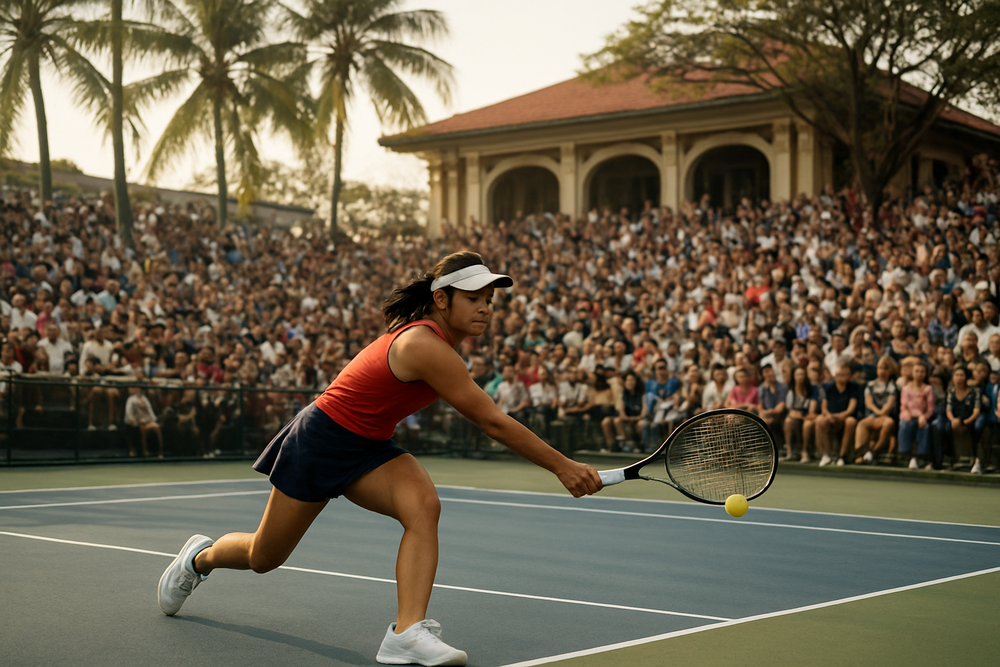
Manila will take a long-awaited step onto the global tennis stage later this month as the inaugural Philippine Women’s Open brings world-class competition to the heart of the capital. From January 26 to 31, 2026, the historic Rizal Memorial Tennis Center will host a WTA 125 tournament, the first of its kind ever staged in the Philippines on hard courts, signaling a landmark moment for the sport in the country.
A Historic First for Philippine Tennis
The Philippine Women’s Open marks the country’s first WTA-sanctioned event, placing Manila on the Women’s Tennis Association calendar for the first time. The tournament carries a prize pool of $115,000—around PHP 6.7 million—and will feature a 32-player singles draw alongside a 16-team doubles competition.
For organisers, the event is more than a week of elite sport. It is a statement of intent. By securing WTA sanctioning, the Philippines formally joins the global professional tour, offering local players exposure that once required travel abroad and giving fans a rare chance to witness top-tier tennis at home.
Rizal Memorial Readied for a Global Audience
At the centre of preparations is the Rizal Memorial Tennis Center, a venue steeped in Philippine sporting history. The Philippine Sports Commission (PSC) has overseen an accelerated programme of renovations, with three of the complex’s seven courts refurbished to meet WTA standards.
Additional bleachers are being installed to accommodate more than 2,000 spectators, transforming the venue into a compact arena designed for proximity and atmosphere rather than sheer scale. “In the next few days, we’re going to renovate the tennis courts in Rizal and we’re making sure to add more bleacher sets. We hope to accommodate more than 2,000 people in January,” PSC chairman Pato Gregorio said.
The event will be limited to Metro Manila (NCR), with organisers stressing that the use of an existing public venue means minimal disruption to traffic or daily life in the surrounding area.
A Strong Field Blending Global and Local Stars
The tournament’s entry list underlines its competitive stature. Among the notable international players expected are Tatjana Maria (world No. 42), Wang Xinyu (No. 43), Donna Vekic, Solana Sierra (No. 64) and Lulu Sun (No. 85). Their presence places the Manila event firmly within the upper tier of WTA 125 competitions.
Local attention, however, will focus squarely on Alex Eala, the 20-year-old Filipina widely regarded as the standard-bearer for the country’s tennis revival. Currently ranked around No. 50, Eala is expected to feature via a wildcard entry, giving home fans a rare chance to see her compete on Philippine soil.
Her involvement comes despite an overlapping schedule with the Australian Open, which runs from January 12 to February 1. PSC officials have played down concerns. “Alex’s availability will not be an issue,” Gregorio said, seeking to reassure fans and sponsors alike.
A Platform for the Next Generation
While the marquee names draw headlines, the tournament also offers a crucial development pathway for local players such as Tennielle Madis, the Philippines’ No. 2. Competing against higher-ranked opponents at home reduces costs and pressures that often limit opportunities for emerging athletes.
Officials hope the impact will extend beyond the professional ranks. By making tickets affordable and staging matches in an accessible public venue, organisers aim to spark grassroots interest, particularly among young players inspired by Eala’s rise.
Three Years, Bigger Ambitions
The event is not a one-off. In November 2025, the Philippine Tennis Association (PHILTA) signed a three-year contract with the WTA, committing the country to hosting an annual tournament through 2028. Discussions are already under way about future expansion.
“If we want to bid for bigger WTA events, maybe we can go to larger stadiums like those in Clark. Every year, hopefully in the next three years, we would have WTA [events] here in the Philippines,” Gregorio said, outlining a roadmap that could see the country hosting higher-tier competitions.
A Modest Event With Outsized Significance
In practical terms, the Philippine Women’s Open is a contained affair: a single venue, a limited audience, and a week-long schedule. Yet its symbolism is far larger. Like the first serve of a long match, the tournament represents an opening rally—measured, deliberate, but full of promise.
For Manila, and for Philippine sport more broadly, the arrival of WTA tennis signals a belief that the country can be more than a distant spectator to global competition. In late January, when the first ball is struck at Rizal Memorial, it will mark not just the start of a tournament, but the beginning of a new chapter.