MANILA — Philippine authorities have launched an aggressive crackdown on wet market retailers in the capital, issuing “show-cause orders” to vendors accused of inflating food prices during the critical holiday season. The enforcement operation, led by the Department of Agriculture (DA) and the Department of Trade and Industry (DTI), targets a widening gap between government-mandated price ceilings and the soaring costs of kitchen staples like pork and onions.
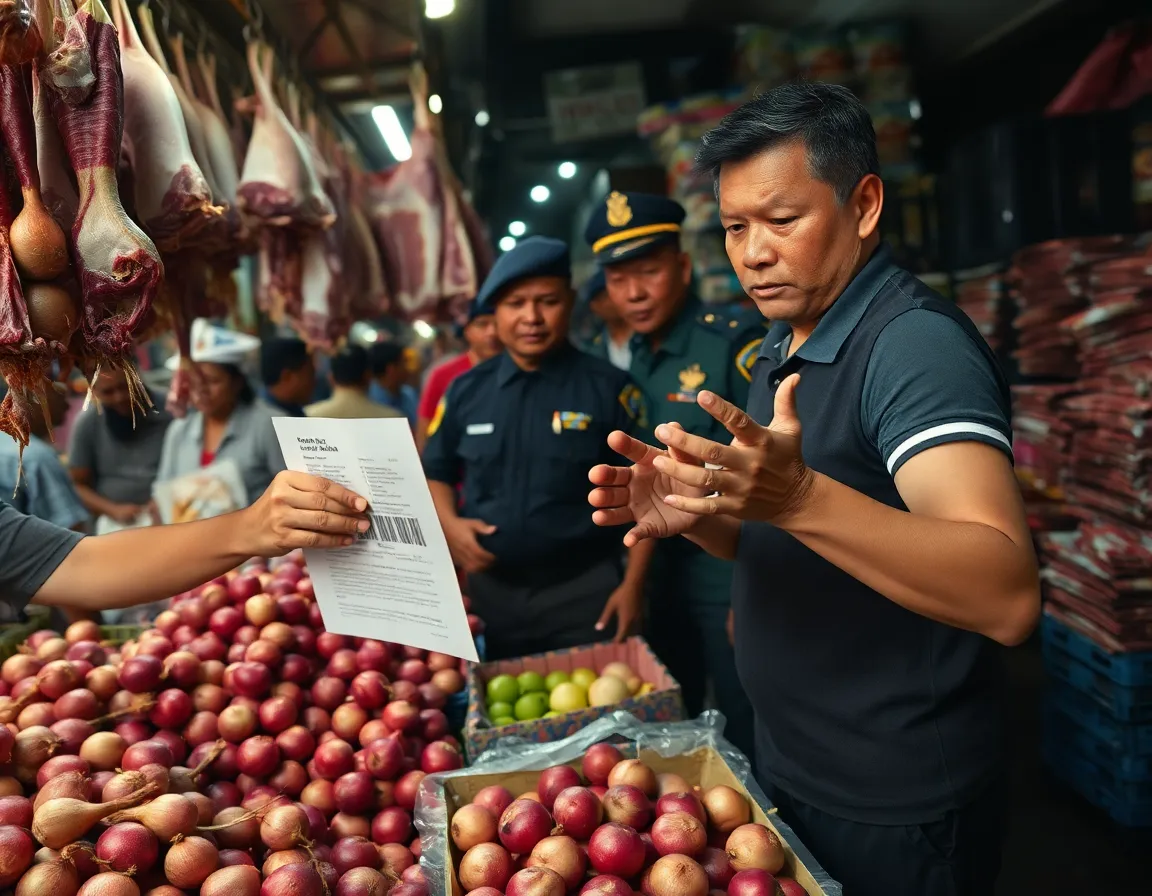
On Wednesday morning, joint inspection teams accompanied by the Philippine National Police descended on Obrero Public Market in Manila. The operation resulted in the immediate issuance of notices to multiple retailers found selling agricultural commodities significantly above the Maximum Suggested Retail Price (MSRP). Agriculture Secretary Francisco Tiu Laurel Jr. described the move as merely the “first batch” of a broader campaign intended to curb profiteering across the metropolis.
A Sharp Disconnect in Pricing
The crackdown comes amid heightened government scrutiny of the food supply chain. Inspectors at Obrero Market documented red onions selling for as high as ₱240 per kilogram ($4.15), a stark contrast to the government’s prescribed cap of ₱150. Similarly, pork liempo (belly), a favored cut for holiday feasts, was priced between ₱420 and ₱440 per kilogram, well above the mandated ₱370 ceiling.
The disparities extended to other goods, with white onions and pork shoulder (kasim) also exceeding their respective price limits. The retailers issued with show-cause orders have been given three days to provide written justifications for their pricing. Failure to prove that high acquisition costs necessitated the markup could result in severe penalties under the Price Act (RA 7581), ranging from fines of up to ₱2 million to imprisonment of five to 15 years.
Government Claims “Mathematical” Certainty
The administration views the current market rates not as a result of genuine scarcity, but as evidence of manipulation. Secretary Tiu Laurel Jr. asserted that the established MSRPs already factor in fair profit margins for every actor in the supply chain, from the farm to the market stall.
“We know the market prices of imported onions, and our MSRP provides fair returns to sellers,” Laurel stated. “There may be some tightness in supply, but that’s no excuse for runaway prices. At current market levels, it already smacks of profiteering.”
Officials argue that the discrepancy is being driven by “cartel-like” behavior among middlemen and distributors. While farmgate prices for hogs have stabilized around ₱255 per kilogram, retail prices remain stubbornly high, suggesting that a markup of nearly ₱170 is being absorbed by intermediaries rather than legitimate transport or utility costs.
The Ghost of Crises Past
The urgency of the current enforcement is rooted in recent history. The Philippines is still grappling with the political fallout of the “Onion Crisis” of late 2022, where prices for the bulb skyrocketed to nearly ₱700 per kilogram—making onions briefly more expensive than beef. To preempt a recurrence during the “Christmas Spike,” a period historically associated with food inflation, the DA implemented new price ceilings earlier this month.
Despite these measures, monitoring teams recorded average red onion prices in Metro Manila hitting ₱213.87 per kilogram last week, triggering alarms for “unjustified” spikes and prompting the inspections that began Tuesday at Quezon City’s Mega Q Mart.
Retailers: Caught in the Middle
On the ground, the narrative is more complex. Many vendors at Obrero Market claim they are merely the visible face of a systemic problem. Retailers argue they are forced to violate the MSRP because their acquisition costs from wholesalers—known locally as biyaheros—are already near or above the government’s selling cap.
“We are just passing on the price,” said one retailer, whose sentiment reflected the collective frustration of the market’s vendors. “If we sell at the government price, we won’t earn anything to feed our own families.”
While consumer groups have generally welcomed the crackdown, there is skepticism regarding its long-term efficacy. Critics often point out that targeting small-scale market vendors allows larger smugglers and hoarders—who control the bulk of the supply—to evade scrutiny.
Broader Implications
The crackdown is expected to have an immediate, albeit potentially volatile, impact on Manila’s local economy. Obrero Market serves as a critical pricing barometer for working-class families in the Blumentritt and Sta. Cruz districts. Reports indicate that consumers are already shifting behaviors, opting for cheaper protein alternatives like chicken or purchasing meat in smaller, “tingi” quantities.
Assistant Secretary for Consumer Affairs Genevieve Velicaria-Guevarra emphasized that the investigation aims to trace the problem up the chain. “Retailers say they have many expenses, so we want to know what these are,” she said. “We need to talk to all players in the value chain before we conclude whether this is a concerted or habitual effort.”
As the holiday season peaks, the specter of a “supply hide”—where vendors withhold stock rather than sell at a loss—looms over the capital, potentially tightening supplies further in the days ahead.