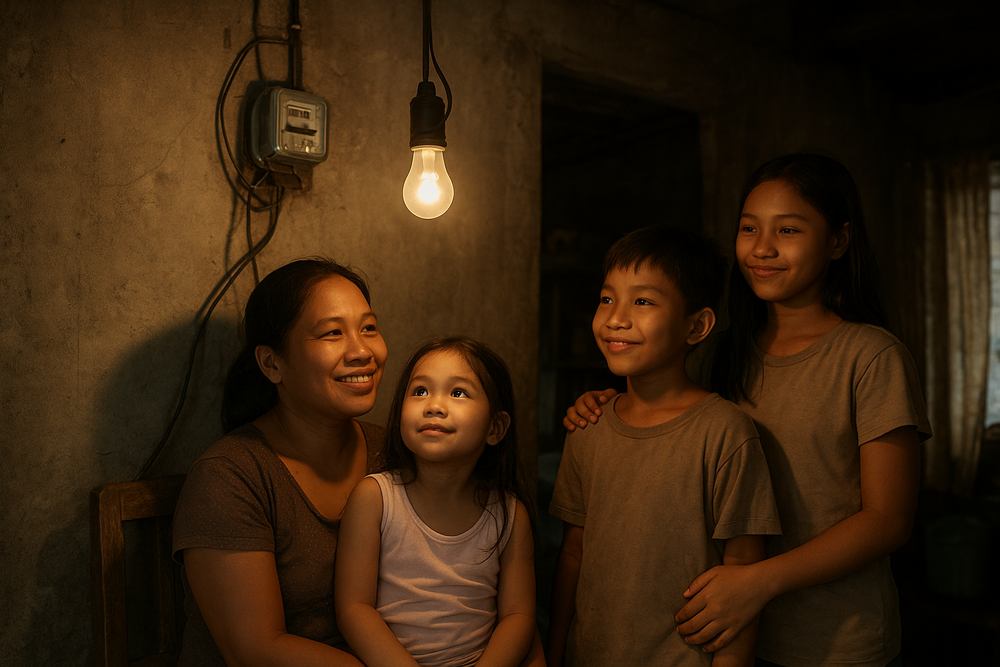
The Philippine government has moved to automatically enroll millions of its poorest households into an electricity discount program, cutting through years of paperwork that kept many from receiving the benefit. Under a new joint resolution, families covered by the Pantawid Pamilyang Pilipino Program (4Ps) will be registered automatically for the Lifeline Rate Subsidy Program, giving them free or heavily discounted power for basic monthly use.
The policy, issued on January 30 by the Department of Energy (DOE), the Department of Social Welfare and Development (DSWD), and the Energy Regulatory Commission (ERC), is expected to ease electricity costs for an estimated 4.5 million vulnerable households nationwide. It takes effect 15 days after publication of the relevant ERC resolutions, likely within the coming month.
Automatic enrollment replaces years of red tape
At the heart of the reform is Joint Resolution No. 01, Series of 2026, which creates a data-sharing mechanism among the DOE, DSWD, the Philippine Statistics Authority (PSA), and electric distribution utilities (DUs).
Instead of filing applications, 4Ps beneficiaries who meet the criteria will be matched automatically with utility records using a DSWD-certified beneficiary list submitted annually as of January 31. Distribution utilities will validate the data and resolve minor discrepancies, such as spelling variations or address inconsistencies.
Manual applications will remain available only for cases involving substantial data mismatches or for other marginalized users who are not part of 4Ps but are certified to be below the national poverty threshold.
A uniform rule for nationwide discounts
In a companion measure, ERC Resolution No. 02, Series of 2026 standardizes the Lifeline Rate Subsidy across the country. Qualified households consuming 0 to 50 kilowatt-hours (kWh) per month will receive a 100 percent discount on generation, transmission, distribution, system loss, metering, supply charges and value-added tax.
The ERC said distribution utilities that already have approved lifeline thresholds above 50 kWh may continue applying higher-tier discounts until further notice.
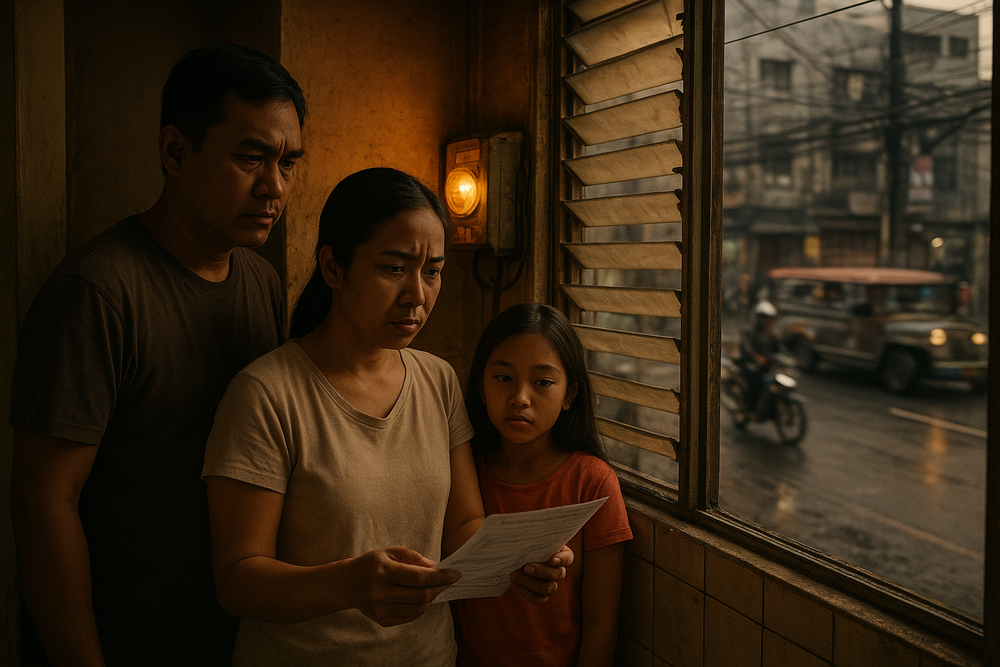
For families living on tight budgets, the impact can be substantial. Zero billing for basic electricity use can free up ₱20 to ₱300 a month—money often redirected to food, school supplies or transport.
Electricity subsidy funded by a nationwide levy
The expanded subsidy will be financed through a ₱0.01 per kWh Lifeline Subsidy Rate collected from all electricity consumers nationwide. The funds will be pooled into a National Lifeline Subsidy Fund, to be administered by the Power Sector Assets and Liabilities Management Corporation (PSALM), with auditing and reporting requirements.
While the levy adds a small amount to monthly bills for non-subsidized users, regulators describe it as a minimal contribution spread across the entire customer base to secure electricity access for the poorest households.
Government frames move as equity measure
Energy officials said the policy is a direct response to a presidential directive to widen access to lifeline subsidies and make social protection programs work at scale.
Energy Secretary Sharon Garin described the reform as a way of removing bureaucratic bottlenecks that have long stifled enrollment.
“In his State of the Nation Address, the President directed the government to expand the lifeline rate subsidy so that more economically disadvantaged Filipinos can afford electricity,” Garin said. “This Joint Resolution is our concrete response to that directive. By automating and simplifying registration for qualified 4Ps households, we are reducing red tape and helping ensure that assistance reaches those who need it most—faster, fairer, and at scale.”
Why the system mattered
The Lifeline Rate Subsidy Program has existed for years under Republic Act No. 11552, but uptake remained low. Many eligible households were unaware of the scheme or discouraged by document requirements and repeated visits to utility offices—costly obstacles for daily wage earners and rural families.
The new framework treats eligibility less like a gatekeepers’ maze and more like a background check: if a household is already recognized by the state as poor, the subsidy follows automatically.
Implementation rests with utilities
Distribution utilities—both private firms and electric cooperatives—will carry much of the operational burden. They will apply discounts to eligible accounts, validate data, and remit the collected subsidy levy.
The ERC said it will oversee compliance to ensure the subsidy is passed on in full and that utilities do not profit from the mechanism.
Relief amid rising costs
For low-income households across the archipelago, the reform offers a modest but meaningful buffer against inflation and volatile power prices. It also shifts the logic of the lifeline program from an opt-in benefit to an automatic safeguard.
In policy terms, it is a small charge powering a broad social net—one kilowatt-hour at a time.