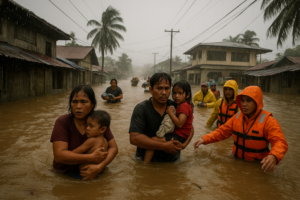
Flash Floods and Landslides Threaten Visayas, Mindanao
Scattered rains and thunderstorms are drenching parts of the Visayas and Mindanao as a persistent shear line combines with the weakening northeast monsoon, or amihan, the Philippine Atmospheric, Geophysical and Astronomical Services Administration (PAGASA) said in its latest advisory. Authorities have warned of possible flash floods and landslides in vulnerable areas, particularly in low-lying and mountainous communities.
In a 4 a.m. bulletin issued over the weekend, PAGASA said the weather systems are affecting Eastern Visayas, Central Visayas, Misamis Oriental, Camiguin, Surigao del Norte, and Dinagat Islands, bringing periods of moderate to at times heavy rain. Additional shear line spillover has also been observed over Albay, Sorsogon, Masbate, and Northern Samar.
“Moderate to at times heavy rains may trigger flash floods or landslides in these areas,” PAGASA said. Residents were advised to remain vigilant as rain bands shift throughout the day.
Shear Line Meets a Fading Amihan
A shear line forms where cold northeast winds meet warmer easterlies, often acting like an invisible fault line in the sky. When these air masses collide, they force warm air to rise, generating rain clouds that can unload heavy downpours over confined areas.
The amihan season for 2025–2026 began on October 27, 2025, and has fueled several surges of cool winds and rain-bearing systems in recent weeks. PAGASA weather specialist Aldczar Aurelio said the monsoon is now gradually loosening its grip.
“The amihan will continue to weaken over the next two to three days, while the easterlies… will be the dominant weather system,” Aurelio said on February 23.
Even so, its residual winds continue to funnel moisture toward the eastern sections of the country. Cagayan, Isabela, and Aurora are experiencing light rains due to the monsoon, while much of Luzon, including Metro Manila, is expected to see generally fair weather with isolated showers.
Rough Seas Threaten Coastal Communities
While rainfall remains localized, conditions at sea are more consequential. PAGASA reported moderate to strong northeast winds over eastern Southern Luzon and the Visayas, generating waves between 1.5 to 2.8 meters. In other parts of the country, winds are light to moderate, with wave heights ranging from 0.6 to 2.1 meters.
These sea conditions could prove hazardous for small fishing vessels and motorized bancas, particularly in the Visayas and along the eastern seaboard. Disruptions in fishing operations may tighten supplies in public markets, affecting both livelihood and food prices in coastal towns.
Localized Disruptions on the Ground
For residents in Cebu, Tacloban, and parts of Northern Mindanao, the weather has meant sudden downpours, slick roads, and sporadic power fluctuations. In rural communities, saturated soil heightens the risk of landslides, especially in areas still recovering from previous monsoon surges earlier this month.
PAGASA emphasized that no tropical cyclones are currently being monitored within or near the Philippine Area of Responsibility. Still, under Republic Act No. 10121, local governments are mandated to activate preparedness measures during such weather disturbances.
“Residents in these areas were advised to stay alert for possible flooding or landslides due to moderate to heavy rainfall,” the agency said.
Minimal Impact in Metro Manila and Much of Luzon
Outside the eastern sections of Luzon, weather conditions are relatively stable. Metro Manila and surrounding provinces may experience isolated rain showers but face no significant threat from the shear line.
In Quezon City, temperatures recently ranged from a low of 23.0°C to a daytime high of 29.9°C, reflecting the lingering coolness of the amihan season. As the monsoon weakens and easterlies take over, forecasters expect slightly warmer and more humid conditions in the coming days.
Staying Alert as Weather Patterns Shift
The current weather pattern underscores how even in the absence of tropical cyclones, overlapping systems can still disrupt daily life. The shear line acts like a narrow rain conveyor belt, soaking some provinces while sparing others just a few hundred kilometers away.
For communities across the Visayas and parts of Mindanao, the message from authorities is clear: monitor official advisories, prepare for sudden downpours, and exercise caution at sea and in landslide-prone areas. As the amihan fades and the easterlies assume control, weather conditions may stabilize — but for now, vigilance remains essential.