Francis Ceccarelli, a 22-year-old alpine skier born in Quezon City, finished 54th in the men’s giant slalom at the 2026 Milano Cortina Winter Olympics on Saturday night, marking the Philippines’ first event of this year’s Games and underscoring the country’s steady, if uphill, pursuit of relevance in winter sport.
Competing at the demanding Stelvio Ski Centre in Bormio, Italy, Ceccarelli posted a combined time of 2:48.23 across two runs on the 1,448-meter course. He improved from 57th place after the first run to 54th overall out of 81 competitors, finishing the race he once described as his primary Olympic goal: reaching the bottom of the course.
A Measured Climb on the Stelvio
Wearing bib number 67, Ceccarelli clocked 1:27.36 in Run 1, placing 57th, with a first checkpoint split of 23.18 seconds. In the second run, he sharpened his pace, finishing in 1:20.87 — good for 53rd fastest in that heat — and climbing three spots in the final standings.
The podium featured elite names in alpine skiing. Lucas Braathen Pinheiro of Brazil took gold in 2:25.00, followed by Switzerland’s Marco Odermatt (2:25.88) and Loïc Meillard (2:26.17).
On a course marked by 52 turning gates and steep, icy gradients, Ceccarelli’s performance was never about contending for medals. It was about representation — and execution under the Olympic spotlight.
From Quezon City to the Alps
Born on November 15, 2003 in Quezon City, Ceccarelli moved to Italy at age eight after being adopted by an Italian couple near the ski area of Abetone. He began competitive skiing in December 2019.
In May 2023, following a three-year process to reacquire Philippine citizenship and secure a passport, he formally switched allegiance from Italy to the Philippines. The move complied with International Ski and Snowboard Federation regulations and opened the door to Olympic qualification through FIS-sanctioned events.
“Ever since I began skiing, my Filipino heritage has always been a part of me. It signifies my birthplace and roots,” Ceccarelli said in a previous interview. “Competing for the Philippines was a goal of mine, as it’s not every day that we see a Filipino athlete skiing at an international level.”
Redemption After Setback
Ceccarelli’s Olympic appearance comes a year after a disappointment at the 2025 Asian Winter Games in Harbin, where he was disqualified in the men’s slalom.
“The Asian Games were a letdown, but they also taught me valuable lessons,” he said. “I learned the importance of self-management and strategy. Sometimes, the experience matters more than winning.”
That lesson appeared to steady him in Bormio, where simply completing two clean runs on one of the sport’s grandest stages marked tangible progress.
In the weeks leading up to the Games, Ceccarelli recorded a career highlight with a 12th-place finish in giant slalom at the FIS CUP in Jahorina, Bosnia and Herzegovina, posting a combined time of 2:05.69. His current FIS points stand at 74.37 in giant slalom and 65.38 in slalom, rankings that secured his Olympic berth.
A Small Delegation, A Broader Statement
The Philippines sent a two-athlete delegation to Milano Cortina, doubling its alpine skiing representation from the previous Winter Games. Alongside Ceccarelli is Tallulah Proulx, who is set to compete in the women’s giant slalom.
For the Philippine Ski & Snowboard Federation and the Philippine Sports Commission, Ceccarelli’s finish may not rewrite record books, but it reinforces a broader objective: sustained participation in a discipline alien to the country’s tropical climate.
The Philippines has no natural snowfields. Its winter sports training relies heavily on athletes raised or based abroad, often in Europe or North America. In that sense, each Olympic start is both athletic performance and logistical triumph.
Inspiration Beyond the Snow
Ceccarelli once said of his Olympic ambition: “It’s an honor to compete. My goal is not only to participate but to finish in the top 50—and to reach the bottom of the course, above all.”
He narrowly missed that top-50 target, but achieved the latter — completing both runs in a field where mistakes often send racers sliding out of contention in seconds.
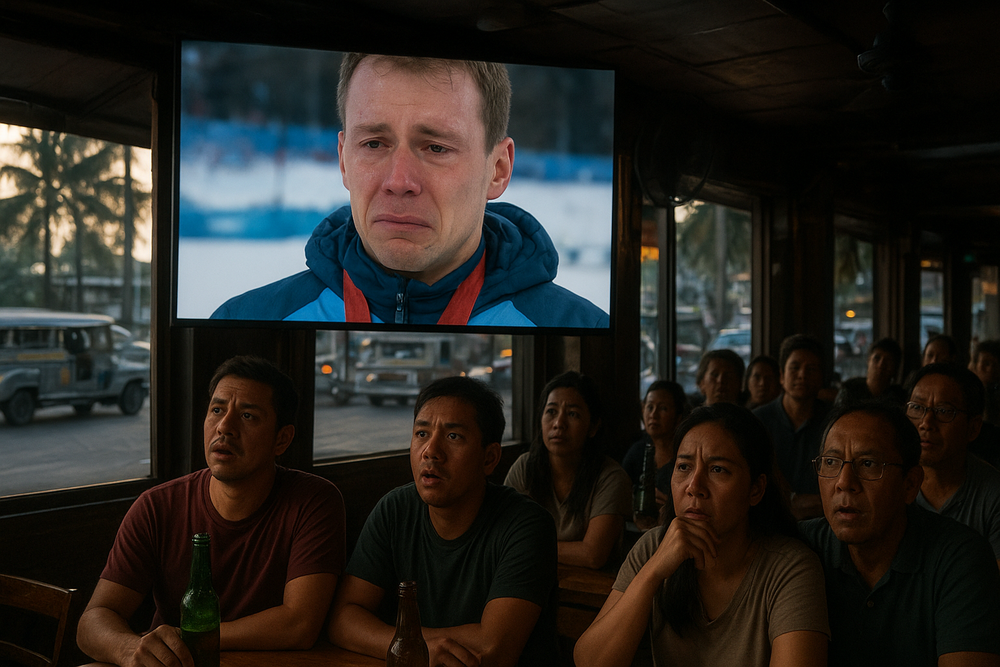
For young Filipinos watching from cities like Quezon City and across the country, his run down Stelvio offered a different image of national sport: a Filipino athlete carving turns on Alpine ice, racing not against geography but against time.
Ceccarelli’s Olympic campaign is not yet over. He is scheduled to compete next in the men’s slalom, an event that traditionally rewards technical precision over speed. For the Philippine delegation, each gate cleared will continue to carry meaning far beyond the mountain.