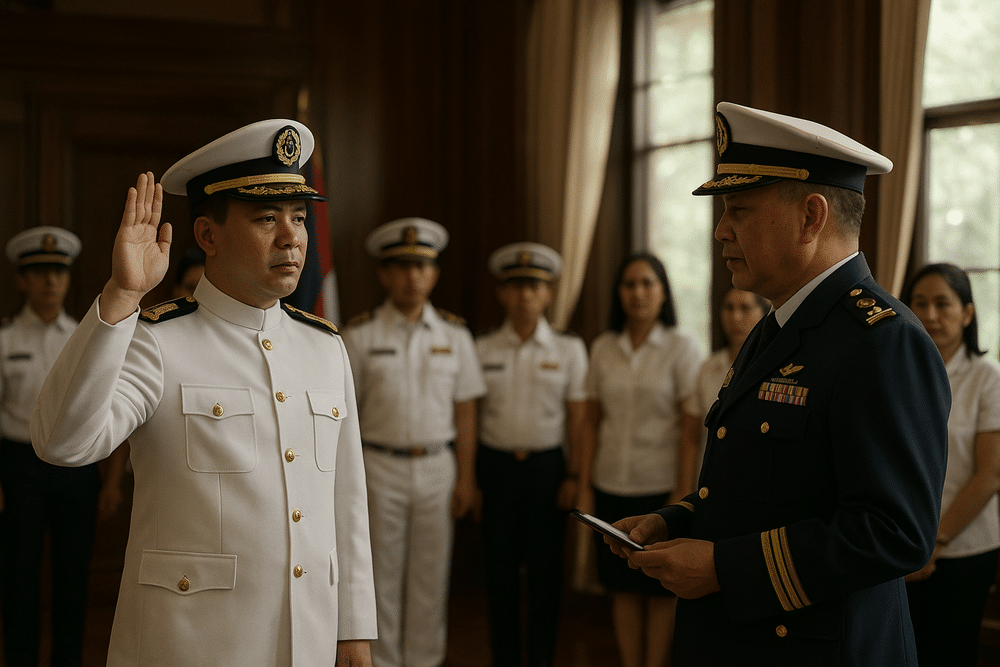
Ferdinand Martin G. Recto has taken his oath as Auxiliary Vice Admiral (AUX VADM) in the Philippine Coast Guard Auxiliary (PCGA), joining the volunteer civilian corps that supports maritime safety, search and rescue, and environmental protection operations across the Philippines’ vast archipelago.
The appointment places Recto among the highest-ranking members of the PCGA, a non-government, non-political, service-oriented uniformed organization that operates under the supervision of the Philippine Coast Guard (PCG). While the auxiliary follows a military-style rank structure, it performs non-military and non-police functions, working alongside the PCG in safeguarding lives and property at sea.
No official confirmation of the specific date of Recto’s oath-taking was available in public records at the time of writing.
A Civilian Force With a National Footprint
The PCGA traces its roots to 1968 and was formally established in 1972 under Republic Act No. 5173. It was later institutionalised under the Philippine Coast Guard Law of 2009 (Republic Act No. 9993), which strengthened its mandate and placed it firmly under the authority of the PCG Commandant.
“The overall authority for PCGA administration is vested in the Commandant,” according to its regulations manual.
Today, the auxiliary operates through a structured nationwide network composed of:
- The National Auxiliary Main Office (NAMO)
- 12 Auxiliary Districts covering Luzon, Visayas and Mindanao
- More than 95 squadrons and numerous divisions
Membership figures have fluctuated in recent years. While historical data places its strength at around 10,000 squadron members, stricter vetting requirements introduced in 2023 — including mandatory national clearances — have brought the number to approximately 5,000 members as of 2024.
The tighter screening reflects broader security considerations and reforms under the current PCG leadership.
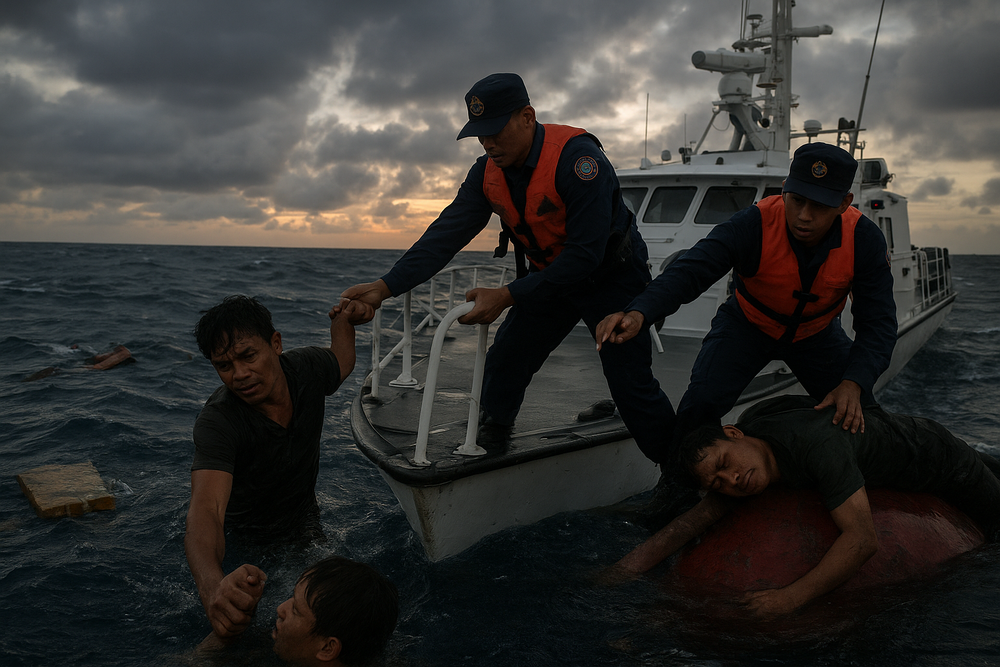
Supporting Search and Rescue Across 7,641 Islands
The Philippines, an archipelago of 7,641 islands, depends heavily on maritime transport and coastal livelihoods. In this complex maritime environment, the PCGA serves as a force multiplier for the Coast Guard.
Under the law, its primary role is to assist in:
- Promoting safety of life and property at sea
- Conducting maritime search and rescue
- Preserving the marine environment and its resources
- Supporting aids to navigation and maritime community relations
“Its primary functions include providing support and assistance to PCG in the promotion of safety of life and property at sea, the preservation of the marine environment and its resources, the conduct of maritime search and rescue…” the law states.
For coastal communities, these functions are far from abstract. The fishing sector alone supports an estimated 1.6 million Filipinos, many of whom rely on safe waters and timely rescue operations during typhoons and maritime accidents. Island commuters and small vessel operators also benefit from safety campaigns and auxiliary patrols.
Military Ranks, Civilian Mandate
Though civilians, PCGA members adopt naval-style ranks that mirror the Coast Guard’s command hierarchy. Recto’s new rank of Auxiliary Vice Admiral places him among the senior echelon of the organisation.
The auxiliary counts several prominent figures among its leadership and members. Records note, for example, that “AUX VADM IDQUIVAL PCGA is a businessman by profession,” underscoring how professional leaders from outside traditional maritime services are integrated into the corps.
The PCGA describes itself as “a service-oriented, uniformed, voluntary organization” whose members adhere to PCG customs and traditions while remaining outside formal government service.
Leadership, Visibility and Institutional Ties
Recto’s oath underscores the auxiliary’s longstanding practice of engaging high-profile individuals to strengthen its outreach and institutional ties. As the PCG operates across 15 Coast Guard Districts, 54 stations and more than 190 sub-stations nationwide, coordination between uniformed personnel and civilian volunteers remains central to its operations.
Administratively, all auxiliary activities fall under PCG supervision, a safeguard enshrined in law to ensure operational discipline and accountability.
Supporters argue that appointments of senior public officials reinforce the bond between lawmakers and maritime frontliners, potentially improving resource mobilisation and legislative backing for maritime safety initiatives.
Vetting and Reform in Focus
In recent years, the PCGA has undergone stricter internal screening measures. Beginning in 2023 and continuing through 2025, reforms introduced mandatory national clearances and tighter oversight of auxiliary personnel.
The measures have reduced membership numbers but signalled a renewed emphasis on credibility and security at a time when maritime issues — including regional tensions and disaster response — remain high on the national agenda.
A Symbolic Role With Practical Stakes
While the position of Auxiliary Vice Admiral does not confer operational command over Coast Guard units, it carries symbolic weight inside an organisation built on voluntary service. In a country where sea lanes are lifelines and storms are seasonal realities, the auxiliary’s work often means the difference between isolation and rescue.
Recto’s elevation to AUX VADM folds another senior public figure into that framework — a civilian corps that functions, in many ways, as the Coast Guard’s second sail: not at the helm, but crucial when winds intensify.
Whether the appointment leads to expanded recruitment, funding or operational reach remains to be seen. What is certain is that the PCGA continues to serve as a bridge between government authority and citizen participation — a partnership designed to keep watch over one of the world’s most maritime nations.