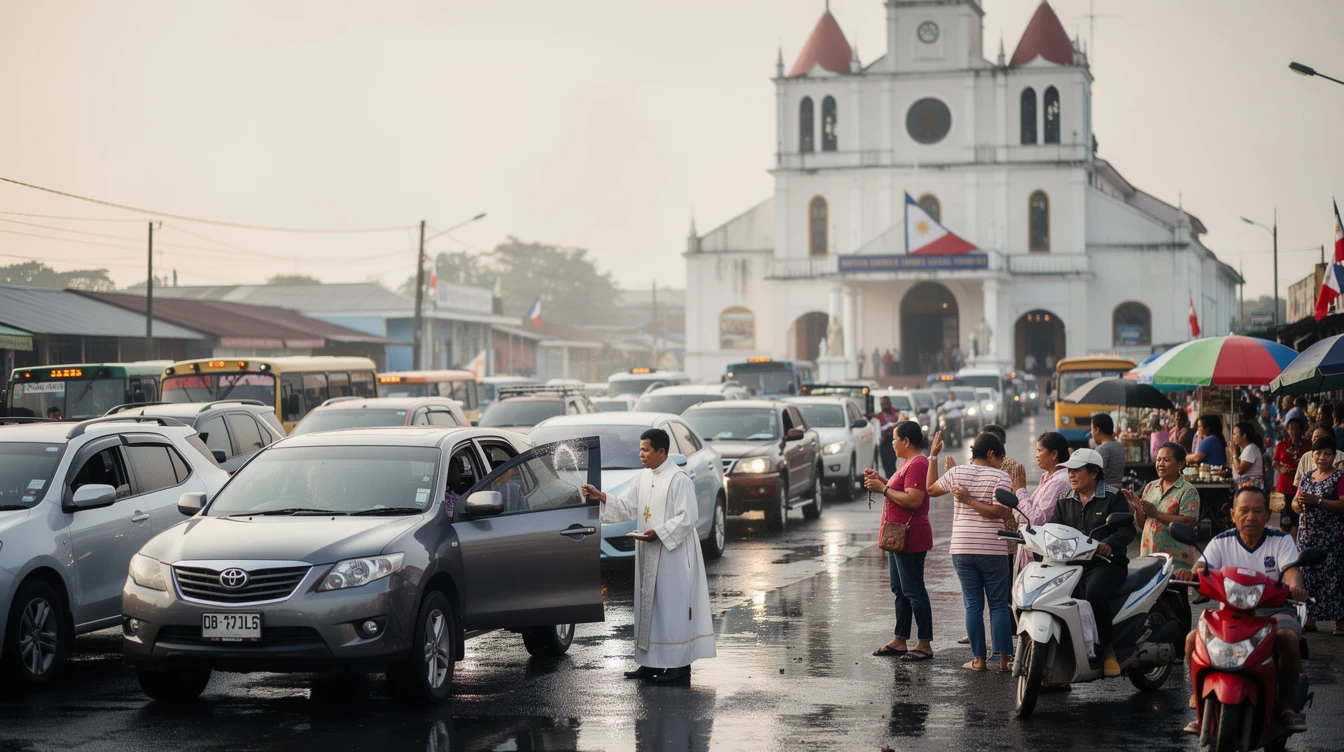
The Minor Basilica of Our Lady of the Rosary of Manaoag in Pangasinan draws thousands of devotees weekly, not only for Mass but for a distinct Filipino Catholic practice: the blessing of vehicles. According to local church officials, car blessings are conducted every day after scheduled Masses, with long queues forming especially on weekends and during the feast of Our Lady of Manaoag every April.
This tradition, while deeply religious, also reflects a broader Filipino cultural emphasis on family safety and protection. For many motorists, a blessed car is more than a ritual—it is a talisman against road accidents, breakdowns, and untoward incidents. A 2023 report in the Manila Times noted that most visitors come to pray, ask for Divine intervention, and pay homage to Mother Mary, with a significant number specifically requesting vehicle blessings.
Filipino
The practice has gained such popularity that the church has a dedicated area behind the basilica for the blessing of cars and accessories. A Facebook page managed by the church regularly posts schedules and reminders for devotees. The ritual involves a priest sprinkling holy water on the vehicle while reciting prayers for protection. Many drivers also bring rosaries, images of saints, and other religious items to be blessed simultaneously.
From a historical perspective, the tradition of car blessing in Manaoag can be traced to the post-World War II era, when Filipinos increasingly owned motor vehicles and sought spiritual security on the road. The church’s reputation for miraculous intercessions, dating back to the 1700s, amplified its appeal. Today, the practice continues to evolve, with some devotees traveling from as far as Metro Manila, Baguio, and even Mindanao to participate.
For more insights on automotive traditions in the Philippines, see Philippine Local.
Drivers
Beyond the religious motive, sociologists suggest that car blessings serve as a communal bonding activity. Families and friends often make a pilgrimage to Manaoag, turning the trip into a shared spiritual journey. The act of blessing a vehicle also reinforces the idea of the car as a sacred space—a protective shell for loved ones. In a country where traffic accidents remain a leading cause of death, this ritual offers psychological comfort.
According to a 2024 Reddit discussion in the Gulong subreddit, many Filipinos express curiosity about the tradition even if they are not religious. One user noted that the practice persists due to "collective habituation" and the desire for tangible protection. Another replied that the blessing also symbolizes thanksgiving for a purchase viewed as a major milestone, such as a car or motorcycle. In many Filipino households, owning a vehicle is a significant achievement, and blessing it consecrates that achievement.
Check the latest trending topics in Philippine Technology.
The ritual itself is simple: after Mass, vehicle owners drive or push their cars to the designated blessing area behind the church. A priest, assisted by an acolyte, walks along the line of vehicles, sprinkling holy water and reciting prayers from the Ritual of Blessings. Owners are encouraged to have the car's windows open so that the blessed water may enter the vehicle. The entire process takes about 30 minutes, but waiting times can extend to two hours during peak seasons.
From an economic perspective, the car blessing tradition has spurred local businesses. Vendors selling religious items, car accessories, and souvenirs thrive near the basilica. Some mechanics even offer pre-blessing check-ups to ensure vehicles are in good condition for the long drive. The town of Manaoag itself has seen growth in hospitality, with inns and restaurants catering to pilgrims. A 2023 report from the Pangasinan Provincial Tourism Office estimated that religious tourism generates over PHP 200 million annually for the local economy.
For more on how faith intersects with everyday life in the Philippines, see Philippine Politics.
The tradition is not without its critics. Some Catholic theologians argue that blessings should be reserved for persons, not objects, and warn against treating the ritual as a form of magic. However, the Archdiocese of Lingayen-Dagupan, which oversees Manaoag, has clarified that the practice is a sacramental, not a sacrament. Sacramentals are sacred signs instituted by the Church to prepare people to receive the grace of the sacraments. The blessing of a vehicle is thus a supplication for God's protection, not a guarantee. "It is an act of faith, not a superstitious charm," Father Jerome Secillano, executive secretary of the Catholic Bishops' Conference of the Philippines, notes.
For Filipino motorists abroad, the tradition has also found a home. Filipino communities in the United States, Canada, and the Middle East have organized car blessing events in churches that honor Our Lady of Manaoag. These gatherings, often held during the feast of the Immaculate Conception or the Manaoag feast day, help overseas Filipinos feel connected to their roots while seeking protection in foreign roads.
Read about weather advisories for travelers in Philippine Weather.
Flock
In an era where road accidents claim over 10,000 lives annually in the Philippines, according to the Philippine Statistics Authority, the car blessing offers a layer of spiritual safety. While it does not replace seatbelts, airbags, or defensive driving, it provides a sense of peace that many drivers find indispensable. The practice also encourages responsible driving. Many devotees say that owning a blessed car reminds them to drive carefully and respectfully, as the vehicle is now a sacred object.
For Filipino readers, understanding this tradition sheds light on the unique blend of Catholicism and folk religiosity that characterizes Philippine society. The car blessing in Manaoag is not merely an eccentric ritual but a testament to how deeply faith is woven into the fabric of everyday life—from the moment one buys a car to every journey taken. It underscores the Filipino value of protection, community, and the belief that divine guidance is needed in every path we undertake.