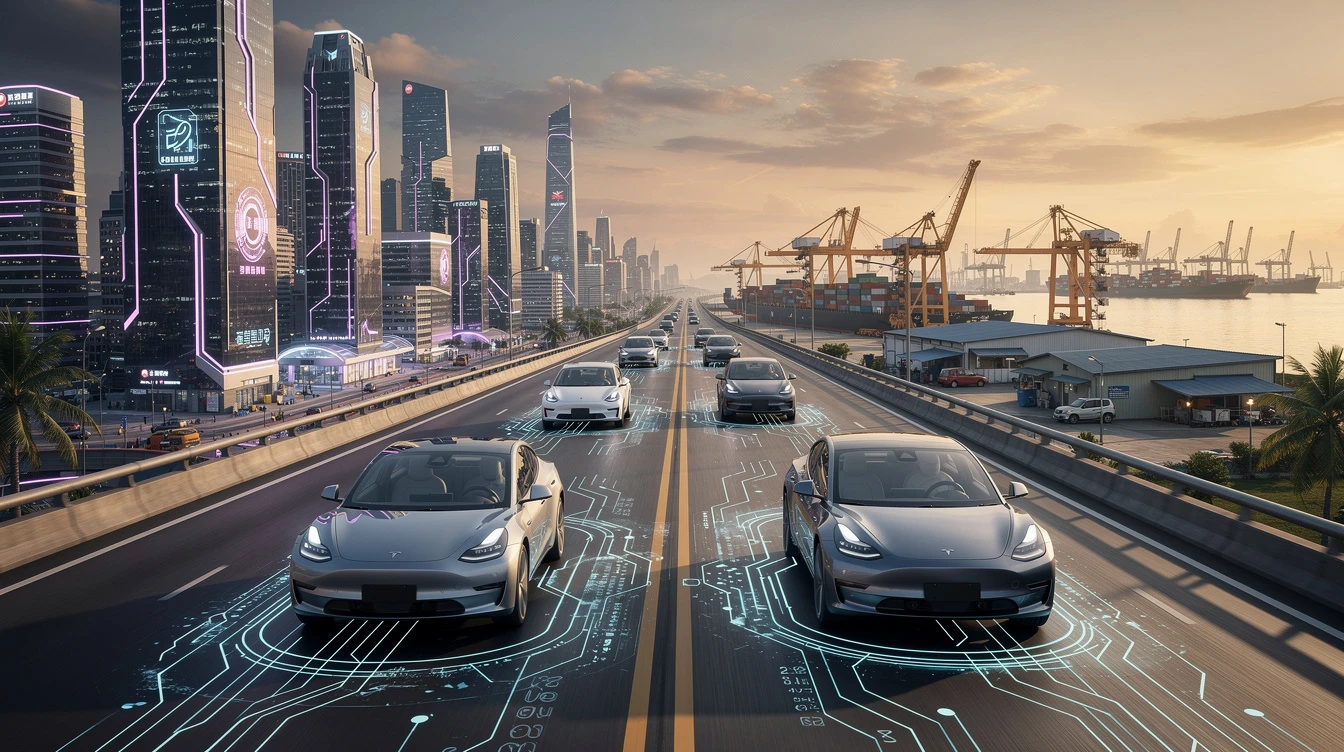
China’s auto industry is racing to embed artificial intelligence in virtually every new vehicle after Beijing issued a sweeping directive, a shift that threatens to disrupt global supply chains and directly impact the Philippine automotive sector. The Beijing Auto Show, which kicked off on Friday, served as the launchpad for announcements that carmakers from Nissan to Dongfeng Motor are integrating AI into their vehicles. “There’s no longer a distinction between a technology company and a car company,” Nissan Motor China chief Stephen Ma told reporters on the sidelines of the event. This rapid transformation means that Philippine assembly plants and importers may face higher costs and technology gaps as Chinese vehicles become more software-driven.
For the Philippines, the implications are immediate. The country imports tens of thousands of Chinese-built vehicles annually, including electric vehicles from BYD and Geely. With Chinese automakers now embedding AI into cars that can self-reason, using chips and software developed domestically, Philippine consumers may soon see smarter but more expensive vehicles. According to industry data, Chinese-brand vehicles accounted for nearly 15% of new car sales in the Philippines in 2025, up from just 5% in 2020. The Philippine Department of Trade and Industry has flagged the need to monitor how these technological shifts affect local manufacturing, noting that the country’s 17 vehicle assembly plants primarily rely on traditional combustion engines.
China’s
China’s drive to embed AI follows a directive from Beijing that positions intelligent vehicles as a national strategic priority. Huawei, the telecommunications giant that pivoted into chips and connected cars, said it would invest more than $10 billion over the next five years to boost computing power for smart driving. This investment dwarfs the entire annual budget of the Philippine automotive sector, which is estimated at around $4 billion. The disparity underscores the challenge for the local industry: how to compete when China’s state-backed automakers are integrating AI into everything from infotainment systems to autonomous driving controls.
Dongfeng Motor, one of China’s Big Four state-owned carmakers, said it would be building cars using “embodied AI technology” in line with China’s long-term plans. This approach combines AI with physical robotics, allowing cars to interact with their environment in real-time. Francois Roudier, secretary general of the International Organisation of Motor Vehicle Manufacturers, told Reuters that China’s automakers are now so advanced they are upending the global car industry. For the Philippines, a major importer of Chinese vehicles, this technological leap could mean that locally assembled cars without AI features become less desirable, or alternatively, that the cost of importing AI-equipped vehicles rises sharply due to embedded software licensing fees.
The Philippine automotive sector is already bracing for impact. In recent statements, the Chamber of Automotive Manufacturers of the Philippines Inc. (CAMPI) warned that the shift toward AI-integrated vehicles could widen the technology gap. CAMPI president Rommel Gutierrez said that local assemblers lack the research and development budgets to incorporate advanced AI systems and may need to seek partnerships with Chinese firms or adapt through joint ventures. The Philippine government, through the Board of Investments, has initiated talks with Chinese automakers to explore technology transfer agreements, but no concrete deals have been announced as of April 2026.
AI-Powered
From a consumer perspective, the integration of AI in Chinese cars offers both promise and risk. Xpeng, a leading Chinese EV maker, said at the show that its updated AI model allows drivers to give commands like “park near the entrance to the shopping center” rather than designating a spot on a map. This level of sophistication could appeal to tech-savvy Filipino buyers, but it also raises concerns about data privacy and security. The Philippine National Telecommunications Commission has not yet issued guidelines governing the data collected by AI-equipped vehicles, leaving a regulatory vacuum that consumer advocacy groups say needs urgent attention.
The timeline for this transformation is compressed. China took 25 years to dominate the global EV market, and now it is hurtling toward the next disruption: embedding AI in cars that will make the next generation of EVs not just network-connected but self-reasoning machines running on Chinese chips and software. Reuters reported that the push follows a high-level call from Beijing to accelerate adoption of indigenous technology. For the Philippines, which relies on a mix of Japanese, American, and Chinese vehicle imports, this means a fragmented future: some cars with deep AI integration, others with none. The lack of standardization could complicate maintenance and repair services, as local mechanics may lack the expertise to service AI-powered systems.
The Philippine government has taken initial steps to address the challenge. The Department of Science and Technology recently announced a partnership with the University of the Philippines to train engineers in AI and automotive software, but the program is in its infancy. Meanwhile, the Department of Trade and Industry has considered imposing tariffs on fully imported AI-equipped cars to protect local assemblers, but such measures could trigger retaliation from Beijing. The balance between fostering local industry and embracing innovation remains a delicate one. For more context on how global tech shifts affect the local economy, see our coverage onPhilippine Business.
In practical terms, Filipino car buyers may see changes as early as 2027, when several Chinese automakers plan to launch AI-equipped models in the Philippine market. These vehicles could offer features like predictive maintenance, real-time traffic optimization, and voice-activated controls. However, the price premium could be significant. Analysts estimate that AI integration could add $3,000 to $5,000 to the cost of a midsize sedan, potentially pricing out middle-income consumers who dominate the Philippine market. For updates on vehicle pricing and trends, follow ourTechnology section.
Revolution:
The convergence of automotive and technology industries also poses a challenge for Philippine regulation. The Land Transportation Office and the Department of Transportation have not yet established standards for AI-driven driver assistance systems. This means that future AI-equipped cars may operate in a legal gray area, with insurers unsure how to assess liability in case of accidents involving self-reasoning vehicles. Industry experts are calling for a multi-sectoral task force to draft regulations before the technology reaches Philippine roads en masse. For a broader perspective on regulatory challenges, read aboutLocal Governance.
For the Philippines, the race to embed AI in cars is a double-edged sword. It offers Filipinos access to cutting-edge technology that can improve road safety and convenience, but it also threatens the viability of the local automotive assembly industry, which employs over 50,000 workers. As China’s auto industry moves at a pace driven by state mandate, the Philippines must decide whether to ride the wave or risk being left behind. The stakes are high, and the window for action is narrow.