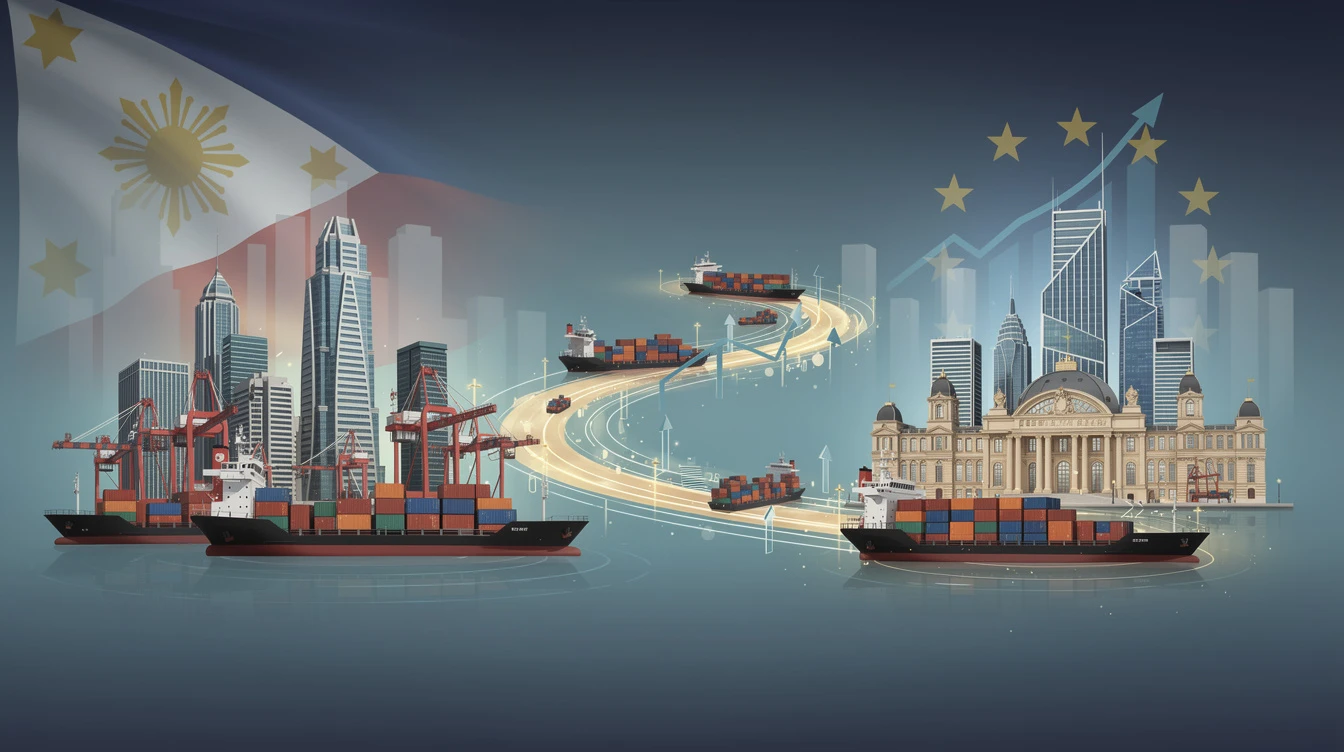
The Philippines and the European Union are on the brink of a historic trade breakthrough. EU Ambassador Massimo Santoro has declared 2026 as the “right year” for a free trade agreement. This comes as the current Generalized Scheme of Preferences Plus (GSP+) privilege is set to expire in 2027.
“It is ending in 2027, so this is why I was mentioning that I am very much hopeful that this is the right year for the FTA,” Santoro said. The next round of negotiations is expected early in 2026.
What’s at Stake for the Philippines?
The EU is the largest foreign investor in the Philippines, according to EU Ambassador Jessen. For Manila, a free trade agreement means locking in tariff-free access for key exports beyond the GSP+ expiry.
Under the GSP+, over 6,200 Philippine products — from tuna to electronics — enter the EU at zero duty. But this preference is not permanent and requires compliance with 27 international conventions on human rights and environment.
The Slovenia Example
Republic of Slovenia Ambassador Smiljana Knez noted that bilateral trade between the Philippines and Slovenia is small at only $30 million in 2025. Yet, Slovenian exports of pharmaceuticals, dairy products, sawn wood, and semiconductors earned 18 million euros (P1 billion).
“This will definitely help, we are very happy that the negotiations are going well and could be signed soon,” Knez said. Slovenia sees the FTA as a mutual gain, not just a concession.
Timeline: Talks Expected to Conclude in H2 2026
Ambassador Santoro revealed that the next negotiation round is “foreseen for the beginning of next year.” Both sides are now working to finalize a date. The target is to conclude talks in the second half of 2026.
This timeline puts the deal well before the GSP+ expiration, giving businesses time to adjust. The urgency stems from the fact that without an FTA, Philippine exporters could lose zero-tariff access overnight.
Key Benefits for Filipino Exporters
An FTA would cover more than just goods. It would include services, investment, and government procurement. This opens doors for Filipino professionals in IT, engineering, and healthcare to work in Europe more easily.
Agriculture also stands to gain. Philippine tropical fruits like mangoes, bananas, and pineapples could compete better against Latin American rivals that already have trade deals with the EU.
What Philippine Industries Win Most?
- Electronics and semiconductors — currently the top export group.
- Processed food and beverages — tuna, coconut products, and dried fruits.
- Business process outsourcing (BPO) — more cross-border service rights.
- Renewable energy parts — aligning with EU’s Green Deal.
Learn more about Philippine trade policy atPinoyPulse Economy.
Expert Opinions: A Win-Win or a Race?
Trade experts see the FTA as a necessary upgrade from the GSP+ regime. “GSP+ is a unilateral preference; an FTA is a binding, reciprocal deal,” said a Manila-based trade analyst. “It signals long-term commitment from both sides.”
However, negotiators must button up issues like intellectual property rights and sustainable development. The EU has strict labor and environmental standards that Philippine manufacturers must meet.
The Philippine government, through the Department of Trade and Industry, has been preparing local industries for these standards. Capacity-building programs are already underway.
How Does This Affect Ordinary Filipinos?
Lower tariffs on European imports could mean cheaper medicines, dairy products, and advanced machinery for local businesses. For overseas Filipino workers in Europe, eased visa rules for professionals may emerge.
On the flip side, local farmers may face competition from subsidized European agricultural goods. Government safeguards and transition periods are expected to be part of the final text.
Discover more about the impact of trade deals on daily life atPinoyPulse About Us.
Future Outlook: What Needs to Happen Next
The FTA is not a done deal yet. Both sides must agree on market access schedules, rules of origin, and dispute resolution mechanisms. The EU also wants stronger commitments on climate action and labor rights.
If concluded in H2 2026, ratification could spill into 2027 — just before the GSP+ expires. That would make the transition seamless for exporters. Ambassador Santoro remains optimistic: “All signs are pointing to a deal this year.”
Conclusion: A Pivotal Year for PH-EU Relations
2026 is shaping up to be a landmark year for Philippine-European trade. The convergence of GSP+ expiry, strong diplomatic will, and growing mutual interest makes the push for an FTA more urgent than ever.
Filipino businesses should start preparing now — upgrading standards, documenting compliance, and exploring new markets. The window is open, but it won’t stay open forever.
For the latest updates on this developing story, followPinoyPulse.com.
FAQ
What is the PH-EU Free Trade Agreement?
It is a bilateral trade deal being negotiated between the Philippines and the European Union to reduce tariffs, improve market access, and set rules for services and investment.
Why is 2026 the right year for the PH-EU FTA?
Because the current GSP+ trade preference expires in 2027. Both sides want to sign the FTA before that to prevent a disruption in duty-free trade.
How will the PH-EU FTA affect ordinary Filipinos?
It could lower prices on European imports like medicines and machinery, boost agricultural and services exports, and create new jobs in industries like IT and manufacturing.
When will the PH-EU FTA talks start?
The next round of negotiations is scheduled for early 2026, with aim to conclude in the second half of the same year.